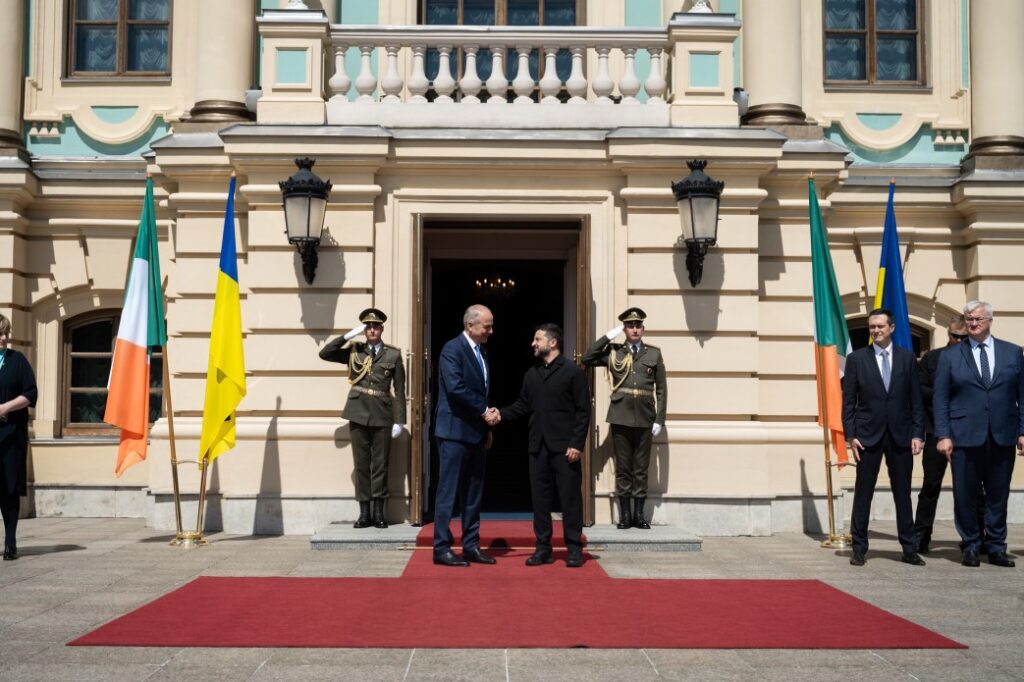
Ireland brought more aid to Ukraine. Irish Prime Minister Micheál Martin and Minister for Foreign Affairs and Trade Helen McEntee announced a new $146 million package of bilateral support for Ukraine in 2026, during the visit to Kyiv on 23 July, the Irish government reports.
The package splits into $117 million for priority non-lethal military equipment and $29 million to help repair and protect Ukraine’s critical infrastructure, with a focus on energy ahead of winter.
Martin arrived in Kyiv to show Irish solidarity three weeks after President of Ukraine Volodymyr Zelenskyy visited Dublin to mark the start of Ireland’s presidency of the Council of the European Union, which runs through the end of 2026.
Alumina question follows Martin to Kyiv
The discussions were also focused on a Russian-owned refinery in Ireland, according to the Irish government.
“I also briefed the President on the findings of our investigation into Aughinish Alumina and the export of alumina to Russia,” he said.
The Aughinish plant is owned by the Russian metals giant Rusal, and the investigation into it is the uncomfortable subtext of Ireland’s support for Ukraine.
Ireland’s Department of Enterprise opened a review after The Irish Times and the Organized Crime and Corruption Reporting Project published an investigation into the plant’s alleged role in supplying Russia’s military industry.
Speaking during a visit to Kyiv on Thursday, Martin said the investigation into the Co Limerick facility did not find “definitive” evidence that it was supplying alumina to the Russian military, but could not rule out that scenario.
“What we have said is that the evidential threshold isn’t there to prove that it goes into weapon making; on the other hand, neither can you say definitively that it doesn’t,” Martin said.
He said close to half of Ireland’s alumina exports go to Europe, namely Sweden and France.
The government may look for another route to the same end. Ireland would work with the European Commission to find a way to ensure its alumina exports do not feed the Russian war machine, without necessarily sanctioning the product, Martin said, calling it “both an Irish issue and a European issue.”
About the Author
