
Wheat in Chicago is at a two-year high, and southern Russia is bringing in its best harvest in years—yet Russian farmers are heading into the season earning less, not more.
Ukraine’s drone campaign in the Sea of Azov closed the Kerch Strait to shipping on 10 July, trapping the route that carries a quarter of Russia’s grain and sunflower-oil exports. Export duties and soaring logistics skim what still moves, and the grain piling up in full elevators is crushing prices at home while the world price climbs out of reach.
Russia is now heading for its weakest July wheat exports in nine years.
“Farmers should be receiving payment for half or all of their wheat harvest and putting that money back into circulation. But there is no one to sell to.”
Ural-Don agricultural holding president Alexander Yaroshenko
The weakest July in nine years
Russia may export 1.5 million tons of wheat this July—half its five-year average for the month and the lowest July volume since 2017, the SovEcon analytical center forecast on 20 July, its second cut in a week after analysts had already reduced July estimates by 13–20%, Kommersant reported.
The IKAR agricultural institute expects under two million tons. Both name the same main cause: navigation limits through the Kerch Strait, beyond which a quarter of Russia’s grain and sunflower-oil exports ship, according to SovEcon, with weak demand from Egypt and Türkiye adding pressure.
Russia shut the strait on 10 July after Ukrainian drones struck vessels across the Sea of Azov, including tankers—a closure Moscow imposed on itself because the water had become too dangerous to cross.

Russia halts Don-Azov Channel shipping, closes Kerch Strait after Ukrainian tanker strikes
The backlog is already physical: grain exports down the Don River—27% of Russia’s grain exports last season—have stopped entirely, elevators at the Don ports are full, and agreed export contracts are collapsing because cargo cannot ship, industry figures told the Rostov business outlet Gorod N.
“Active trading should be picking up right now. Farmers should be receiving payment for half or all of their wheat harvest and putting that money back into circulation. But there is no one to sell to,” Ural-Don agricultural holding president Alexander Yaroshenko told the outlet.

The price rally Russia cannot collect
September wheat in Chicago gained more than 10% in a week, touching two-year highs, while Paris wheat hit a 17-month high, SovEcon director Andrei Sizov noted. “The market is starting to understand this is not the typical short-lived Black Sea rally,” the Financial Times quoted him as saying—this time, export estimates for both Russia and Ukraine may be cut substantially.
The Ukrainian half of that warning is already happening. Russia struck back at Ukraine’s grain gateways the same week: massed attacks on Chornomorsk on 10–12 July forced Kernel, Ukraine’s largest grain exporter, to halt terminal operations, with about 45,000 tons of wheat and 9,000 tons of sunflower oil lost or damaged—leaving Ukraine’s deep-water grain exports with almost nowhere to go.
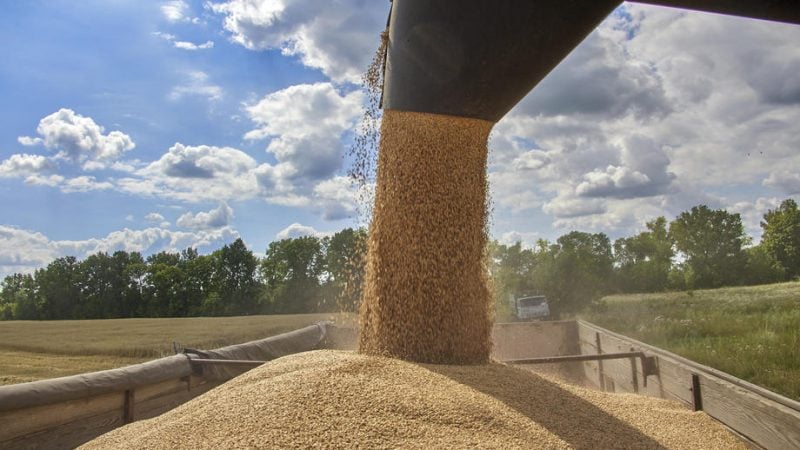
Both of the Black Sea’s grain suppliers are choked at once—the reason, in Sizov’s reading, is that the market has stopped treating this as a passing rally.
The tension raises world prices, and the money goes to Russia’s competitors. Russian farmers are fenced off from their own rally twice—a floating export duty skims the price above them, and logistics costs climb as grain hunts for other routes. Ruble prices will stay under strong pressure, Sizov wrote on Telegram.
Why rerouting does not save the season
Russia’s deep-water ports beyond the strait can ship 4–4.5 million tons of grain a month—enough for July, but at the season’s peak in August through October, Russia normally ships 5–6.5 million tons a month, Sizov calculates on Telegram.
The industry agrees from the ground: the Black Sea ports cannot physically handle southern Russia’s seasonal volumes, and the railways to them were not built for it, Yaroshenko told Gorod N—while a grain trader told the same outlet that rerouting would jam rail approaches to Novorossiysk for months. The shallow Azov ports are not a convenience; they are the margin between Russia’s export capacity and its harvest.
And this year, the domestic market has more grain than usual to absorb. SovEcon expects the southern crop—grown in exactly the regions that ship through Azov—to rise 17.2% from last year. The best harvest is arriving in the provinces with the most blocked ports.
The long clock
The squeeze works through margins. Falling farm profitability is already cutting sowing—wheat area this year is the lowest since 2014, Forbes reported—and Sizov expects the trend to worsen in 2027.
The market is pricing the decay in real time: Rodnye Polya, once Russia’s largest grain exporter, was sold this month for 11.7 billion rubles ($150 million) to a little-known holding company, and terminal incomes will decline as the grain market’s export potential shrinks, Sizov told Kommersant.
Put together, the mechanism runs in one direction. Blocked ports overfill the domestic market; the surplus crushes the prices farmers live on; falling margins cut next year’s sowing; smaller harvests shrink the exports that made Russia the world’s top wheat supplier. The world, meanwhile, is already paying two-year-high prices to buy its wheat elsewhere—and the longer this runs, the more of Russia’s market share moves to the competitors the rally is enriching.
About the Author
