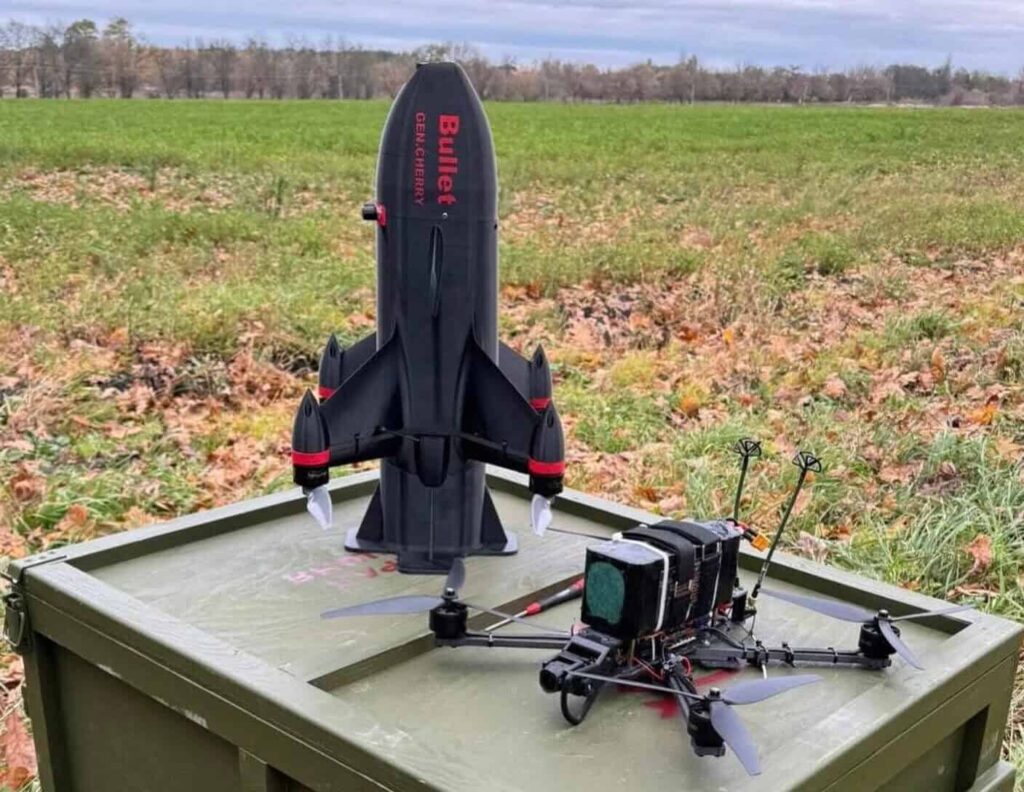
Drones made by Ukrainian company General Cherry recorded more than 20,000 confirmed target hits in June, topping Ukraine’s effectiveness ranking for FPV strike systems, the company told Militarnyi. It was the company’s third consecutive month at the top, with confirmed hits across the spring exceeding 40,000. General Cherry led in two categories: total “e-points” earned across all strike systems and FPV drone effectiveness.
The ranking matters because of what it feeds. Ukraine runs a combat-into-currency procurement system: frontline units earn “e-points” for verified battlefield results, then spend those points on the Brave1 Market, choosing hardware directly from manufacturers. More than 400 units have ordered over 500,000 systems this way.
The scoring is based on confirmed combat results uploaded and verified through Ukraine’s battlefield systems, which means a manufacturer’s ranking is not a marketing claim but a running tally of which drones actually convert to kills. A company at the top of that ranking is one whose drone units will keep choosing.
The company behind the number
General Cherry said its June result rose more than 5,000 confirmed hits over May—the largest month-on-month gain of any manufacturer in the ranking—and attributed the improvement to iteration based on operator feedback from combat units.
The same company builds the General Cherry AIR and Bullet interceptor drones that Ukrainian forces used to shoot down Russia’s AI-modified Molniya strike drone on the Zaporizhzhia front—meaning the manufacturer topping the strike-effectiveness ranking is also producing the interceptors defeating Russia’s autonomous drones. General Cherry recently developed a reconnaissance drone, Sweetheart, with a range of up to 150 km.

Why is the manufacturer ranking different?
Ukraine’s points system has two visible faces. On the demand side, units compete on a public leaderboard—”Birds of Madyar” topped the unit rankings for 2025, the year Ukrainian drones hit some 820,000 Russian targets in total—and the best-performing units get access to the best hardware first. On the supply side, which the General Cherry result illustrates, manufacturers are ranked by how effectively their systems perform in combat.
The two are linked: units buy what works, verified performance determines what’s available, and the manufacturers whose drones score highest get ordered most. It is a feedback loop in which battlefield data, not procurement lobbying, determines market allocation.
That loop is why the West is studying it. The US launched a near-identical marketplace in March 2026, copying Brave1 Market and DOT-Chain Defense. Ukraine produced roughly 4 million drones in 2025, more than all NATO members combined, and aims to reach 7 million in 2026—an output distributed across competing manufacturers whose survival depends on frontline performance.
Read also
-
The Azov Sea wasn’t enough—Ukraine’s drones followed Russia’s oil fleet into the Black Sea
-
Ukraine’s Navy just showed the Barracuda sea drone leading a three-drone strike—no crew in the fight
-
Russia plans to build 120 Banderol missiles in month. Analyst who found it in 2025 says weapon is “nothing outstanding”
About the Author
