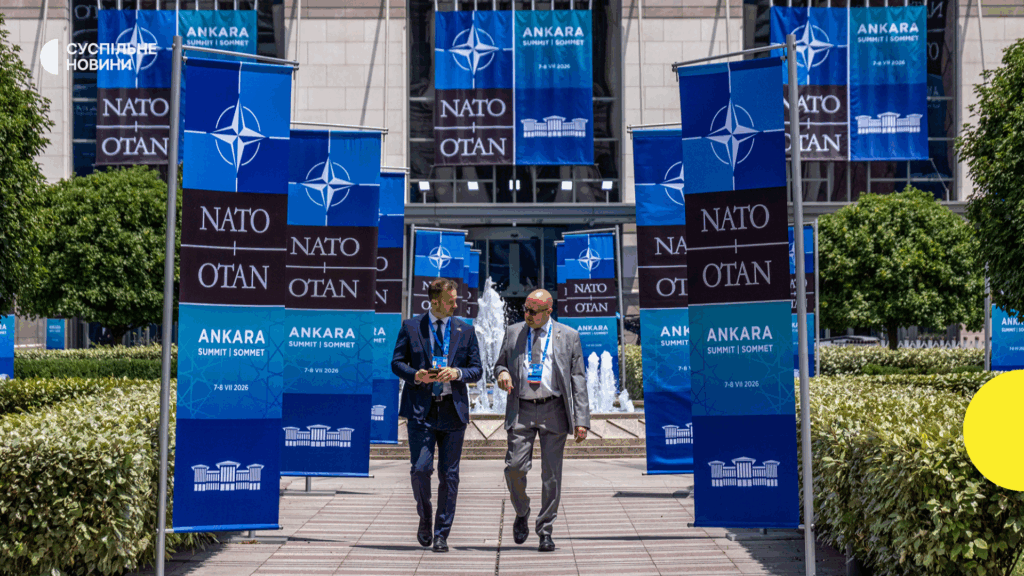
NATO leaders from the alliance’s 32 member states opened a two-day summit in Ankara, Türkiye, on 7 July, with US President Donald Trump set to hold a bilateral meeting with Ukrainian President Volodymyr Zelenskyy on the sidelines, Reuters reports.
The gathering follows months of tension between Washington and European allies, with Trump accusing NATO members of failing to support the US war effort against Iran and suggesting he could quit the alliance or disregard its mutual defense pact, Reuters reports. European governments are countering with new arms deals and defense spending figures meant to show they are heeding US demands to invest more in their own security.
Arms deals and an AWACS replacement
Dutch Defence Minister Dilan Yesilgoz told Reuters on 6 July that the Netherlands would announce deals and plans worth more than $3.43 billion (€3 billion), including partnerships with Belgium on air defense and Britain on naval ships.
NATO also plans to announce it will replace its aging fleet of US-built AWACS surveillance aircraft with Sweden’s Saab GlobalEye, four sources told Reuters last week. Details of the broader arms deals set to be unveiled Tuesday have been kept confidential, part of an effort by NATO to generate publicity ahead of the summit, Reuters reports.
European spending increases pressure narrative
European allies made “staggering” increases in defense spending, driven partly by fears of Russia since Moscow’s 2022 invasion of Ukraine but also because Trump had been “extremely forceful” in encouraging them to do so, Rutte said, per Reuters. NATO’s European members and Canada spent $90 billion more on defence in real terms in 2025 than in 2024, bringing total spending to more than $570 billion — an increase of around 20 per cent in a single year, Rutte said last month.
“We are now creating an alliance which is sustainable, where the US knows it is a fair deal,” Rutte told reporters in Ankara on the eve of the summit.
A draft of the summit’s final declaration reviewed by Reuters journalists states that European allies will note they increased their defense investment by $159 billion (€139 billion) together with Canada, and will pledge to take on “greater responsibility for the Alliance’s defense.”
Trump’s threats over Iran and Greenland
Trump has renewed harsh criticism of fellow NATO members in recent months, accusing them of failing to do enough to help the US in its war with Iran and suggesting he could quit the alliance or disregard its mutual defense pact, Reuters reports. European officials say they largely honored commitments to let the US use their airspace and bases despite not having been consulted about a war that roiled their economies and was unpopular in Europe, per Reuters.
The US has also announced troop withdrawals from Europe, cut the forces it assigns to NATO’s defense plans — including an aircraft carrier, refueling aircraft, fighter jets and drones — and launched a six-month review of its military presence on the continent, Reuters reports. European officials say they are braced for a repeat of Trump’s criticism and hope Erdogan and Rutte will use their relationships with the US president to keep the summit on an even keel, though they cannot be certain of a positive outcome given tensions over Greenland and Iran and Trump’s recent feud with Italian Prime Minister Giorgia Meloni, according to Reuters.
Russia’s Kyiv attack and Ukraine’s push for air defense
Russia launched a large-scale attack on Kyiv overnight on 6 July, using tens of ballistic and cruise missiles, including Zircon hypersonic missiles, and hundreds of drones. On the morning of 6 July, following the strike, Ukraine’s need for more air defense systems and urgent reinforcement of missile defense would be discussed at the Ankara summit, European Commission President Ursula von der Leyen said.
Zelenskyy and Foreign Minister Andrii Sybiha called for the same.
“It is very important that the world, primarily America and our European partners, leave the NATO summit in Ankara with strong decisions in support of our air defense, and therefore, the protection of ordinary people’s lives,” Zelenskyy said. “As long as Patriot missiles remain in allies’ warehouses, this only encourages Russia to keep ‘winning’ against residential buildings. The US and Europe have enough strength to stop this terror.”
The White House earlier confirmed Trump would hold a bilateral meeting with Zelenskyy on the summit’s sidelines. Weeks earlier, at the G7 summit, Zelenskyy sought US licenses allowing Ukraine to produce its own air defense systems; he is expected to again raise the shortage of Patriot interceptor missiles in Ankara.
Kyiv wants to convince Washington that an opportunity now exists to pressure Vladimir Putin into direct talks with Zelenskyy, Ukrainian sources told the Kyiv Independent. Kyiv hopes to leverage rising internal pressure inside Russia, including a fuel crisis, to secure Trump’s support, including on strengthening Ukraine’s air defense, the sources said.
Trump plans to lay out his own vision for a peace deal with Russia during the meeting with Zelenskyy, a US official familiar with the summit preparations told the Kyiv Independent. Trump is also expected to hold a phone call with Putin after the summit. Zelenskyy will not take part in the summit’s main session and, unlike in previous years, will not deliver a speech to Alliance leaders, The Telegraph reports.
An $80 billion pledge built mostly from existing funds
NATO allies are set to confirm commitments to provide $80 billion (€70 billion) in military equipment, aid and training for Ukraine’s defense forces in 2026, and to affirm a goal of maintaining at least an equivalent level of assistance in 2027, Reuters reports. The US is not expected to provide funding toward this aid.
Even the $80 billion figure is mostly a reallocation of existing funds rather than new money for Ukraine, combining NATO’s existing annual commitments with funding already provided through an EU loan, without any new pledges, The Telegraph notes. A specific reference to aid would nonetheless mark a difference from last year’s summit statement, which made no mention of financial assistance to Ukraine.
Italy proposed softening the wording of the final statement before the Ankara summit began, calling for the removal of any reference to providing Ukraine with military aid at least through the end of 2027, Bloomberg reports. Rome argued that specifying a timeframe could preclude the possibility of ending the war through negotiations at an earlier stage. Rome is unlikely to escalate the dispute or break the Alliance’s consensus, and aid to Ukraine itself is not in question, sources familiar with the Italian government’s position told Bloomberg.
Rutte addressed the same question a day before the summit opened. “Let me be clear. All allies must make efforts so that our support for Ukraine continues to flow. Because your security is so closely linked to our own,” he said.
Finnish President Alexander Stubb said Ukraine’s campaign of long-range strikes has convinced NATO allies, including the US, that Ukraine’s defense forces have strengthened their position in the war. All Alliance members, including the US, see that “Ukraine is currently winning on the battlefield,” Stubb said.
“I think all [NATO leaders] understand why Ukraine is doing this,” he added, saying pressure on Russia must be increased and that this is a shared Alliance position. Despite concerns over possible Russian nuclear escalation, Ukraine’s campaign has already changed US strategic thinking about the war and strengthened Kyiv’s negotiating position, Stubb said.
Summit schedule
Besides NATO leaders, the summit is expected to be attended by South Korean President Lee Jae-myung, European Council President António Costa, von der Leyen and Zelenskyy.
A brief joint statement from Zelenskyy and Rutte is expected in the afternoon of 7 July, Interfax-Ukraine reports. In the evening, Zelenskyy is due to attend a reception and dinner for heads of state and government and their spouses, hosted by Türkiye and NATO. The same evening will also see a dinner-format meeting of the Ukraine-NATO Council at the level of foreign ministers, alongside a meeting of Alliance defense ministers with the “Indo-Pacific Four” — Japan, South Korea, New Zealand and Australia.
Read also
-
Belgorod gas facility burns as Moscow fends off over 430 drones in one night
-
Russo-Ukrainian war, day 1594: Lack of Patriot interceptors leaves Kyiv exposed to Russian attacks, as death toll rises to 19
-
Putin says Russia is 10 kilometers from Sumy. Real distance shows how Kremlin manufactures collapsing front
About the Author
