After months of slow, costly assaults, Russian troops have begun seeping into Kostiantynivka, the southern keystone of Ukraine’s fortified defensive line in Donetsk Oblast, Reuters reported. How close the city is to falling has become a public argument between Ukrainian commanders, Western analysts, and Kremlin-installed officials. The push comes as Ukrainian strikes keep gnawing at Moscow’s supply lines and oil industry far behind the front.
Russia’s fifth-year offensive in eastern Ukraine has meant trading enormous casualties for a few wrecked kilometers at a time, a pace independent monitors estimate would need years more to swallow the rest of the oblast.
Russia presses into the fortress belt
Kostiantynivka sits at the southern end of four fortified cities that form the spine of Ukraine’s defense in industrial Donetsk Oblast. Fighting has begun to reach into the city. Senior Ukrainian commanders said last week that small Russian groups were trying to slip into its outskirts, pointing to close-quarters street battles ahead.
Russia’s manpower edge is driving the push, even though Ukrainian mid-range drone strikes on its logistics have worn down its fighting power, analysts said. Taking the city would hand Russian forces a launch point to move north along the fortress belt, now the main axis of their campaign. Any such advance would likely prove long and bloody, echoing the costly sieges of nearby Pokrovsk and Avdiivka. President Vladimir Putin has insisted Russia must seize all of Donetsk Oblast before the war ends. Ukraine still holds roughly a fifth of it after more than four years of fighting.
“The stakes are rising each day”
Putin claimed last week that Russia was close to capturing the city, whose pre-war population of nearly 70,000 has dropped to around 2,000. Senior commanders of Kyiv’s 19th Army Corps rejected that as an exaggeration. They told Ukrainian media their troops were picking off small Russian groups that had slipped in.
Major General Viktor Nikoliuk, head of Ukraine’s eastern operational command, said the city could hold. He told the country’s public broadcaster on Thursday that it could last at current manpower and resource levels. The US-based Institute for the Study of War (ISW) assessed on 23 June that the infiltrations fell short of “a rapid operational breakthrough.” Still, ISW said, the tactical situation was worsening for Ukraine.
Russian attempts to encircle the city through pincer moves keep raising the cost of defending it, said Ukrainian analyst Ruslan Mykula of the DeepState open-source mapping group.
“A choice will have to be made: either raise the stakes or withdraw,” he said. “And right now, the situation is such that the stakes are rising with each passing day.”
Emil Kastehelmi of the Finland-based Black Bird conflict analysis team said the city’s fall “seems to be more of a question of time.” Ukraine’s deep strikes had not slowed the offensive, he added. “The effect (of mid-range strikes) hasn’t been so great that it would have forced the Russians to suspend their offensive,” he said. Even with heavy losses in the rear, he said, Russian forces could still attack in certain sectors.
Russian troops are also pressing the northern end of the fortified line. They are hitting the cities of Sloviansk and Kramatorsk with air and drone attacks from around 15 kilometers (9 miles) away.
Drone-infested skies and a collapsing supply road
Ukrainian supply routes are already under steady pressure, with artillery, drones, and guided bombs hammering the road running north out of the city, soldiers in the area said. Reuters recently traveled with the “Predator” rifle brigade of the National Police, tasked with guarding the route from drones and remotely dropped mines.
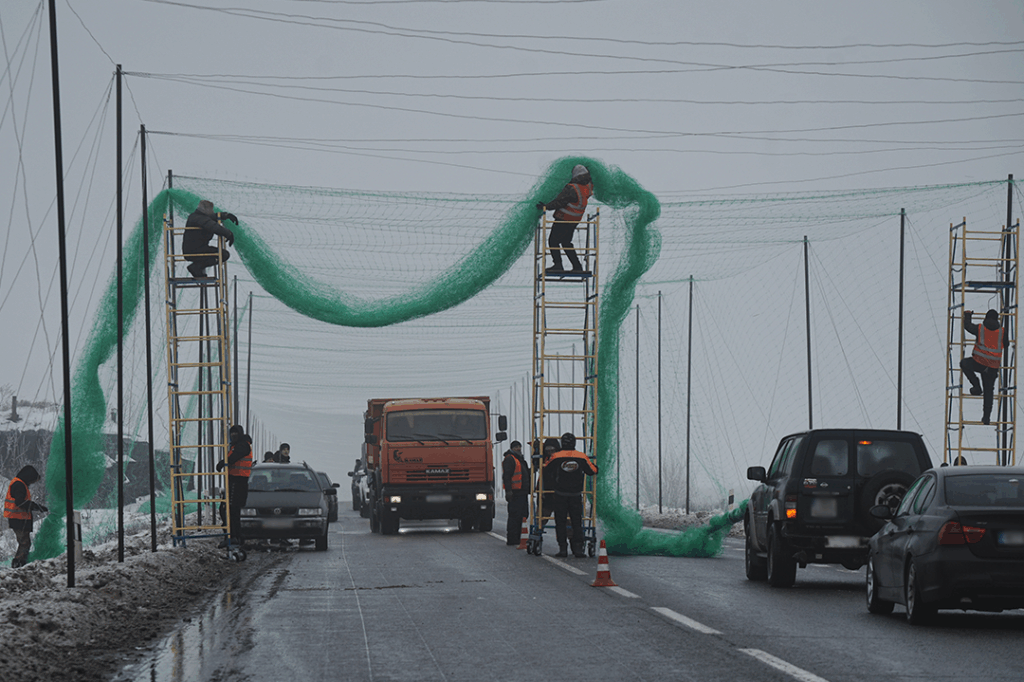
Strands of fiber-optic cable used to steer first-person-view (FPV) drones lie tangled in anti-drone netting strung over the road. Ground robots now haul most of the food, water, and supplies into the so-called kill zone, while soldiers race past on quad bikes. The road is too dangerous to carry out the dead and wounded by normal vehicle. “Everything happens on foot,” said 34-year-old serviceman Oleksandr Kosmin.
Civilian life nearby is breaking down. In Druzhkivka, about 12 kilometers (7 miles) to the north, residents are being pushed out as the fighting closes in. On one tree-lined street, a Russian drone had killed a husband and wife inside their van, the white ribbons marking it as civilian still fluttering on the roof.
“Why am I leaving? Because I’m scared. Drones are flying,” said Larysa Sereda, 59, from a police evacuation van. “But I plan to return home. I don’t want to stay in some strange place. The war will end, and I’ll come home.”
Russia’s war machine under strain
The creeping gains come even as Russia’s war effort buckles. Ukrainian attacks keep cutting the supply lines into occupied Crimea, alongside longer-range strikes on its oil sector. Russian-installed authorities on the peninsula have declared a state of emergency over the economic fallout. They have halted all fuel sales to individuals and businesses.
Across the front more broadly, Russian forces look overextended, and many assaults now come down to just one or two soldiers, Mykula said. Denis Pushilin, the Kremlin-installed head of occupied Donetsk Oblast, claimed to Reuters that the drive to seize more cities was pressing on. “Talking about whether this is happening slowly or quickly isn’t really the point,” he said.
Russian hardliners have urged Putin to drop the US-backed peace process and widen the war as Ukrainian strikes intensify, including on Moscow.
Read also
-
Russian airstrike kills police officer during civilian evacuation in Kharkiv Oblast
-
Ukraine drones hit Crimea’s S-300/S-400 near Kerch—and knocked out power across four occupied territories overnight
-
Rebuilding Ukraine while it burns — calling it progress: what Ukraine Recovery Conference 2026 actually delivered
About the Author
