Is it becoming too hot to host the World Cup? In some host cities, the answer is yes.
The World Cup has grown to the biggest sporting event on the globe since its first tournament in 1930. As the tournament has expanded, so has another global phenomenon: rising temperatures. Extreme heat is increasingly affecting play; prompting hydration breaks, schedule adjustments and, in the case of Qatar 2022, an unprecedented shift from summer to November and December.
A new analysis by Climate Central looked at just how much hotter these host cities have gotten since the last times North America hosted the tournament in 1970 (Mexico), 1986 (Mexico), and 1994 (United States), by comparing the frequency of extremely hot June and July days.
World Cup schedule | Group schedule, results | Standings
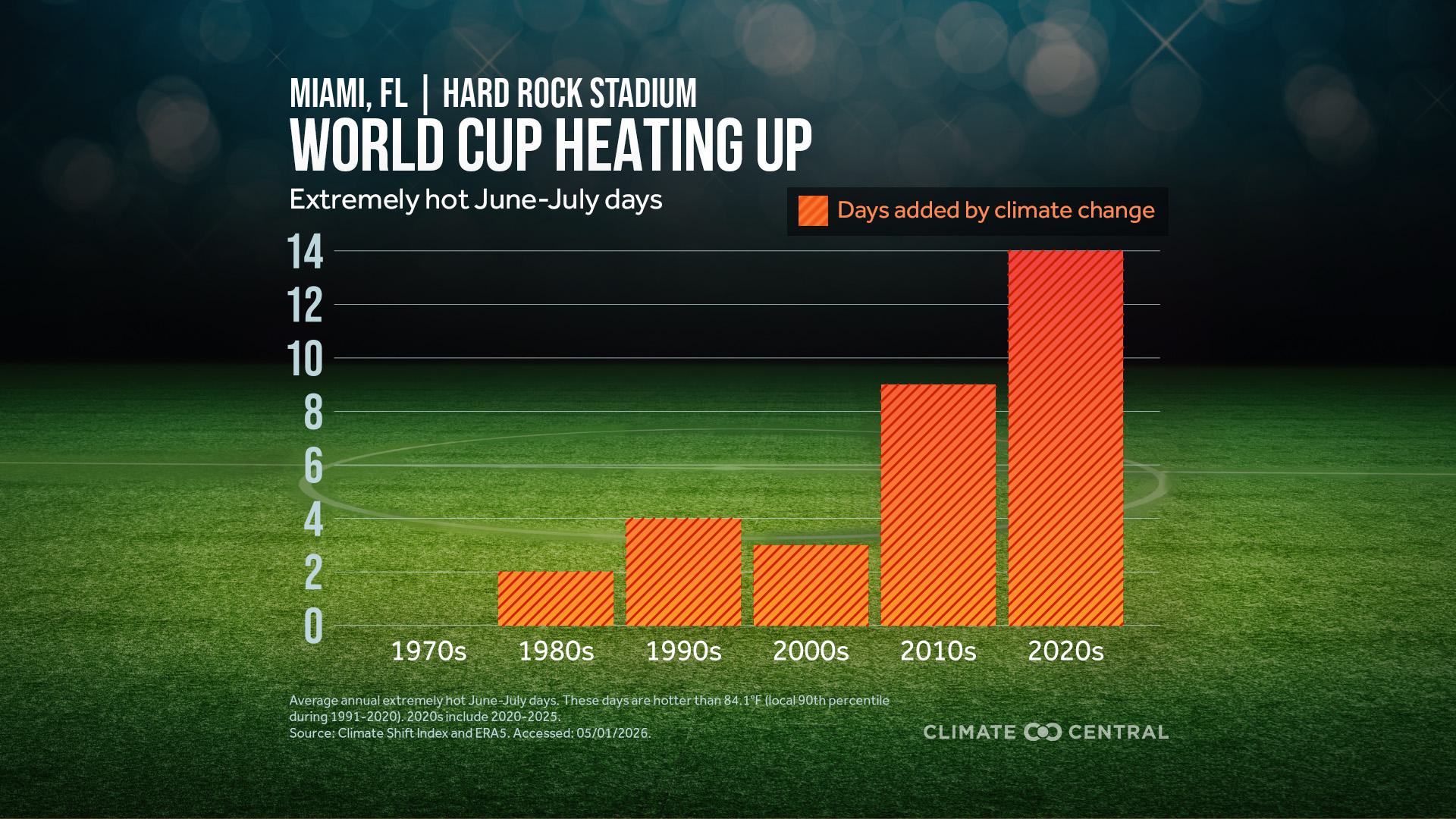
On average, these extremely hot days have tripled in repeat host cities. Both Miami and Mexico City now have five times more extremely hot June and July days since the last host years, averaging only two extreme days in the 1980s, but closer to twelve extreme days in the most recent decade. In both cities, more than 90% of those extremely hot days were added by climate change.
“Heat preparedness has just become a part of event planning. It’s not an optional add-on at the end.” Loren Parra, Miami-Dade County’s chief resilience officer and director of the Department of Environmental Resources Management, said South Florida is no stranger to hosting major events in extreme heat. Miami is hosting seven World Cup matches including a quarterfinal match and the third-place match final. “It’s a core structural component of hosting events as large as the World Cup,” Parra says it takes heavy coordination efforts across cities, municipalities, and departments.
Dubbing the campaign, “heat is not a game,” strategic urban and logistic planning went into mapping out various cooling and hydration stations across Miami-Dade County for this summer’s World Cup. Four cooling trailers equipped with air conditioning and first aid kits will be housed at Hard Rock Stadium, called Miami Stadium for the FIFA games. Two hydration stations will mark the entry points of the stadium to serve fans on long wait lines to get into the venue.
“As people travel across Miami-Dade to get either to and from the games, or if they’re just exploring the county during their time here, we’re installing eight [additional] free cooling/ water hydration stations at our public transit stations,” adds Parra.
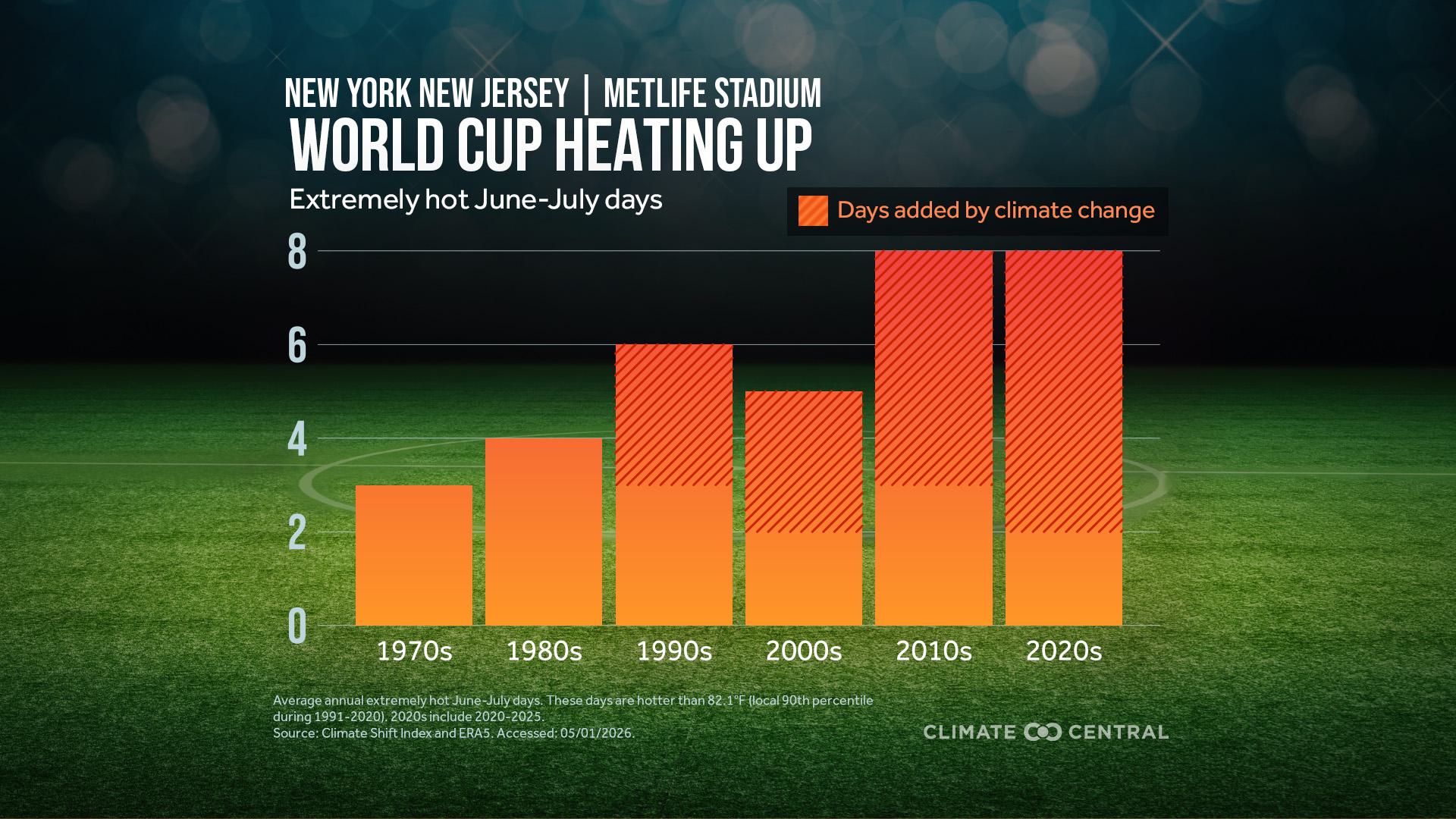
Miami is not alone. The Climate Central study also found that 14 of the 16 stadiums hosting this summer’s World Cup now see more extremely hot June and July days since 1970. Even in host cities with cooler climates like Boston and Vancouver, climate change has put its thumb on the scale, adding at least four more extremely hot June and July days in the last decade to both cities.
That’s why heat preparations need to go beyond water bottles. Miami-Dade County’s DERM team emphasizes that innovative infrastructure needs to be a part of the plan in Miami and other host cities to keep them viable and resilient enough to host future games. Parra explains, “We have a very robust heat action plan that’s really a blueprint to reduce heat exposure, to strengthen emergency response, to increase long-term infrastructure solutions like the cooling infrastructures, the tree canopy, [and] building more efficiently.” She adds extreme heat preparedness needs to be treated like measures taken for stronger hurricanes or higher sea-levels, noting that the county has even looked into greener, more efficient, and less heat-trapping building materials as an alternative to concrete.
Earlier this year her team tackled heat by adding shade, planting 200 new trees in a green area located in Miami Gardens, home of the FIFA host stadium. Previously, the are had a low tree canopy with only 13% coverage, meaning more exposure to direct sunlight, excessive heat and poorer air quality.
“Partnering with organizations like FIFA and the Arbor Day Foundation that were actually willing to invest in our low canopy neighborhoods ahead of FIFA is really a part of the legacy building that we are trying to do around the World Cup,” adds Parra. This program helped add some green space near the stadiums in all 16 host cities in North America ahead of the World Cup.
Extreme heat, however, isn’t the only threat. Host cities along the coast are also vulnerable to sea-level rise. Hard Rock Stadium is especially susceptible; Miami is surrounded by water and prone to hurricanes and intense storms that bring extreme rainfall and storm surge. Climate Central found that nearly all areas of Hard Rock Stadium’s property will flood occasionally by 2070, including practice facilities, access roads and more than a hundred acres of parking lots. “By 2090, 42% of the locations examined are expected to experience frequent flood risk.” Farther north, Climate Central’s FloodVision Tool shows that MetLife Stadium in New Jersey, home of the World Cup final on July 19, could be inundated by sea-level rise by 2070.
Weather-related challenges are already affecting this year’s tournament. In Houston, the first tropical storm of the season was named just in time for Wednesday’s highly anticipated match between Portugal and DR Congo. Tropical Storm Arthur prompted warnings along Houston’s coast and heavy downpours pushed into the city from the Gulf most of the week. This forced officials to stage barricades at flood-prone locations and prepare dump trucks to handle any high-water conditions amid ongoing flash flooding concerns.
So, when and where is the best place to host the World Cup? The most extreme heat in Qatar was avoided by delaying the 2022 event six months into November and December. Similarly, winter games may be needed again in 2034 when Saudi Arabia is slated to host the tournament. Daily normal high temperatures top out at 110 degrees in the capital city of Riyadh during the typical World Cup months. High temperatures exceeding 120 degrees in the desert region are very common.
While the Northern Hemisphere is baking in summer, the Southern Hemisphere is cooling down for winter. To stay in the June-July window, tournaments may need to capitalize on the cooler winter climate south of the equator. Southern Hemisphere summers also tend to be more mild and not as extremely hot. The Northern Hemisphere has more land mass which heats up faster than the bigger, deeper ocean spaces in the Southern Hemisphere.
To ensure the games can continue in any country in either hemisphere in the future, planning needs to happen now. Parra is hopeful her team can set an example for other host cities.
“Resilience really needs to be an integrated component of planning for major events like the World Cup,” she says. “Resilience has just got to be in the planning discussion from the beginning.”
About the Author
