
Ukrainian forces conducted 50,000 missions with unmanned ground vehicles as of January, the Ministry of Defense announced. The number is constantly growing: from 7,500 missions in January to 14,000 in May, and the number of units employing UGVs grew from 117 to 230.
“The UGV is a very, very promising thing,” callsign Electric of the 93rd Brigade told Euromaidan Press—his brigade was an early adopter, having used UGVs for three years running.
“It has already proven its effectiveness, developing and scaling quickly, and becoming one of those tools of war that is already contributing to victory.”
UGVs are meant to solve Ukraine’s chronic personnel shortages and battlefield casualties and have been rather effective, according to testimonials such as these. The General Staff has credited ground robotic platforms with cutting personnel casualties by up to 30%. In the Azov Corps, a single battalion moves over 40 tons of equipment per month with UGVs.
However, just having more machines is not nearly enough. Ukrainian forces are working to solve a myriad challenges before these ground crawlers can live up to their fullest potential, including:
- Creating a military doctrine for their use
- Establishing sufficient training for their operation
- Building the infrastructure to deliver, modify, and repair them
- Ironing out spare parts shortages, intercompatibility, and delivery challenges
- Figuring out how to employ the menagerie of the dozens of systems in service
“The development of UGVs is one of our priorities: the more tasks robots perform, the more lives of military personnel can be saved,” Defense Minister Mykhailo Fedorov said in a statement.
More doctrine, more training
While robotic ground crawlers existed before the full-scale invasion, mass adoption only exploded in 2026. The number of units using UGVs doubled between January and June. “The majority of brigades don’t have a (specialized) working UGV unit inside,” said Andrei Kushniarou, Commander of the 108 Battalion “Da Vinci Wolves.”
As a result, many units are getting UGVs for the first time without much of an idea of what to do with them, soldiers said in interviews. This applies not just to driving them but planning missions, figuring out what models work best for specific tasks, and which ones to commit to purchasing.
“They began rapidly scaling up UGVs in just over six months,” Electric said. “Before that, there was no systematic use of this in the army. There were only isolated, isolated units that were doing something, trying things out.”
“Systematic implementation began in just over six months and it scaled up from a dozen units, to hundreds of units. That is, this is an incredibly rapid leap, so there is no doctrine, nothing. There is only the experience of certain successful units, which share it and finally scale it up.”
This is natural: any new way of war requires figuring out. Ukrainian air defenders and UAV operators have had a long and difficult learning process over the past four years before Ukraine began to tip the drone war in its favor. UGVs must tread a similar path.
For the time being, for every story of a UGV rescuing a wounded soldier or capturing a Russian position, there are lesser-known stories of troops flailing about and learning on the job. Kushniarou said he has seen logistics UGV operators using the same route to deliver supplies to front line troops for half a year, as though inviting Russian FPV drones to come and destroy them.
“We have some classes for FPV drones, for the bombers, where they use simulators before taking the real drones. But we don’t have this kind of thing for UGV’s,” said Olexiy Severin, the financial director of Ukrainian Unmanned Systems, which produces the heavy-duty Ravlyk ground drone for units including the military intelligence (GUR).

The solution is more training. There are some military training centers, such as the one operated by the 3rd Corps, as well as others scattered among different units. The military is working on creating more—for example, the South Operation Command, which plans to not only train soldiers how to use drones but to better integrate them with infantry. Volunteer-led initiatives like Dignitas are launching their own programs.
One bottleneck is the lack of experienced instructors, soldiers said. Experienced operators are at a premium, both on the front line and in the classroom. Meanwhile, current best practices become outdated in roughly six months. Another bottleneck is cash.
“We need money. A lot,” Electric said. “First and foremost, money for scaling up production facilities, training centers and infrastructure development workshops. Everything is ready for it, it’s just a matter of stating the facts and writing a doctrine.”
Managing the menagerie of systems
Around 33 different models are available through the DOT-Chain marketplace. The actual number of different models of UGV floating around the country is closer to 200, soldiers said.
This can be an overwhelming number of systems to get used to. Every system comes with its own nuances, use cases, and teething troubles. And “basically every one” has to be modified by the unit before it can be used, said Mykyta Puz, a technology liaison with the Azov Corps. Other soldiers agreed with him.
“That’s why we were the first to create our own universal control board, which we’re installing throughout this entire zoo, standardizing the electronic components at a minimum,” Electric said. They must also add their own cameras and Starlink terminals.
The 93rd isn’t alone in this. Starlink is the standard army-wide control method for driving UGVs at a distance, yet Starlink doesn’t come standard with UGVs. Many robots come without night vision and thermal cameras integrated into the basic package.
Other parts require tinkering as well, especially when UGVs come from outside Ukraine. Multiple soldiers were quite negative with their reviews of foreign-made machines, with reviews like “highly expensive, utterly useless” and “the quality of work is really bad.”
Specific complaints ranged from the act of driving toggling a safety cutoff switch, antennas jostling loose, or radio controls dying when a friendly UAV was flying nearby.
The 93rd is trying to solve the “zoo” issue by limiting themselves to no more than 10 systems they trust, of which two are the mainstay and several more sit in backup.
Spare parts and infrastructure
The challenge there is access to spare parts, with Electric calling it “critical… We only supply them through our own resources and methods.”
Kushniarou said that units have a choice to make. They can decide to rely on just one or two developers, to buy UGVs from them. But if these developers get hit by a Russian missile, or some parts fail to arrive from China, they can be screwed.
Or they can embrace the “zoo,” work with many developers at the same time, which spreads out the risk, but turns into a “logistical hell” where parts are concerned. This also calls for really good specialists who know how to work with a dozen different systems.
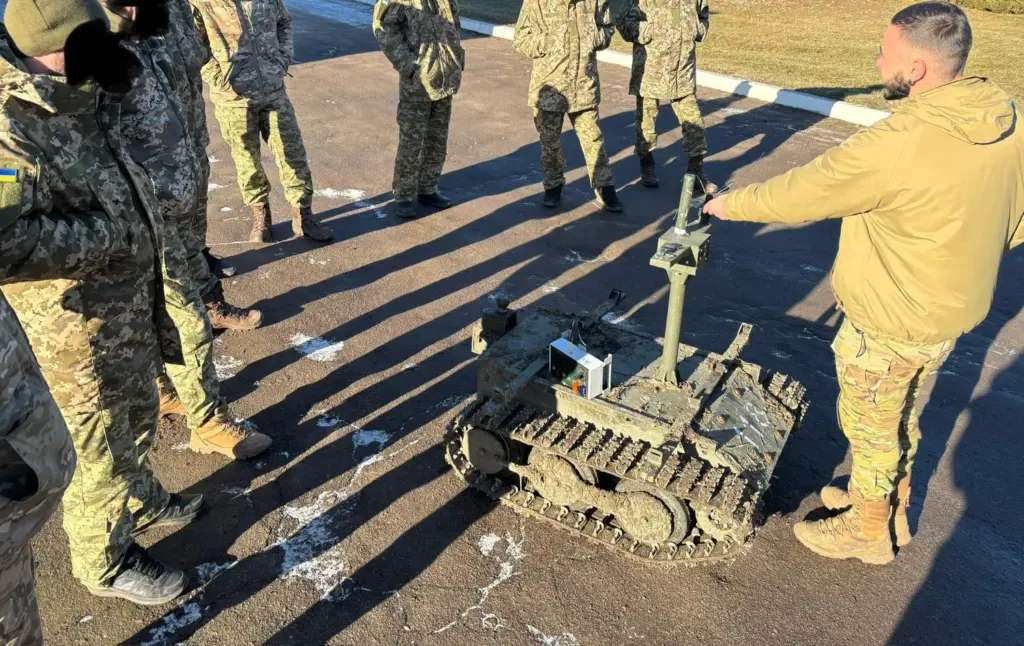
Getting parts can be a doozy, even when they are available. Severin said that units are begging his company to include a second battery for the Ravlyk UGV into the standard purchase package because “to buy additional batteries is all the circles of hell, harder than to buy a new UGV, because they have to go through multiple layers of military permission.”
He said that the company replaces wheels free of charge at its own expense, just so Ravlyk users can get them repaired in a week instead of a month.
The solution is to build a more robust military-wide infrastructure for UGVs, soldiers said. That includes a spare parts pipeline, repair and servicing centers, and analytical centers for what can be improved.
“You can’t just have a UGV, you need to create infrastructure around it,” like workshops, R&D centers, analytical centers, and logistics systems for parts,” Kushniarou said. “Without infrastructure, any drone or any UGV, it’s just a tool without a master.”
Scaling up adoption
Ukraine has set a goal to offload 100% of logistics tasks to UGVs. If all of the doctrinal and military-industrial teething troubles can be resolved, many more frontline warfighters’ lives can be saved.
The Defense Ministry previously mentioned several things it’s doing to accelerate adoption.
One is the development of “a separate UGV competence center” that will liaise between the General Staff and the military and become a “single point of contact” for manufacturers.
The ministry also said it’s working on “comprehensively resolving” a VAT issue that led to contract delays. Severin told Euromaidan Press that a VAT that applies to electric vehicles has hit the Ravlyk, making it cost 30% more when purchased directly by units, discouraging them from using it.
Procurement contracts are now being signed for the following year, to ensure the lots can be delivered.
As for 2026, Ukraine has plans to contract for 50,000 UGVs. But as of mid-May, the Ministry of Defense wrote that over 3,000 orders have been filed through the DOT-Chain marketplace and over 1,000 of them were delivered. Even though this number doesn’t include direct unit purchases, getting to 25,000 units by the end of June seems unlikely.
It would be in the military’s best interest to prioritize getting good systems rather than fulfilling the number at any cost.
About the Author
