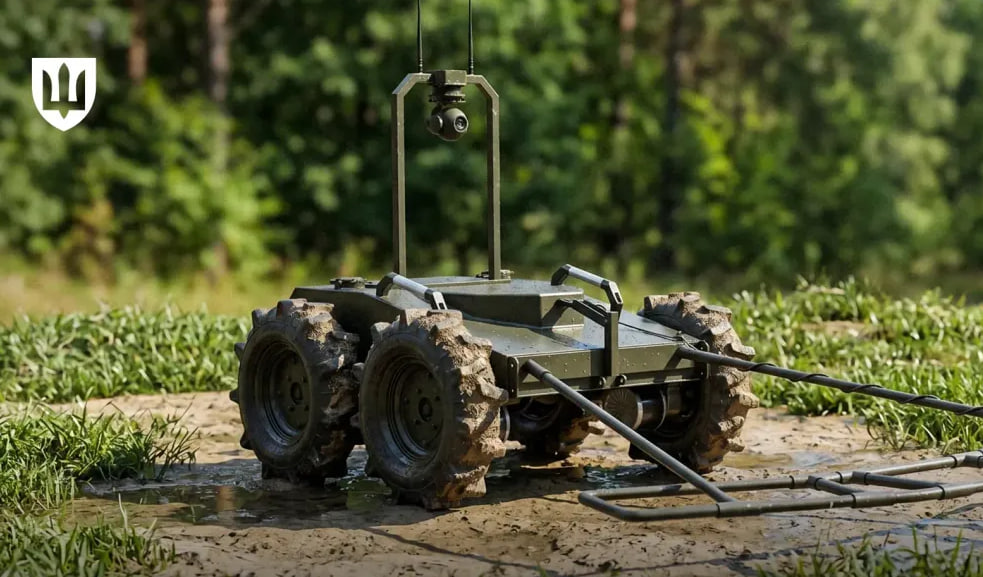
Ukraine’s Defense Ministry codified the domestic NEO-1 sapper robot for military use, the ministry announces. It is a 60-kilogram modular ground platform capable of remote demining, 70-kg cargo transport, and towing carts of up to 120 kg.
The codification sits within an aggressive Ukrainian ground-robot procurement scale-up: the Defense Procurement Agency plans to contract more than 25,000 ground robotic complexes in the first half of 2026, which is twice the volume of all of 2025.
NEO-1’s primary purpose is remote demining to minimize risks for Ukrainian sappers and other military personnel operating in areas contaminated with Russian mines and unexploded ordnance.
Ukraine has identified approximately 460,000 hectares of Ukrainian territory requiring clearance. The NEO-1 codification fits Ukraine’s stated strategic goal of maximally transitioning frontline logistics, engineering, and other personnel-exposed tasks to unmanned platforms.
Remote demining as primary mission
NEO-1 was developed by a Ukrainian manufacturer based on the operational experience and stated needs of Ukrainian military units on the frontline.
The platform’s primary mission is to remotely drag detection equipment across mine-contaminated terrain, allowing sappers to clear areas without physically entering them.
The same chassis can be reconfigured for logistical roles: carrying up to 70 kilograms of cargo across rough terrain, or towing a separate cart loaded up to 120 kilograms.
This dual-use profile means a single NEO-1 platform can rotate between engineering tasks (demining, EOD support) and logistics tasks (resupply, casualty evacuation prep) as needed.
Multi-channel metal detector finds low-metal mines and filters out small-debris false signals
For demining, NEO-1 is equipped with a multi-channel metal detector that can identify both large explosive devices and mines with minimal metal content.
The system also incorporates filtering algorithms that suppress signals from small metal debris (shell fragments, wire, casing remnants from artillery), reducing the false-positive rate that consumes operator time during clearance operations in heavily contested terrain.
The robot operates in both automatic and manual modes, with onboard cameras transmitting real-time imagery to the operator throughout the mission.
Compact specifications make NEO-1 deployable by small infantry
The NEO-1 platform weighs approximately 60 kilograms, reaches a top speed of 7 km/h, and operates for up to eight hours without recharging. The standard control range is 500 meters, which can be extended to 3 kilometers when operationally required. The compact weight and modular construction allow NEO-1 to be deployed by a small infantry team without specialized launching equipment, distinguishing it from heavier ground robotic systems that require dedicated transport vehicles or fixed launching infrastructure.
Read also
About the Author
