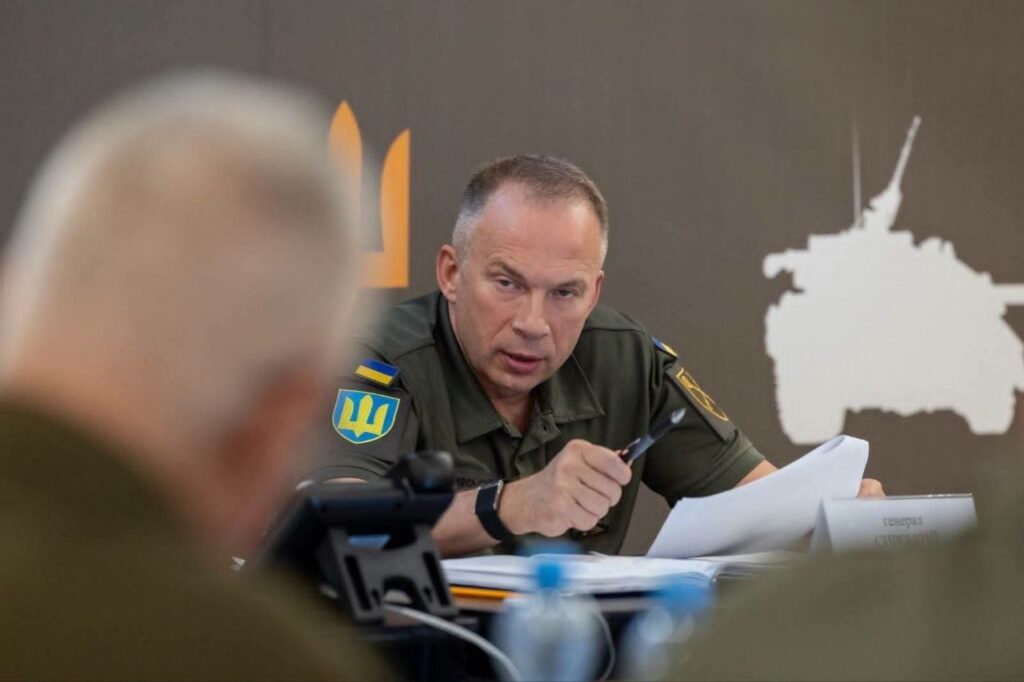
Russia’s large-scale offensive in the first half of 2026 failed to achieve any of its stated objectives despite holding an almost two-to-one advantage in personnel and equipment, Ukraine’s Commander-in-Chief Oleksandr Syrskyi said after reviewing the Armed Forces’ performance over the first six months of the year.
According to Syrskyi, Russian forces have been unable to sustain the breadth of their offensive operations. While Moscow was previously conducting active assaults across 13 operational axes, that number has now fallen to six or seven, reflecting a significant narrowing of its offensive effort.
Russian offensive loses momentum
Ukraine’s military continues to conduct defensive operations while carrying out stabilization measures and localized offensive actions that have allowed it to retain the operational initiative in some sectors, Syrskyi said. He added that the ratio of Ukrainian to Russian assault actions now stands at roughly 40 to 60.
Syrskyi attributed the slowdown in Russia’s campaign to Ukraine’s active defense strategy, saying the pace of Russian territorial advances has more than halved during the first six months of 2026.
He also said Russian forces are suffering average monthly losses of around 32,000 killed and wounded as Ukraine continues its strategy of exhausting the invading army.
According to Syrskyi, the rate of territorial gains by both sides has approached parity, while Ukrainian forces are increasingly liberating territory relative to areas where Russia is still advancing.
Moscow’s objectives remain unchanged
Despite the assessment, Syrskyi cautioned that the war remains far from a turning point.
He said Russia has not abandoned its objectives of fully occupying Ukraine’s Donetsk and Luhansk oblasts and is seeking to expand offensive operations into Dnipropetrovsk and Zaporizhzhia oblasts while enlarging a buffer zone along Ukraine’s northern border.
His comments came as Russian Foreign Minister Sergei Lavrov reiterated that Moscow will continue the war until it achieves the Kremlin’s maximalist objectives outlined by President Vladimir Putin in June 2024.
Those demands include Ukraine withdrawing from territory it still controls in four partially occupied oblasts, abandoning its NATO ambitions, and accepting conditions widely viewed as amounting to capitulation rather than a negotiated peace.
Syrskyi also warned that Russia continues to intensify missile and drone attacks, increase its use of guided aerial bombs, and commit crimes against civilians.
Ukraine expands long-range strike campaign
Syrskyi highlighted Ukraine’s growing long-range strike campaign against Russia.
Ukraine has increasingly used long-range and middle-range strikes to disrupt the infrastructure supporting Moscow’s invasion. Recent attacks have targeted logistics routes, rail infrastructure, fuel depots, and energy facilities in occupied Ukraine and Russia’s border regions that supply and sustain Russian forces at the front.
He said Ukraine’s Deep Strike operations hit 697 targets inside Russia during the first half of 2026, inflicting at least $6.1 billion in direct and indirect economic damage. Ukraine’s Middle Strike campaign struck a further 7,028 Russian targets during the same period.
The commander also reported that Ukrainian artillery completed more than 456,000 fire missions, missile forces conducted over 1,140 strikes, the Air Force flew more than 1,100 strike missions, and support units carried out around 1,400 combat tasks.
Troop rotations and military reforms
Addressing personnel issues, Syrskyi instructed commanders to rotate troops from frontline positions at least once every 60 days whenever operationally possible, calling regular rotations essential for soldiers’ health, combat effectiveness, and fair treatment.
He added that criminal offenses within the Armed Forces declined by 12% during the first half of the year following reforms to military discipline and oversight.
Ukraine has pursued broad military reforms in 2026 focused on improving force generation, command efficiency, and the long-term sustainability of its armed forces.
About the Author
