- Russian tanks attacked toward the free city of Kramatorsk this week
- Tank attacks are vanishingly rare owing to the threat from tiny drones
- The tanks carried a new anti-drone shield instead of the usual welded cages
- The shield bought them minutes, not survival
Overeager to break through Ukrainian defenses and march on the city of Kramatorsk from the south, the Russian Center Group of Forces got desperate and sloppy this week. They paid for their desperation and sloppiness in lives and metal. The tanks were carrying a brand-new anti-drone shield, and they had left the welded scrap metal at home.
That combination is the news. For more than a year, Russian commanders have kept their armor off the roads because Ukrainian drones kill tanks faster than factories can rebuild them. The Arena-M active protection system is the fix that was supposed to let the tanks come back—reliable enough, the Kremlin’s own press said 10 days ago, to make the improvised cages unnecessary. This week it went out on a road in Donetsk Oblast without them.
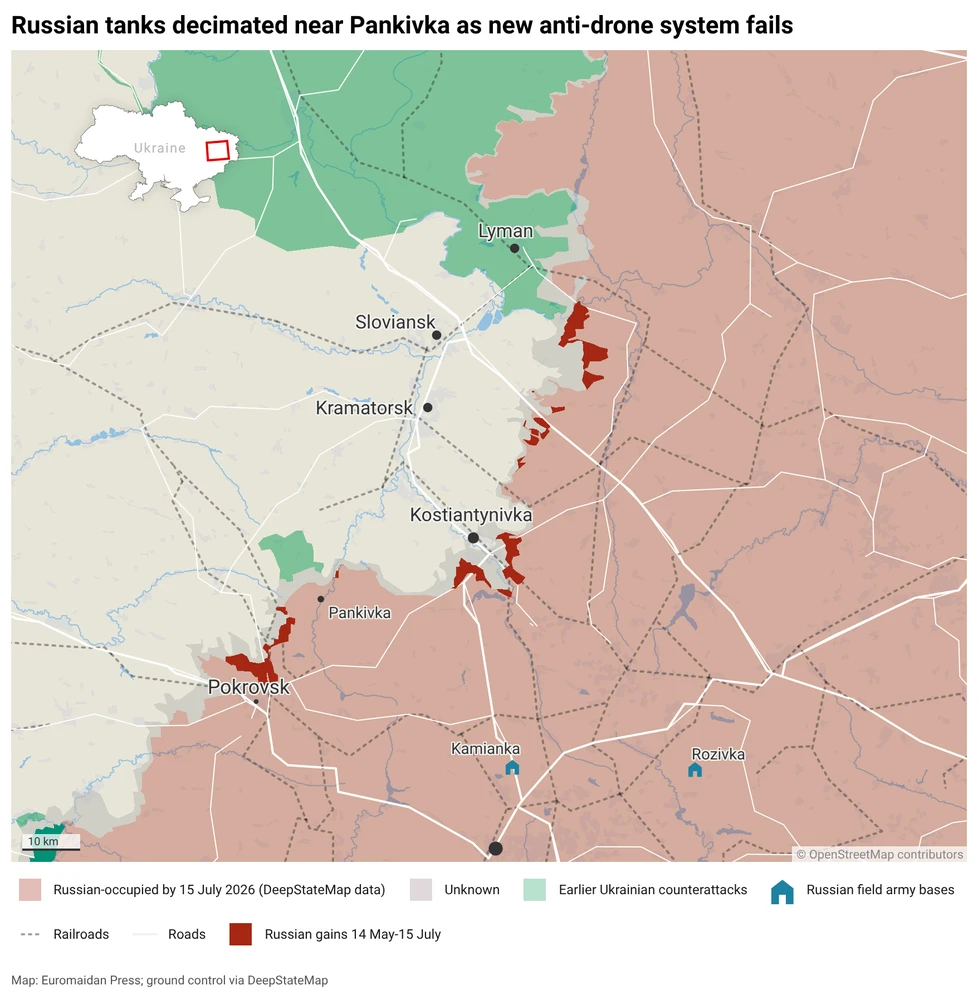
On and around 23 July, the Russians rolled tanks along the road through the village of Pankivka, roughly 36 km southwest of Kramatorsk and its twin free city of Sloviansk in eastern Ukraine’s Donetsk Oblast. Ukrainian drones spotted the tanks coming, and attacked.
When the smoke and dust cleared, the Russians had lost at least 9 tanks. Ukrainian tank kills were already running hot: the general staff in Kyiv claimed Ukrainian forces took out 28 Russian tanks across the 1,200-km gray zone in the two days before, 21–22 July. “It was a good day,” wrote Dimko Zhluktenko, a soldier with the Ukrainian Unmanned Systems Forces’ 413th Regiment.
The mechanized assault was unusual for its rarity. For more than a year now, the Russian army of occupation in Ukraine has mostly parked its armored vehicles, and instead attacked on foot or on motorcycles or other light vehicles. The pause in mechanized assaults has bought time for the Kremlin to ramp up vehicle production and bring battered regiments and brigades back to up to their full allotment of tanks and other armored vehicles.
But those vehicles aren’t necessarily being used in Ukraine. Ukrainian tiny explosive drones are everywhere all the time, and Russian forces have few ways of reliably defeating them. Russian commanders correctly concluded that small groups of infantry stand a better chance of slipping past Ukraine’s undermanned defenses than big, easy-to-detect tanks do.
Infantry infiltrations work. They’re how Russian assault groups have ground their way into the city of Kostiantynivka, 24 km southeast of Kramatorsk. Moscow claimed the city on 3 July. Ukraine’s general staff says it still holds it. And infiltration is how the Russians are gradually creeping around the city of Lyman, 21 km northeast of Sloviansk. The infiltrations are slowly closing a vice around Kramatorsk and Sloviansk, the last free big cities in Donetsk Oblast.
Costly attacks
But the infantry action is costly. The Kremlin recruits around 30,000 fresh troops every month but, if the Ukrainian general staff’s tallies of killed and wounded are accurate, loses roughly that many troops every month. Ukraine is desperately short of infantry. Russia isn’t nearly as desperate, but that doesn’t mean it’s got infantry to spare.
Last month, analyst Jompy predicted that if infantry casualties spiked or recruitment slipped, Russian commanders “could also be forced to go back to mechanized warfare.” That may be why the Center Group of Forces pivoted back to tank-led assaults in their south-to-north push toward Kramatorsk.
The shield that replaced the scrap metal
Without so-called “active defenses” that can shoot down incoming drones, “it is currently very easy to throw a tank battalion into [an] assault and lose it all without achieving anything,” analyst Jakub Janovsky explained. The Arena-M is Russia’s answer. It uses a Doppler radar to spot incoming rockets, missiles, and drones, and 12 launchers ringed around the turret fire tiny charges meant to shred the threat a few meters out.
Twelve is the whole magazine. And the system does not run itself: the commander switches it on when reconnaissance or a drone detector warns him, the Russian state newspaper Izvestia reported on 13 July, in a dispatch from a training range where crews of the Center grouping’s 90th Tank Division were learning the new machines.
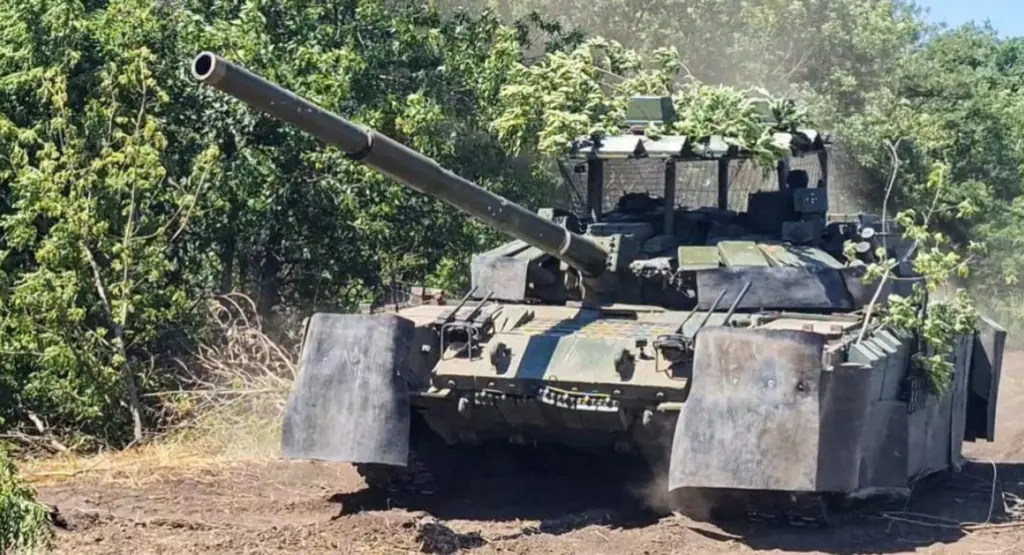
That dispatch is worth reading for what the reporter noticed was missing. No turtle armor. No tsar-mangal. No dreads, no cages, no hedgehogs—none of the welded scrap the Russian army has bolted onto its armor for two years. A company commander told Izvestia the system had shown high effectiveness against drones on the range, and that the tanks would reach the line of contact within days. Russian industry has been calling the Arena-M the first system in the world able to protect armor from FPV drones and loitering munitions. Israel’s Rafael announced drone-interception upgrades to its Trophy system in January 2025.
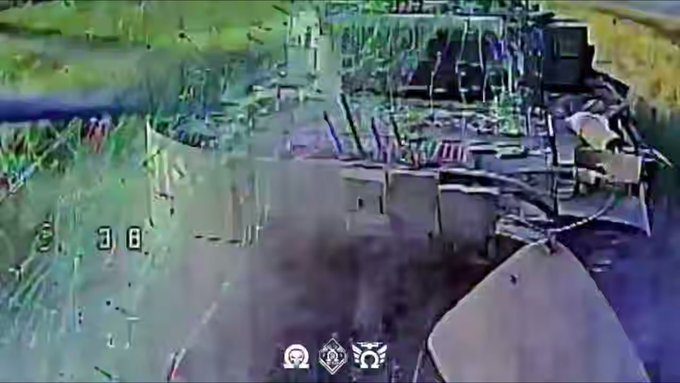
Ten days later the tanks were on the road, without the cages, and Ukrainian drones found them. Footage published by Ukraine’s border guards and by the National Guard’s Omega unit shows a T-72B3A taking a hit to the rear, then two more drones finishing it. A second tank—this one wearing a conventional mangal cage—was leading it and was immobilized too. Both Russian answers to the drone problem were on that road. Neither one came off it.
What the shield actually did is contested, and the argument is worth following. One Russian armor specialist watching the video saw no reaction at all—countermeasures still sitting in their launchers, no attempt to engage. Observer Matt Drew, watching the same footage, read it the other way: a puff of smoke off the turret in the opening seconds, an explosion to the side, and several drone feeds that cut out before reaching the tank—which is what an interception looks like from the drone’s camera. Only after the tanks were disabled and abandoned could the drones close in and linger, and it took bomber drones to finish the hulks. “Probably not the success the Russians were hoping for,” Drew wrote, “but it definitely worked for a while.”
A while is the problem. Twelve charges is a finite number and Ukrainian drone crews do not attack in twelves. A shield that intercepts the first drones and runs dry against the tenth turns a tank into a slower target, not a surviving one. And the latest push toward Kramatorsk failed.
That doesn’t mean Kramatorsk and Sloviansk are safe. Hurling tens of thousands of troops and, occasionally, a few armored vehicles against Ukrainian defenses, the Russian Center Group of Forces is making very, very slow progress toward the twin cities from both the south and the north.
But every assault the Ukrainians defeat delays the day when Kramatorsk and Sloviansk come under direct siege and infiltration. The cities are most vulnerable from the north around Lyman, mapper Clément Molin noted. “The current situation is not very good for Ukraine in this direction.”
At the current rate of advance, the Russians may be able to slip their first infiltrators into Sloviansk from the north some time next year, Molin concluded.
About the Author
