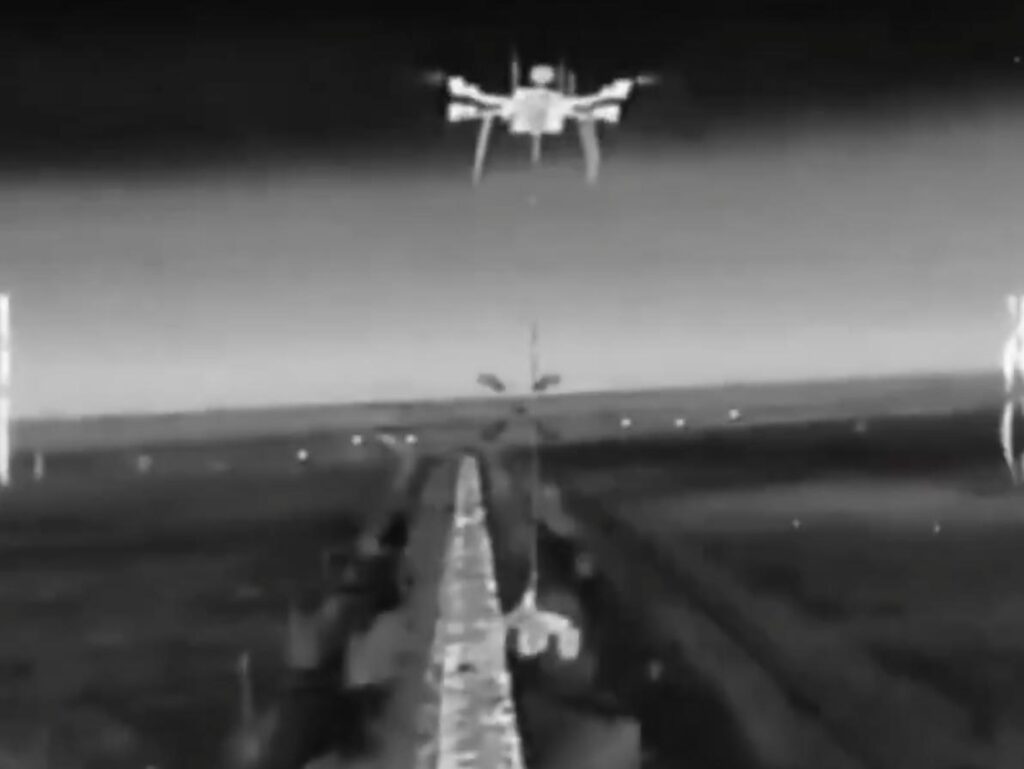
- Russian troops captured a new Ukrainian tactic on video
- A Ukrainian heavy bomber drone airlifted an explosive ground robot into action
- More precise than a bomb, an explosive UGV can crack open a Russian bunker
- The robotic airlift is just the latest in Ukraine’s ever-expanding all-robot mission sets
Just days after landing robots on an enemy shore in the first all-robot amphibious assault, Ukrainian forces flew one into battle. This week, a Russian video circulated depicting a Ukrainian heavy bomber drone airlifting an explosives-laden unmanned ground vehicle into action.
What happened next is unclear. Did the exploding UGV successfully strike its target?
Regardless of the outcome, however, the unmanned air assault is notable. If Ukrainian forces can use an unmanned aerial vehicle to airlift one unmanned ground vehicle, they can do it a second time. And a third. And fourth. So on until these kinds of all-robot operations become routine.
And that’s indeed the aim in Kyiv. To make robotic combat operations an everyday occurrence in order to help alleviate a deep and persistent manpower shortage. This spring, recently sacked Ukrainian defense minister Mykhailo Fedorov claimed Ukraine would acquire 25,000 UGVs in just the first six months of 2026.
That’s twice as many UGVs as Kyiv bought in all of 2025. The rapid mass acquisition would allow more Ukrainian brigades to shift to robotic resupply missions, removing potentially thousands of precious human logisticians from dangerous roads.
But UGVs perform combat missions, too. Armed with guns, they help counterattack Russian infiltrators and also patrol roads inside the disputed gray zone. In November, one gun-armed UGV belonging to the Ukrainian 5th Assault Brigade, fighting north of Kostiantynivka in eastern Ukraine’s Donetsk Oblast, inadvertently advanced UGV tactics in an accidental encounter with an up-armored Russian MT-LB infantry transport.
The UGV, equipped with thermal night vision and armed with a remotely operated M2 .50-caliber machine gun, was reportedly on a combat trial—crawling around the battlefield at nighttime for testing purposes—when an MT-LB rolled toward it on the same road.
Connected via radio, the UGV operators opened fire, peppering the tracked MT-LB with rounds until the Russian vehicle passed by—and escaped in the opposite direction.
One-way drones
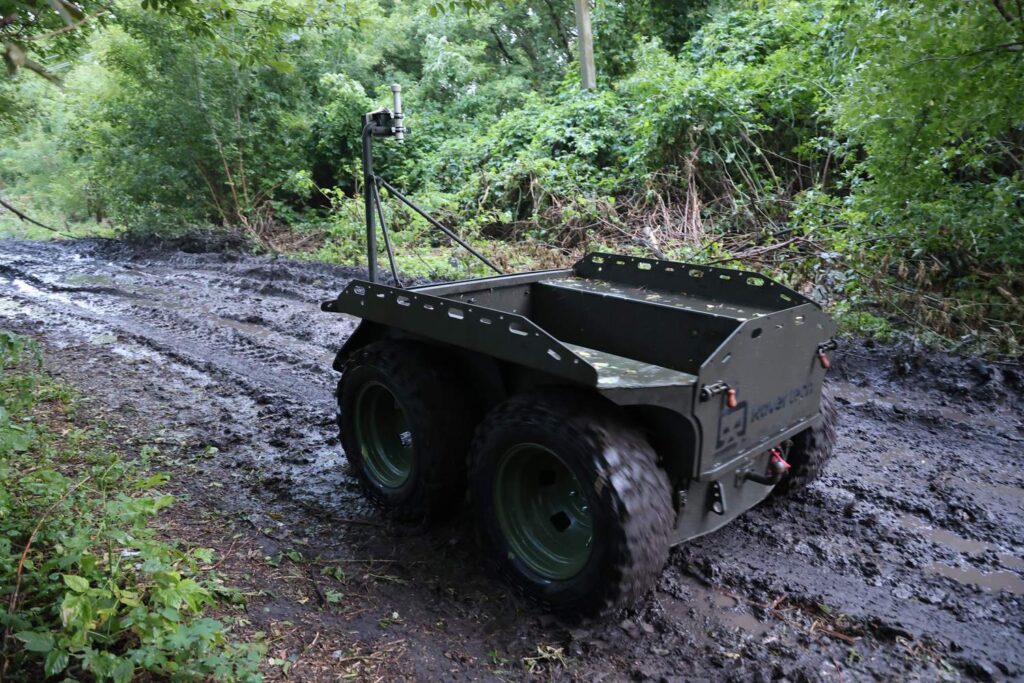
Other Ukrainian UGVs are meant to fight exactly once. They’re suicide bombers, hauling payloads of explosives into Russian strongpoints and blowing themselves up. Back in January, the Ukrainian 3rd Assault Brigade’s NC-13 robotics unit piled a dozen TM-62 anti-tank mines, each with 7.5 kg of explosives, onto one of its UGVs and carefully steered the robot into a Russian bunker presumably somewhere south of the ruins of Kupiansk in eastern Ukraine’s Kharkiv Oblast.
It made a very big boom. As seen in an official video, the NC-13 team broke into cheers when an escorting aerial drone registered the blast. The team had carefully assembled, painted, and deployed the robot apparently over a period of days before maneuvering it 19 km across rough terrain to deliver the explosive payload.
The recent robotic air assault addressed the mobility problem. A 19-km trip is a long trip for a remotely controlled vehicle that’s susceptible to enemy radio jamming and prone to getting stuck in potholes. Airlifting a UGV underneath a heavy bomber drone gets the UGV into action faster and with less risk of a loss or accident en route.
Ukraine’s 123rd Territorial Defense Brigade has carried out the first known mission of its kind.
Ukrainian operators remotely guided an unmanned maritime platform across the Black Sea, carrying a machine-gun-equipped ground robot. They landed the robot on the occupied Kinburn… pic.twitter.com/wKncXttJqb
— Special Kherson Cat
(@bayraktar_1love) July 13, 2026

A heavy bomber drone could just drop a bomb, of course. But a UGV can do something an aerial bomber can’t do: drive straight through the open door of a Russian bunker regardless of how much protection the Russians pile atop the door.
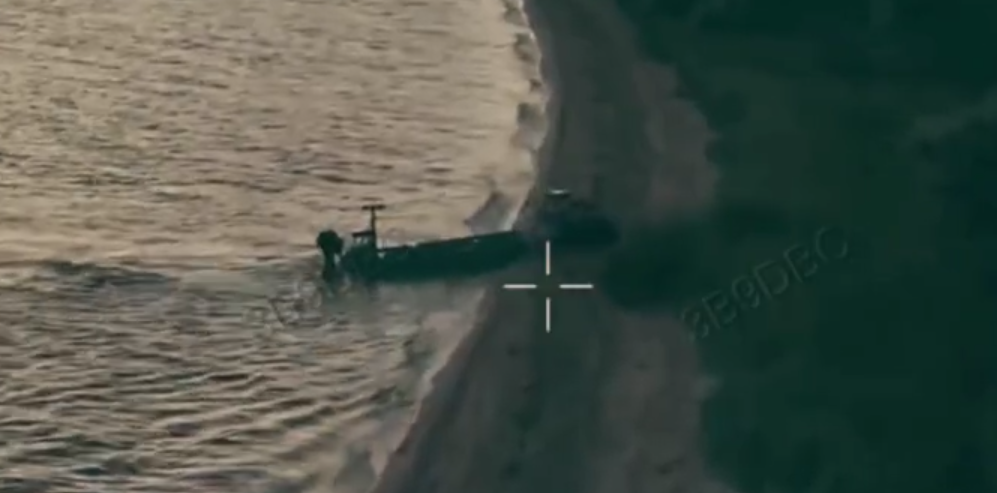
The Ukrainians are finding more and more new ways to get their UGVs into action. On 13 July, the Ukrainian 123rd Territorial Defense Brigade sailed several unmanned surface vessels across the western Black Sea and landed gun-armed unmanned ground vehicles on the Kinburn Spit, at the westernmost edge of the Russian occupation zone in southern Ukraine.
The 123rd Territorial Defense Brigade released a video montage—shot by a USV, a UGV and an escorting UAV—depicting the UGV firing on a Russian installation with its suppressed .50-caliber machine gun.
It was an all-robot amphibious assault. “An impressive feat,” RAND analyst Michael Bohnert wrote.
The later robotic airlift was no less impressive.
About the Author
