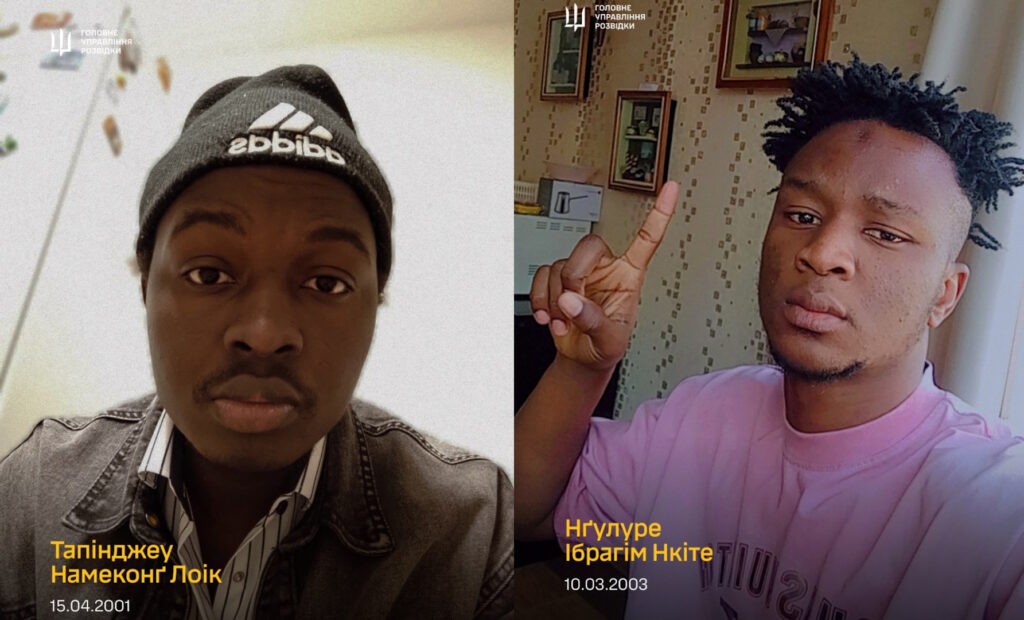
Two men from Cameroon signed Russian army contracts and died within about a month. Ukraine’s Defense Intelligence (HUR) published the identities of both, saying their bodies were found on the Lyman and Zaporizhzhia sectors of the front.
The two are recent entries in a recruitment pipeline that has pulled at least 27,000 foreign nationals from more than 130 countries into Russia’s army, a pipeline the European Parliament voted 479 to 17 in March 2026 to classify as human trafficking.
By the count of HUR‘s “I Want to Live” project, Russia has cost the lives of at least 106 Cameroonian citizens since the full-scale war began.
One was student. One had been in Russia two months
Both men were from Douala, Cameroon’s largest city. Both signed as infantry soldiers. Both were sent to a training center briefly and then to the front. Both were killed in what HUR calls “meat assaults”, the frontal infantry attacks Russia uses to find Ukrainian firing positions with human bodies.
Ngouloure Ibrahim Nkite, born 10 March 2003, arrived in Russia on 9 February 2026. He signed a one-year rifleman’s contract in the city of Oryol on 4 April. After a few weeks at a training center, he was sent to occupied Luhansk Oblast. He was killed around 12 May near Lyman in Donetsk Oblast. He was 23, and he had been in Russia for three months.
Tapindjeu Namekong Loique, born 15 April 2001, was a student at Michurinsk State Agrarian University in Tambov Oblast when he was recruited. He signed his rifleman’s contract in Vologda on 25 March 2026. Like Nkite, he spent little time in training. He was killed around 23 April near Huliaipole in Zaporizhzhia Oblast. He was 25.
From contract to death, each man lived roughly a month.
Pattern HUR is documenting
Meanwhile, Ukraine says Russia plans to open eight new cultural centers in Africa to funnel young people toward the war, part of what it calls “a war for the minds of Africans.” Ukraine counts more than 1,780 Africans from 36 countries fighting for Moscow.
HUR published the two men’s names alongside its standard message: that the only way for a foreign national in the Russian army to survive is voluntary surrender, through the “I Want to Live” project.
Read also
-
20,000 confirmed hits make General Cherry Ukraine’s top FPV drone maker
-
A nationwide bomb-shelter overhaul is underway in Belarus as Moscow pushes Minsk toward its war against Ukraine
-
You can’t jam what you can’t identify: Ukraine just fielded its first portable drone detector
About the Author
