
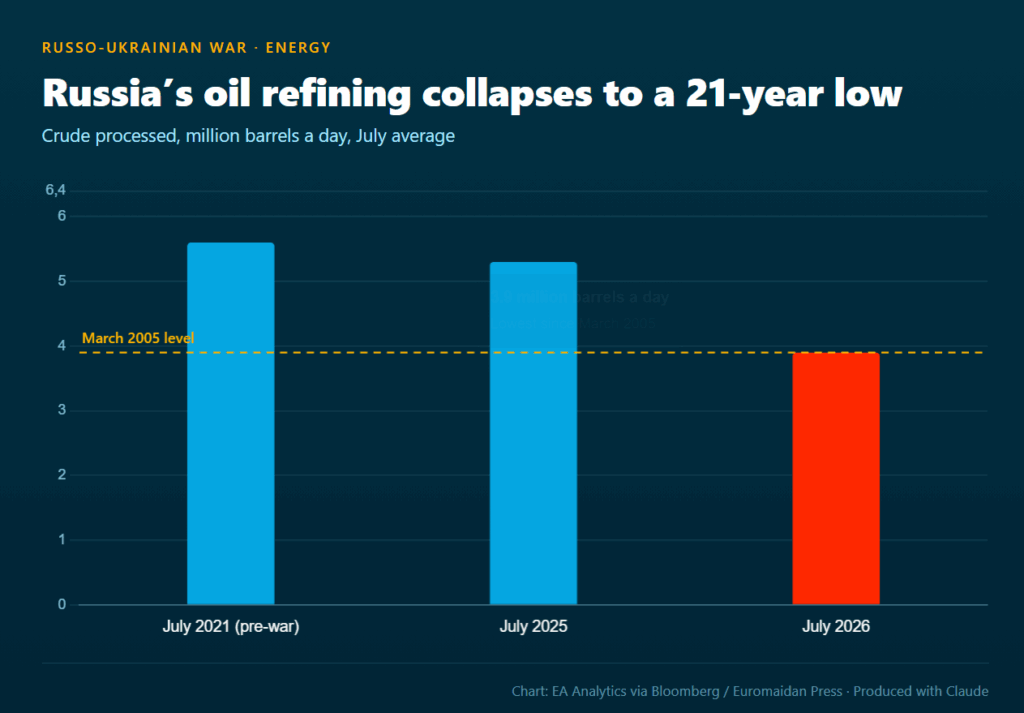
Ukrainian strikes have pushed Russia’s oil refining down to 3.9 million barrels a day so far in July—the lowest level since March 2005 and more than 1.4 million barrels below a year ago, according to EA Analytics figures reported by Bloomberg on 13 July.
The loss of a key global diesel supplier has driven prices to multiyear highs.
The collapse forced Moscow to ban most diesel exports through the end of July, on top of earlier gasoline and jet fuel restrictions—and the loss of a key global diesel supplier has driven prices to multiyear highs on a market already strained by Middle East disruptions.
Moscow hides the numbers
Russians can feel where this is going. They typed “how to make gasoline” into the Yandex search engine more than 17,000 times in June—the highest number since the full-scale invasion of Ukraine began in 2022, the Bell reported, citing Yandex Wordstat data.
Russia classified its refinery statistics after the strikes began, so EA Analytics reconstructs the numbers from external sources: satellite tracking of oil fields and storage tanks, and real-time cargo flows.
The International Energy Agency’s independent estimate points the same way—3.8 million barrels a day in June, 1.6 million below a year earlier, with more than half of Russia’s refining capacity affected since May.
The domestic market is short 400,000–600,000 tons of fuel a month.
Other analysts put the figure lower still. Energy Intelligence estimates current runs at about 3.6 million barrels a day—a level Russia last saw no later than 2002—with roughly 3.1 million barrels of daily capacity idle and no known restart dates.
The domestic market is short 400,000–600,000 tons of fuel a month, and imports from Belarus and Kazakhstan cover only about half the gap, the group’s analysts estimate.
Why the shortage runs coast to coast
The campaign behind the collapse: about 50 Ukrainian attacks in 100 days that hit at least 24 of Russia’s 34 large refineries, a Bloomberg tally shows—a campaign Kyiv says is designed to force the Kremlin to the negotiating table. Ukrainian drones now fly a claimed 3,400 km on one charge—this month reaching the Omsk refinery, Russia’s largest, which mainly supplies domestic consumers.

A $50k Ukrainian drone just hit a refinery 2,500 km inside Russia. The expensive missiles couldn’t
That is why the shortage runs from Karelia to Kamchatka: hours-long lines, rocketing pump prices, rationing by license plate number in some regions, and a recommendation to Novosibirsk companies to bring back remote work to save fuel.
“We must acknowledge that there are problems and shortages,” Deputy Prime Minister Alexander Novak said—he now holds meetings on the fuel market almost daily.
Yandex users, meanwhile, are exploring a different fix.
About the Author
