Ukraine is the first state to fund combat humanoid robots as a separate category in defense procurement. Ukraine’s Brave1 defense cluster has opened a grant competition for developing domestic bipedal humanoid robots designed exclusively for military tasks, Tech Times reports.
The decision creates a doctrinal precedent that other armed forces will have to respond to, regardless of whether the first grant recipients fire a single shot.
Brave1 CEO Andrii Hrytseniuk framed the move as a strategic response to global trends in humanoid development.
“We see how quickly the humanoid robotics industry is developing worldwide, in China and the United States. We see that such robots have value for strengthening our military capabilities. That is why we are moving in this direction,” Hrytseniuk said.
Only humanoid robot tested in real combat conditions
Ukraine is designing systems for combat environments without GPS access, under electronic warfare pressure, where a robot may end up buried in rubble or in a flooded trench.
The only humanoid robot tested in real combat conditions in Ukraine so far is the Phantom MK-1. Its limitations include low payload capacity, no water protection, short autonomous work time, and high technical complexity.
Ukraine’s Brave1 grant reflects those limitations. Instead of asking developers to build a fully autonomous combat robot at once, the program allows them to start with simpler platforms that can be improved and expanded with new functions.
Ukraine’s ground robot ecosystem runs on wheels, tracks, and four legs
The theoretical advantage of humanoid robots lies in their human-like body structure. It lets them work in human-designed environments: use stairs, pass through narrow corridors, operate inside buildings, interact with equipment designed for people, all without changing the infrastructure.
On a factory floor, bipedal robots operate on level, predictable surfaces. On a battlefield, they have to cross mud, rubble, shell craters, and blast effects.
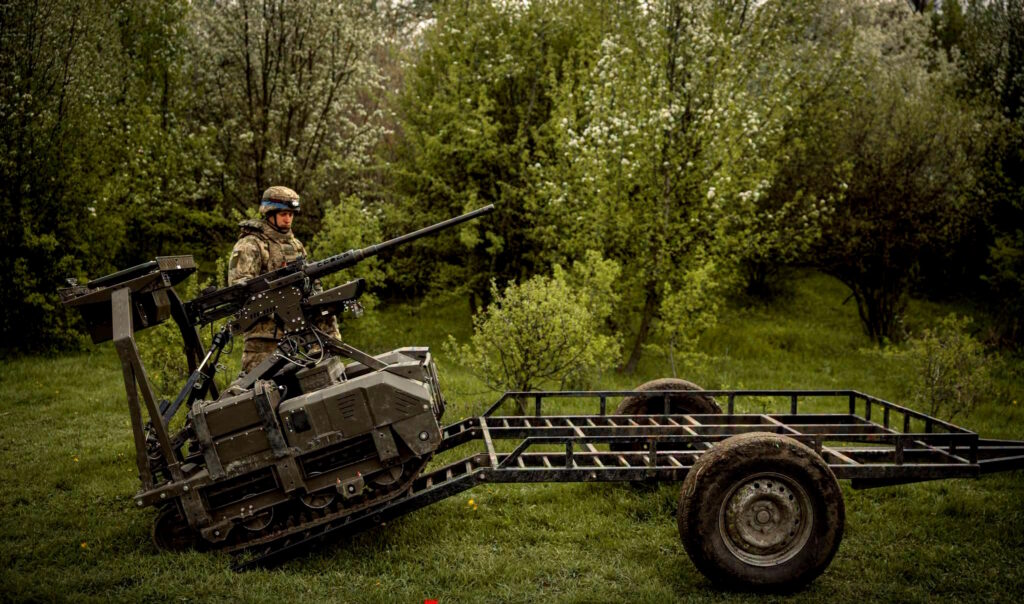
Ukraine’s ground robots that are actually winning battlefield missions are wheeled, tracked, and four-legged. These configurations succeed because of simplicity, lower cost, and quick replacement ability.
Ukraine’s Defense Forces received 1,028 ground robotic complexes worth 487 million UAH ($11.7 million) through the DOT-Chain Defense marketplace by mid-2026.
Ukraine’s Defense Ministry codified 67 new ground robot models in the first half of 2026 alone, none of them bipedal. Ukrainian forces captured a Russian position for the first time using only drones and ground robots in April 2026.
Brave1 methodology starts simple and iterates on battlefield
Brave1 has applied its staged development approach to FPV drones, ground robotic complexes, interceptor drones, and other military technologies. Systems go from experimental development to practical battlefield application through rapid testing and feedback. The bipedal humanoid category is now on the same track.
A military humanoid must withstand impacts, dirt, radio interference, extreme temperatures, and enemy attacks. Repair happens directly in field conditions.
Ukraine’s Defense Ministry adviser Serhii “Flash” Beskrestnov flagged in May 2026 that ground robots operate in a much more challenging communication environment than aerial drones. Terrain, urban infrastructure, tree lines, and cover constantly interfere with the control signal, and a robot that loses its link drops out of the mission.
The connectivity constraint that already limits wheeled and tracked robots will apply doubly to a bipedal system trying to balance itself on unpredictable terrain.
The Brave1 grant does not commit Ukraine to deploying humanoid robots in the near term. It commits the state to funding domestic developers who will attempt to build systems for a battlefield where wheels, tracks, and four legs currently dominate, and where a bipedal humanoid must earn its place against faster, cheaper, and more replaceable competitors.
Read also
-
Ukraine built 90% of its newly authorized weapons itself. Year ago, it was 70%
-
Drone Australia just trialed learned to fly through Russian jamming over Ukraine
-
Ukrainian strikes emptied Russia’s refineries. Now Russia is smuggling fuel to front under tarpaulins and grain
About the Author
