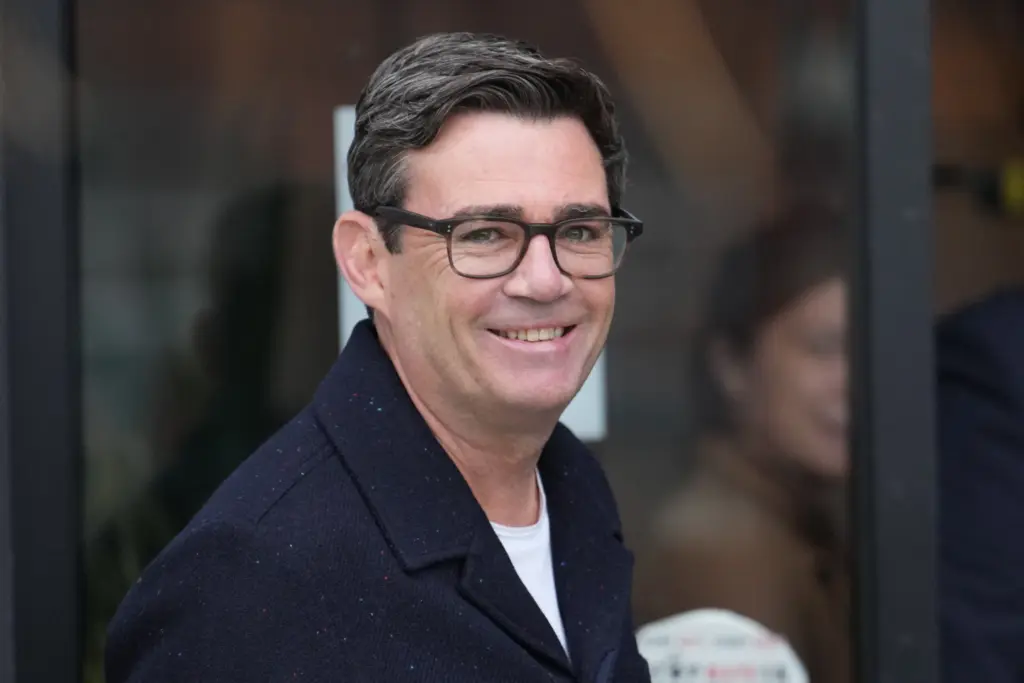
Andy Burnham, all but certain to become Britain’s next prime minister in the coming weeks, has told Ukraine what it wanted to hear. British support “will not waver,” he wrote in The Times, pledging to hold aid at “100%” of current levels. He added that British and broader Euro-Atlantic security are tied to developments in Ukraine. For Kyiv, the words are welcome.
They are also beside the point. The question that has worried Ukrainian officials through Britain’s summer of political chaos was never whether Burnham personally supports Ukraine—he plainly does, from backing Ukraine and its mayors since 2022 to building an “Unbroken Cities Network” that has linked Lviv with Manchester and Liverpool since 2023. The question is whether Britain, as Burnham inherits it, can keep the promises he is making.
How he got here
Burnham reached the threshold of Downing Street by a route modern Britain has almost never used—the last premier to enter the Commons through a by-election was Alec Douglas-Home in 1963. mid-June, he was not even a member of Parliament—he had spent nine years as mayor of Greater Manchester, outside Westminster entirely.
When Keir Starmer’s government began to collapse after a catastrophic showing in May’s local elections, in which opposition parties made major gains, and Labour lost roughly 1,500 council seats, a sitting Labour MP stood down specifically to let Burnham contest the vacant seat. He won it in a landslide, was sworn in on 22 June, and within hours, Starmer announced his resignation.
Burnham is now the only candidate to replace him. He arrives, in other words, not on a wave of confidence but as his party’s emergency exit—the man Labour MPs believe is their best hope of surviving the next election against Nigel Farage. That origin shapes everything about how he is likely to govern, including his approach to Ukraine.
Why the pledge is the easy part
British support for Ukraine will continue under Burnham for the simplest of reasons: it is mainstream in his party, and he believes in it. Starmer’s signature foreign-policy achievement—co-chairing a European “coalition of the willing” for Kyiv—is not something Burnham has any reason to unwind. Foreign Secretary Yvette Cooper calls him “100% behind” Britain’s unwavering support for Ukraine.

UK, EU, and Canada sanction Russian networks linked to deportation of Ukrainian children
The strain lies elsewhere, in three pressures the pledge does not resolve. The first is attention. Burnham is a domestic politician who ran an inward-facing campaign and has said strikingly little about foreign affairs. Analysts expect him to delegate diplomacy and concentrate on Britain’s cost-of-living and public services crises. Ukraine, under him, is likely to keep a competent maintainer rather than the hands-on champion Starmer became.
The second is money, and it is the real threat. Britain has pledged to raise defense spending toward 3.5% of GDP by 2035. Still, the path there is unfunded, and the fight over it already claimed a casualty: Defense Secretary John Healey resigned in June over the lack of a credible plan to pay for it. Burnham has to fix decaying public services, raise defense spending, and sustain aid to Ukraine, all against near-record national debt and strict fiscal rules. Something has to give, and Kyiv’s line is not the most politically protected.
The third is the electorate. The force now driving Labor’s fear—Farage’s Reform UK—campaigns on the claim that Labour prioritizes foreign commitments over ordinary Britons’ living standards. Reform is aligned with Trump and known for skepticism toward Ukraine rather than open-ended support. It is not anti-Ukraine, but among Britain’s major parties, it is the most skeptical of the current aid scale—and it is winning. Burnham’s central mission is to beat it, which means proving he can deliver at home, a goal that directly competes with the money and attention Ukraine needs.
What it means for Ukraine
The honest reading is neither the reassurance of the headlines nor the alarm. Under Burnham, British support for Ukraine will not be cut in principle, and the coalition Starmer built will hold. But it now rests on fiscal arithmetic that already toppled one minister, and on an electorate drifting toward a party that frames the war as a cost. Nothing changes on the day Burnham enters Downing Street. The question is what changes over the years he has to govern—and whether a prime minister who won power by promising to look inward can keep looking outward at the same time.
About the Author
