Ukraine’s central bank reserves rose 12.1% in June to $51.3 billion (2.3 trillion hryvnia), reversing a four-month, $12 billion drawdown driven almost entirely by one thing: the cost of oil.
A war between Israel and Iran that shut the Strait of Hormuz forced Ukraine to spend down its financial buffer to defend the hryvnia against rising fuel-import costs. On 8 July, oil prices spiked again—a reminder that the recovery rests on a war Ukraine has no control over.
It is the first monthly increase since January, when reserves peaked near $57.7 billion (2.5 trillion hryvnia) before four straight months of decline
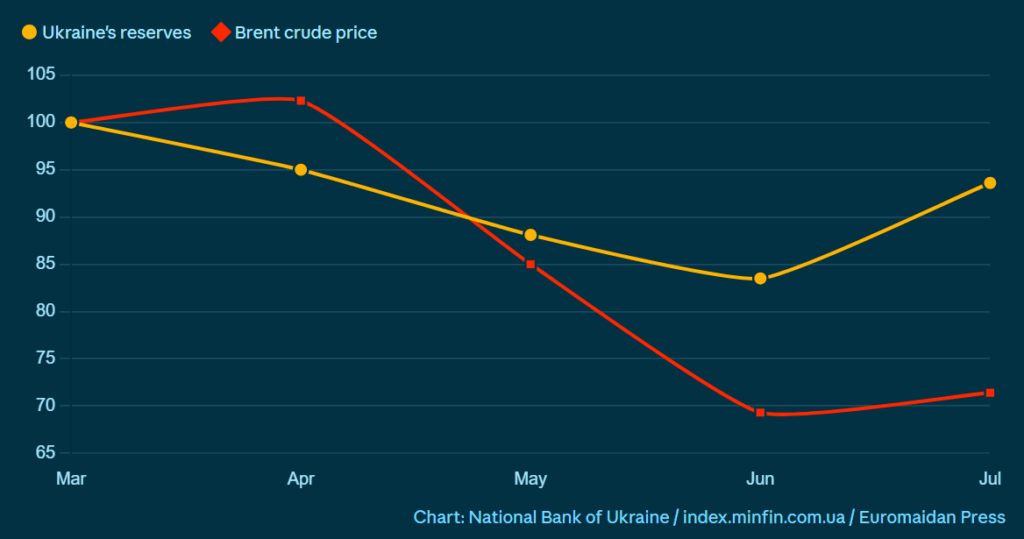
The National Bank of Ukraine reported the figure on 7 July, up from $45.7 billion (2 trillion hryvnia) at the start of June. It is the first monthly increase since January, when reserves peaked near $57.7 billion (2.5 trillion hryvnia) before four straight months of decline drained a fifth of the buffer.
Oil prices drive the buffer
Ukraine imports nearly all its refined fuel, so global oil prices translate directly into Ukraine’s import bill and, from there, put pressure on the hryvnia. When oil spikes, the National Bank sells dollars from reserves to keep the currency stable; when oil falls, it can sell less.
Ukraine’s fuel inflation hit 23.4% year-on-year in March, more than twice the headline rate, and the National Bank paused a rate-cutting cycle.
Brent crude touched $115 a barrel (5,000 hryvnia) in late April and climbed back above $110 (4,800 hryvnia) in mid-May as the Israel-Iran war escalated and the Strait of Hormuz stayed shut to most shipping. Ukraine’s fuel inflation hit 23.4% year-on-year in March, more than twice the headline rate, and the National Bank paused a rate-cutting cycle it had only just begun in January.
Then, through June, a US-Iran truce began restoring tanker traffic through Hormuz and OPEC+ raised output quotas. Brent fell from $91 a barrel (4,000 hryvnia) at the start of June to $72 (3,100 hryvnia) by month’s end, according to daily price data—a drop of more than 20% in four weeks.
The National Bank also sold $5.15 billion (225 billion hryvnia), defending the hryvnia.
Ukraine’s government still pulled in $11.3 billion (493 billion hryvnia) from partners in June—$6.8 billion (297 billion hryvnia) from the EU, $4.5 billion (196 billion hryvnia) via the World Bank—and the National Bank also sold $5.15 billion (225 billion hryvnia) defending the hryvnia, according to the same NBU release. Import cover improved from 4.7 to 5.2 months in a single month.
Drone funding stands apart from reserves
A separate $4.4 billion (192 billion hryvnia) payment is not included in that total. The European Commission disbursed €3.9 billion on 30 June as the first tranche of a €6-billion drone-procurement package under the EU’s wider Ukraine Support Loan—money earmarked for weapons purchases, not counted toward general reserves.
Ukraine also paid down $270 million (12 billion hryvnia) in foreign debt and $172 million (7.5 billion hryvnia) to the IMF in June.
Brent jumped over 5% in a single day after the US struck Iran again.
The relief is already fragile. On 8 July, Brent jumped over 5% in a single day after the US struck Iran again and revoked its oil-export waiver, following attacks on tankers in the Strait of Hormuz. Oil’s June retreat took a month to build. It may take less than that to unwind, and with it, the conditions that let Ukraine’s reserves recover.
About the Author
