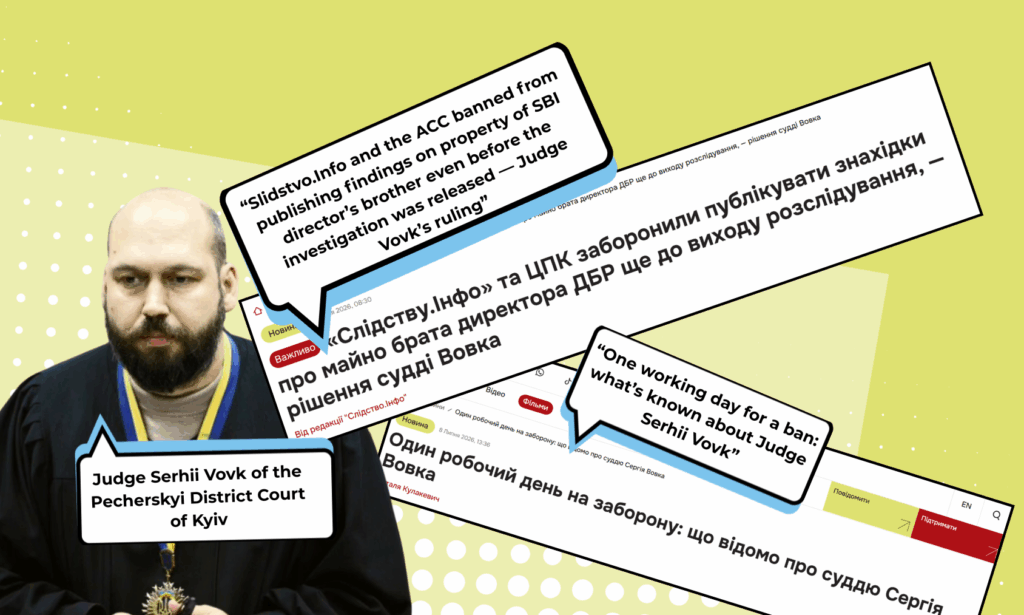
A Ukrainian court has blocked the publication of a completed investigation, using a legal tool meant to protect evidence in a lawsuit that, as of publication, does not exist.
On 24 June, investigative outlet Slidstvo.Info and the Anti-Corruption Action Center (ACC) sent questions to a company called Parkovyi-2 about 143 real estate properties that the reporters had traced to Oleksandr Sukhachov, a Kharkiv businessman and the brother of State Bureau of Investigation (SBI) Director Oleksii Sukhachov, according to Slidstvo.Info’s own statement.
According to the court’s own account, the claimant now has 10 days from 6 July to file the suit.
Parkovyi-2 never answered; on 3 July, a Friday, it sued instead, and by Monday, 6 July, Pecherskyi District Court Judge Serhii Vovk had signed an order barring Slidstvo.Info and the ACC from publishing anything about the property.
The underlying defamation or privacy suit that would normally justify such a ban has still not been filed. According to the court’s own account, the claimant now has 10 days from 6 July to file the suit, or the order will lapse on its own, the Pecherskyi court told Suspilne.
Why a request turned into a courtroom order
The mechanism at work is an interim injunction, ordinarily used to freeze assets or preserve evidence while a court case is underway, not to stop a story before the case behind it is lodged.
The court defended the ban as a routine practice under Ukraine’s martial-law provisions, arguing that weighing free expression against the injunction is a matter for the court once the actual lawsuit is filed.
If it survives this use, any person facing embarrassing reporting has a template: file an injunction first, then decide later whether to sue at all.
A tool built to prevent evidence from disappearing mid-case has just been used to stop a finished story from appearing at all, while no case is open yet to test it against. If it survives this use, any person facing embarrassing reporting has a template: file an injunction first, then decide later whether to sue at all.
Euromaidan Press could not independently verify whether this specific sequence—an injunction granted before the underlying suit is filed—has legal precedent in Ukraine; none of the reporting reviewed cites a prior case.
As Ukrainska Pravda reports, the court’s order itself gives two reasons for the ban: that publishing details of the properties and how they were financed could cause Oleksandr Sukhachov “irreparable harm,” and that the information could expose Parkovyi-2’s trade secrets.
Maksym Savchuk told Ukrainska Pravda the months-long investigation had traced dozens of properties to Oleksandr Sukhachov and found “threads leading directly to” the SBI.
“We believe the Anti-Corruption Action Center and Slidstvo.Info are simply being used to test an instrument for banning journalists from exposing corruption,” ACC director Darya Kaleniuk said in a statement.
Slidstvo.Info co-author Maksym Savchuk told Ukrainska Pravda the months-long investigation had traced dozens of properties to Oleksandr Sukhachov and found “threads leading directly to” the SBI his brother runs.
Reporters Without Borders expressed concern, saying courts should not be used to suppress reporting on matters of public interest.

Why the SBI’s own family matters here
Ukraine’s SBI investigates officials and law enforcement, including cases that touch its own ranks. A court has now shielded the family of the person who runs it from published scrutiny, days before any legal case against that scrutiny existed.
On 7 July, investigators raided the home of Babel co-founder Oleksii Babenko, days after his outlet published an investigation.
This is not the only recent case of pressure on Ukrainian outlets reporting on state institutions. On 7 July, investigators raided the home of Babel co-founder Oleksii Babenko, days after his outlet published an investigation into deaths at Ukraine’s largest assault regiment.

Ukraine opened a criminal case over 25 non-combat deaths at its largest assault regiment. Serving soldier’s response was to call reporter “media killer”
Judge Vovk has a documented history of rulings favoring politically connected figures, according to Slidstvo.Info, which reports he sentenced former Interior Minister Yurii Lutsenko in 2012 in a case the European Parliament later called inconsistent with international fair-trial standards, and separately lifted an asset freeze on 415 properties linked to businessman Ihor Kolomoisky.
Slidstvo.Info found that his wife had become the owner of a Volkswagen Multivan, now worth roughly $90,000.
In 2015, parliament approved Vovk’s own arrest after prosecutors accused him of a ruling that unlawfully stripped someone of property rights; he was suspended, then reinstated in 2016. In 2022, Slidstvo.Info found that his wife had become the owner of a Volkswagen Multivan, now worth roughly $90,000; when asked how she had afforded it, Vovk said it had been a gift from unnamed family members.
The DEJURE Foundation reported that the SBI searched Ukraine’s High Qualification Commission of Judges in March 2025, shortly after judges from the Pecherskyi court, including its chair, were called in for a review that could have cost them their posts.
DEJURE stopped short of alleging a direct link between that episode and this ruling, describing the two courts’ relationship instead as an exchange of favors.
Kyiv has committed to EU-standard anti-SLAPP legislation by 2027 as part of its accession process.
Slidstvo.Info and the ACC say the case carries the hallmarks of a Strategic Lawsuit Against Public Participation, or SLAPP—a suit filed less to win than to exhaust and silence the party being sued, and note that Kyiv has committed to EU-standard anti-SLAPP legislation by 2027 as part of its accession process, under the same first cluster of talks covering judicial reform and freedom of expression.
Slidstvo.Info says it will appeal and continue seeking to publish the investigation.
A publication ban issued within one working day, against a story that had not yet run, is the kind of case that cluster is meant to prevent. Slidstvo.Info says it will appeal and continue seeking to publish the investigation. The outlet has operated for 14 years and says no court has found it published false information.
About the Author
