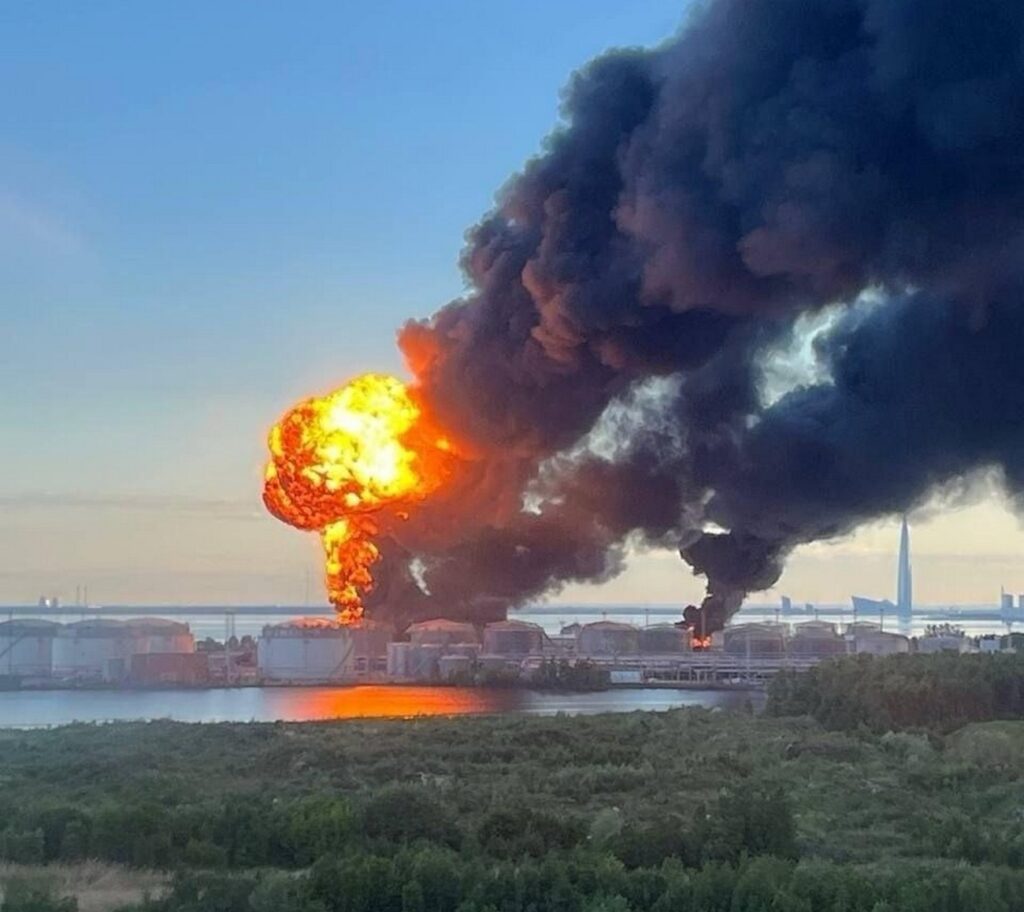
Ukrainian strikes have idled 42.74% of Russia’s oil refining, the General Staff said on 4 July. Over the past month, Ukrainian forces successfully attacked eight refineries and destroyed or critically damaged over 60 storage tanks, of which 58% held petroleum products and 42% held crude oil. Industry losses from the campaign have reached $13.5 billion since August 2025.
The General Staff’s cumulative figure sits between two other assessments of the campaign’s damage. Ukrainian energy analyst Mykhailo Honchar calculated on 30 June that half of Russia’s primary refining capacity was offline, while the International Energy Agency and Reuters-cited industry sources put the offline share at 33% to 40% through June.
What all three assessments agree on is that the second quarter of 2026 was the most intense phase of Ukraine’s campaign against Russian fuel production, with visible consequences reaching Moscow filling stations and occupied Crimea.
June strikes reached refineries over 1,100 km from Ukraine
Ukraine’s Defense Forces confirmed strikes on the TANECO and TAIF-NK refineries in Nizhnekamsk, Tatarstan, on 12 June, over 1,100 km from Ukraine’s border. TANECO ranks among Russia’s largest refineries, with a design capacity of over 16 million tons of oil per year. Nizhnekamsk canceled its Russia Day celebrations after the strikes.
The strike campaign also reached Slavyansk-na-Kubani in Krasnodar Krai on 28 June, hitting a major fuel supplier for occupied Crimea.
On the same night, Ukraine reached the Slavneft-YANOS refinery in Yaroslavl, one of Russia’s five largest plants, about 700 km from the border. Honchar’s 30 June analysis noted a shift in Ukrainian ordnance from drones to Neptune cruise missiles converted for land attack, with heavier warheads inflicting longer, costlier repairs.
Fuel crisis reaches Moscow and 53 Russian regions
Russia has been under gasoline rationing in 53 of its regions and all five occupied Ukrainian territories as of mid-June. Fuel shortages reached Moscow and St. Petersburg in the same month, with the Moscow Times reporting that Russian wholesale diesel prices were up 43% since January.
The Russian government imposed a full gasoline export ban through the end of July and began importing fuel by sea.
Independent tracking shows Russian refinery runs averaged 4.58 million barrels a day in May, down about 13% from a year earlier and the lowest since 2009, per OilX estimates. Russian oil companies received about 700 billion rubles ($9.7 billion) in subsidies across April and May to keep fuel moving.
Read also
-
Russia’s 4th-largest oil refinery in Kstovo halts its main crude unit after 20 May attack
-
Analysts spotted missile launcher Ukraine had kept classified for three years
-
Helicopter, railway bridge, two command posts: Ukraine lists six strikes in one day
About the Author
