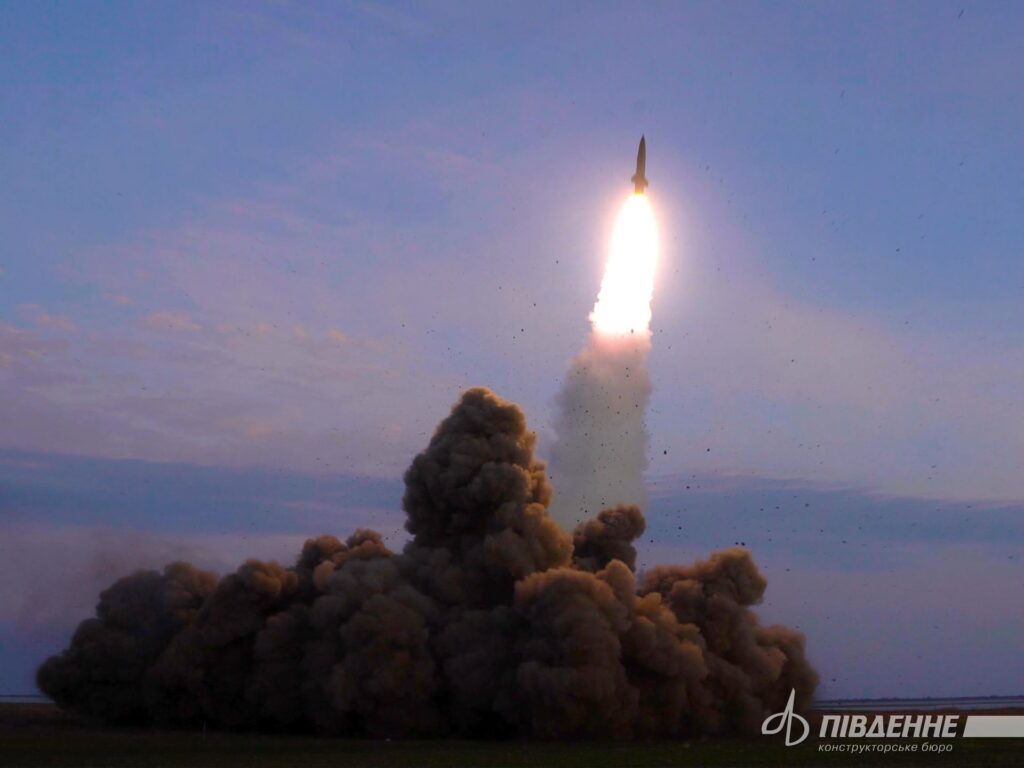
Russia’s Defense Ministry said its air defenses shot down a Ukrainian “long-range operational-tactical missile”—a designation describing a ballistic weapon, and the first Russian claim of its kind in the full-scale war, Russia’s Ministry of Defense reported on 1 July.
The admission is the news. A ministry that has spent four years belittling Ukrainian strike capabilities gains little by inventing a new missile class for its enemy—and it lands the same week Fire Point, Ukraine’s most prolific munitions-maker, said its FP-9 ballistic missile was approaching flight tests, with launches aimed at Moscow.
Ukraine has not confirmed any ballistic missile use. The claim cannot be independently verified, and Moscow has incentives of its own—a reported intercept flatters its air defenses.
But an admission against interest, from the party watching its own radar picture, is the strongest indication yet that Ukraine’s ballistic program has left the test range.
The statement named no missile type, launch site, or target—only that the intercept came within 24 hours, alongside seven guided bombs and 602 fixed-wing drones.

Open-source analysts had already been tracking something two days earlier. During a 30 June alert over Moscow Oblast, S-300 and S-400 batteries engaged an object at altitudes far above drone and cruise-missile flight paths, the Russian military channel Voennyi Osvedomitel wrote, and the Ukrainian OSINT group CyberBoroshno geolocated a crater near the village of Yudanovka, on the capital’s southwestern approach.
The Ukrainian OSINT channel Exilenova wrote that the warhead was powerful “for that distance.”
Whether the ministry’s missile and the Moscow Oblast intercepts were one launch or two remains unclear—either reading means the program is now operating in combat conditions.
Two missiles fit the profile
Fire Point’s FP-9, with a stated range of 855 kilometers and an 800-kilogram warhead, was nearing flight tests after final engine work, and chief designer Denys Shtilerman said in June that once the engine test passed, “the next flight should be launched toward Moscow.” Shtilerman has denied the 30 June object was an FP-9. The Sapsan, developed by KB Pivdenne, is the other candidate.
Ballistic missiles compress warning time and demand top-end interceptors—the asymmetry President Volodymyr Zelenskyy had in mind when he called Russia’s ballistic arsenal its “last remaining argument in this war.” For four years, Ukraine has been on the receiving end of that argument.
That it may now be firing back is the shift. And if the first missile was intercepted, or fell short, that may not be the setback it looks like: Fire Point rushes new weapons into combat to gather data, not to inflict damage—the FP-5 cruise missile spent a year missing before it began levelling Russian factories.
David Axe traces that combat-testing method, and what a first ballistic launch at Moscow signals, in his analysis for Euromaidan Press.

About the Author
