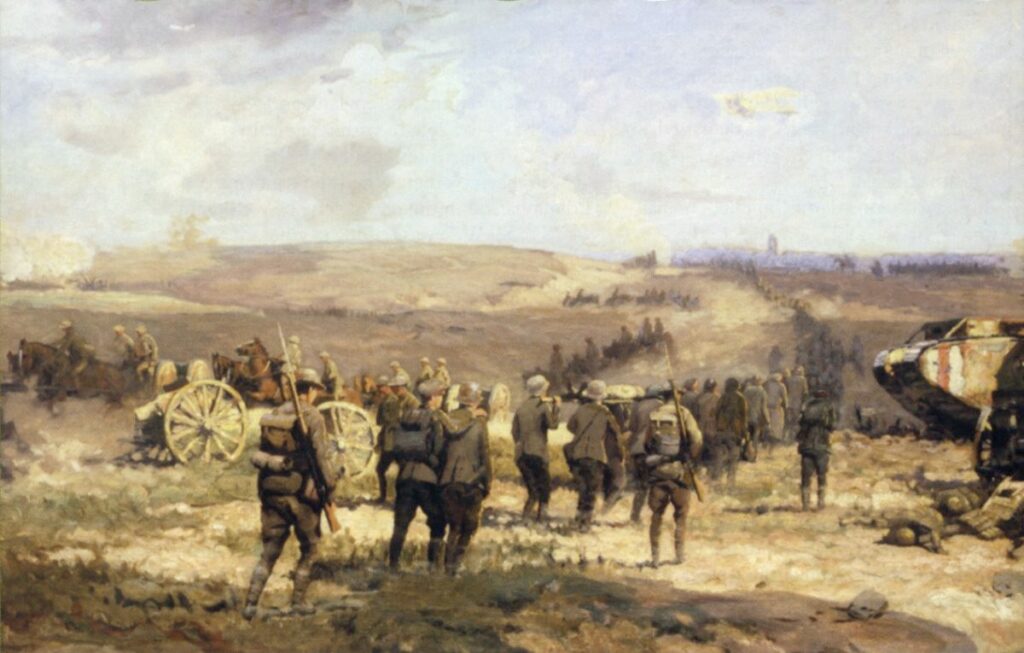
NATO’s former deputy supreme commander thinks the way out of Ukraine’s grinding war was invented in 1918.
Sir Richard Shirreff, now chief foreign military advisor to Ukraine’s Commander-in-Chief Oleksandr Syrskyi, told Euromaidan Press that the front today looks like the First World War before its final act: four years of attrition, trench lines, infantry machine-gunned for a few yards of no-man’s-land. The deadlock everyone now treats as permanent is, in his reading, exactly the deadlock of 1914–1917—and it broke.
NATO’s former second-in-command says what the alliance won’t: only Russia’s defeat ends the war
“Only after the innovation and revolution in military affairs in 1918 was a path carved through the German army,” Shirreff said. “For the first time you had aircraft, tanks, artillery, and infantry coordinated by rudimentary radios—joined-up warfare.”
That is the combined-arms breakthrough that produced the Hundred Days Offensive—the Allied advance that collapsed the German army in the war’s final months, after years in which the same army could not be moved. The leap was not a new weapon. It was the synthesis: air, armor, artillery, and infantry fighting as one system instead of four, tied together by the new technology of radio.
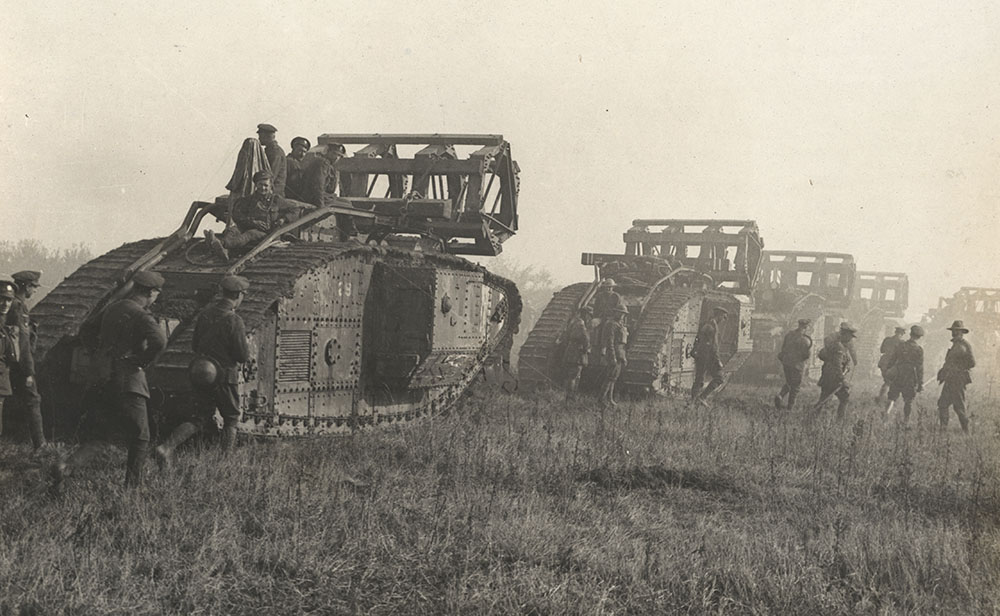
The difference it made was total. For three years the Western Front had swallowed a generation—the Somme alone cost more than a million casualties for gains measured in miles.
What changed in 1918 was not more men or bigger guns; it was that the pieces began to move together. Tanks breached the wire, artillery walked ahead of the infantry on a timed schedule, aircraft spotted the guns, and radio held the sequence in step. An army immovable for years came apart in weeks.
Shirreff’s argument is that Ukraine sits in the 1917 phase now—enormous mutual attrition, neither side able to convert battlefield success into a decisive break. Ukraine has already supplied part of the 1918 answer itself: deep-strike drones now reach more than a thousand kilometers into Russia, and its long-range campaign pins down a far larger army. Its engineers invent cheap, novel weapons for a battlefield nobody else in the world knows how to fight on.
What that innovation lacks is what 1918’s lacked until the Allies supplied it: funding, scale, the West’s technological edge, and integration into a system that turns invention into breakthrough.
This, he says, is where NATO could actually help—not with troops the North Atlantic Council will never sign off on, but by helping Ukraine “generate a big military idea,” the doctrinal synthesis the alliance spent decades building and Ukraine is now improvising under fire.
The historical rhyme carries a warning too. The 1918 breakthrough came only after four years of casualties that a decisive earlier synthesis might have spared. Shirreff’s point is that the pattern is available now—if the West chooses to help build it, rather than waiting for attrition to run its full course.
Shirreff lays out the full strategy—Sky Shield, the Article 5 guarantee for unoccupied Ukraine, and what a ceasefire “that means victory over Russia” would require—in our full interview.
About the Author
