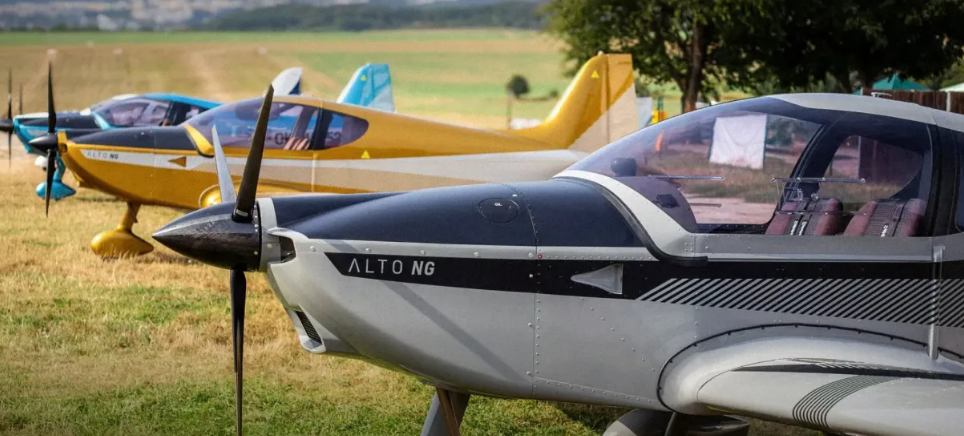
Ukraine has received 10 light planes to train its next fighter pilots at home. The Defense Forces took delivery of 10 ALTO NG trainers through the Air Force Capability Coalition, with five purchased directly by the Czech government and five paid for by Czech citizens through a crowdfunding charity, the Defense Ministry said.
Cheap, simple ALTO NGs let Ukraine stand up a flight school on its own soil, cut the price of a training hour far below that of a fighter, and reduce its dependence on foreign programs while moving pilots faster toward NATO-standard jets.
Charity buys other five
Five of the planes were given as a gift from the Czech public. The crowdfunding initiative Dárek pro Putina (“A Gift for Putin”) raised the money, the same group that has bought Ukraine six D-30 howitzers, a Black Hawk helicopter, 1,000 anti-tank launchers, and 10 tons of explosives.
Its pitch for the planes was blunt: Ukraine needs pilots, and they have to learn to fly on something.
Planes carry future pilots
The aircraft is powered by a Rotax 912 ULS engine, providing ample performance for its class.
Its maximum takeoff weight is 600 kg. The aircraft features a wingspan of 8.2 meters and a fuselage length of 6.3 meters. A 1.1-meter-wide cockpit offers sufficient space for both pilots to operate the aircraft comfortably.
The aircraft has a cruise speed of up to 180 km/h and a maximum speed of 260 km/h. Its fuel capacity is 92 liters.
Trainees will use it for basic and advanced flying, navigation, and NATO-standard takeoff and landing procedures, then the transition drills that lead to modern Western fighters, the ministry said.
“This approach significantly raises our pilots’ combat readiness and makes defending the sky simpler, more modern, and more effective,” it said.
Training pipeline still lags jets
Ukraine has fielded Western fighters faster than crews to fly them. It operates American F-16s and French Mirages, has begun training pilots on Swedish Gripens, and is working toward a fleet that could eventually include 150 of them.
A domestic basic-training base shortens the path to all of it and keeps inexperienced pilots out of scarce combat jets while they learn the fundamentals.
Read also
About the Author
