San Carlos is for you if you like: Quiet beaches, rugged mountains, swimming with cows
The first thing that will strike you about San Carlos is that it’s quiet. It’s a town with everything you’d want from Mexico’s glorious Pacific coastline, tucked away in the Gulf of California.
The Sonora beach town is not a destination of big crowds or big gestures, and that is part of its appeal: Midweek, you can still find long, quiet stretches of sand; calm, swimmable water for snorkeling and paddleboarding; and dark, starry nights that remind visitors this is a town framed by both desert and sea. For travelers willing to rent a car, slow down and let the days fall into a simple rhythm of beaches, viewpoints and small-town routines, this corner of Sonora offers a version of Mexico’s coast that feels approachable yet slightly off the well-worn track.
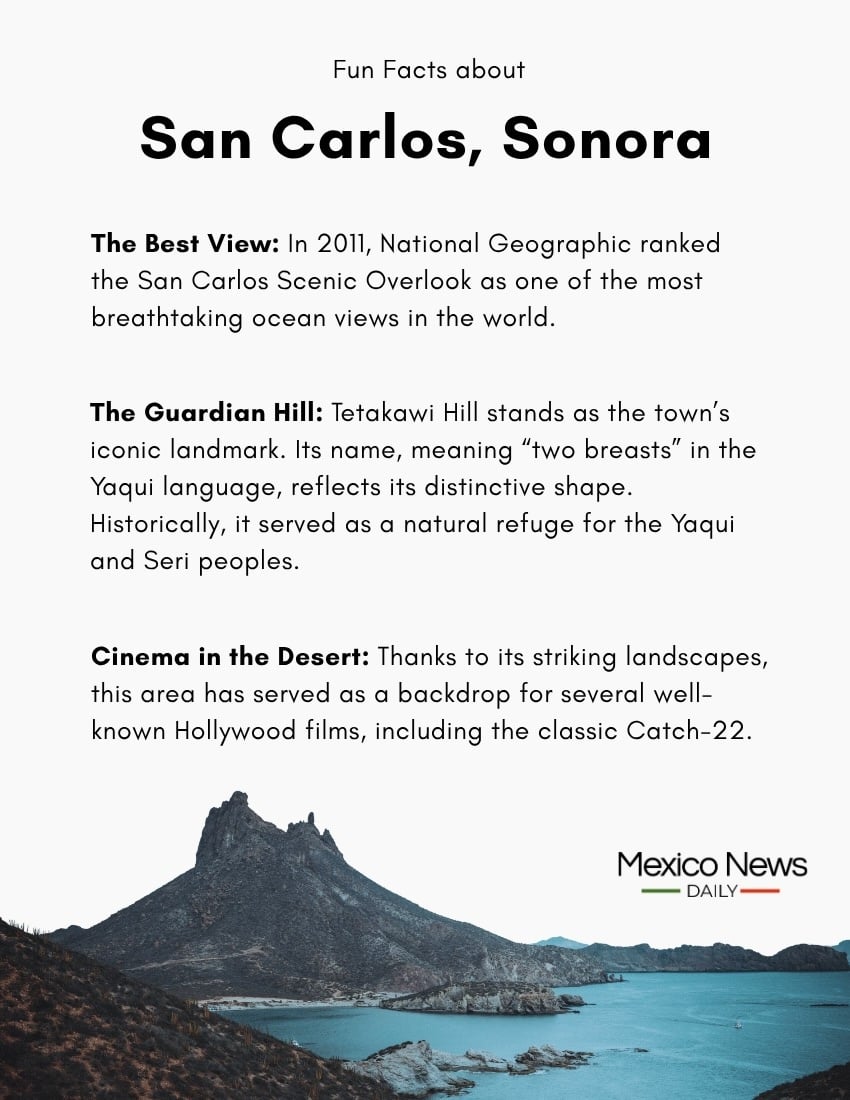

San Carlos works as a counterpoint to Mexico’s bigger beach hubs: a place where access through Hermosillo, a small inventory of rooms and rentals, and a marina-focused economy naturally cap the scale of tourism without sacrificing clear water, good seafood or time on the sea. Instead of promenades packed with bars and beach clubs, you get a quieter rhythm of boat trips, diving and early-evening malecón strolls, with visitors planning around seasons, opting for the milder shoulder months between summer heat and cooler winters rather than worrying about how to escape the crowds.
If you’re headed to the beach for the first time, veteran Mexico News Daily reporter Gaby Solís took a look at where to swim, what to do and the best food in town.
Sometimes, humans get a humbling reminder of who’s really in charge when a Sonoran sandstorm rears up out of the desert and rolls toward the Gulf of California like a moving mountain, swallowing condos, marinas and palm trees in a wall of dust. One minute it’s all blue sky and sunset cocktails; the next, the horizon disappears, the wind roars and you find yourself watching nature redraw the scene in sepia tones while you wait it out indoors.
For travelers, storms like this aren’t about drama or damage stats so much as perspective: In a place where cactus and tide line meet, your role is to step back and witness the show when it arrives. Come for the sailing and beach walks, but leave room in your San Carlos story for moments when the desert reminds the resort who was here first.
In 2019, just steps from the high-rise condos and palapa bars of San Carlos’ Playa Blanca, even the local livestock got in on beach life, as a viral webcam clip showed a lone cow ambling the shoreline and wading into the Gulf of California like any sunburned tourist in search of a cool-down. For visitors today, it’s a quirky snapshot of everyday Sonora that still rings true, in a town where beach days unfold at a leisurely pace and the line between postcard-perfect resort and working cattle country remains charmingly thin.
It’s exactly the kind of unscripted, low-key moment that captures San Carlos’ appeal: relaxed, a little rough around the edges and never taking itself too seriously, even when the internet briefly points its cameras this way.
Guaymas: the pearl of the Sea of Cortés where I surrendered my heart
Just 15 minutes across the bay from San Carlos, Guaymas comes across as a working port with a long memory, where desert and sea meet in a compact city shaped by Indigenous communities, Spanish colonization, pearl fishing, foreign incursions and Mexico’s early naval history. Walk the malecón and nearby plazas and you move past landmarks like El Pescador and the Plaza de los Tres Presidentes, reminders that this harbor has produced national figures as well as generations of fishermen.
Give it time and Guaymas also shows a quieter side: bays, estuaries and mangroves on the edge of town, views across to Teta Kawi and San Carlos, and everyday routines that still revolve more around the port than tourism. For visitors already familiar with Sonora’s beaches, it offers a grounded counterpoint — a place to connect the region’s landscape, history and contemporary life in one small, very local-feeling city.
Living with the great cats: protecting the jaguars of Mexico’s northern border
Just 250 kilometers east of San Carlos, travelers can swap beach chairs for the backroads of Sonora’s Sierra foothills, where the Northern Jaguar Reserve shelters some of the last wild jaguars along Mexico’s northern border. Base yourself in nearby ranch country, then join local conservation groups to see camera traps, birdlife, and “jaguar-friendly” cattle operations in action, for an easygoing, soft-adventure day that’s as appealing to curious nature lovers as it is to retired road-trippers.
A visit here isn’t about guaranteed big-cat sightings so much as stepping into a working landscape where ranchers, biologists and schoolkids are learning to live with predators again, trading old myths for trailcam images and practical coexistence. Travelers who come with patience and a light footprint are rewarded with expansive canyon views, star-filled nights and the rare satisfaction of knowing their tourism pesos help keep one of North America’s most elusive animals on the map.
How to get there
By air
Hermosillo: Less than two hours from San Carlos, Hermosillo International Airport connects the city with the entire region. Flights to all northern Mexican airports, plus Mexico City (both AICM and AIFA), Guadalajara, Cancún and Guadalajara mean getting here from almost anywhere in Mexico is extremely simple. For U.S. travelers, Hermosillo boasts a direct connection to Phoenix Sky Harbor, opening up ease of access from north of the border too.
Los Mochis: Los Mochis serves domestic routes from most major Mexico hubs, Mexico City, Guadalajara, Monterrey, San Jose del Cabo and Tijuana. For travelers in the region, it also serves several smaller airports, including La Paz, Creel, Mexicali and Chihuahua. Located 400 km (248 miles) from San Carlos, it is a five-hour scenic coastal drive.
By road
It is recommended to avoid driving at night in northern Mexico, although driving on toll roads and highways during daylight hours is considered safe.
Puerto Peñasco (Rocky Point): 549 km (341 miles), roughly a six-hour drive.
Nogales, Arizona: 424km (263 miles), roughly a five-hour drive.
Lukeville, Arizona: 572km (355 miles), roughly a six-and-a-half-hour drive.
Mexico News Daily
The post Discovering Mexico: San Carlos appeared first on Mexico News Daily
About the Author
