Defense Minister Mykhailo Fedorov said as a result of strikes on Russia’s logistics arteries, occupied Crimea will soon turn from a peninsula into an island, which would lead to “very unexpected consequences for the Russians.”
Fedorov didn’t elaborate on what those consequences would be, but there are several, each worse for Russia than the last. First, the Zaporizhzhia Oblast offensive could grind to even more of a crawl or stall out entirely, pushing Russia’s objective to get close to the regional capital by the end of summer out of reach.
“We will likely start to see these effects mature in the coming weeks if Ukraine sustains the current tempo,” of logistical attacks, said Christina Harward, the Russia deputy team lead at the Institute for the Study of War.
Second, holding on to occupied Kherson Oblast might become progressively harder. Ukraine forced the Russians to abandon the city of Kherson in 2022 after constant attacks on their logistics made holding the western bank of the Dnipro River untenable. A variation of this scenario may be in the cards.
In “Kherson Oblast and Crimea—yes,” Azov Corps’ press service responded when asked if a “Kherson 2.0” is possible. “While the administrative borders of the Crimean Peninsula do not fall directly within the operational zone of First Corps Azov, the logic governing transportation hubs there is identical.”
And third, if Crimea can be completely cut off, as Ukraine tried to do with land forces in 2023, it may force Russia to make a rough decision: continue pouring their efforts into conquering Donbas or redirect them to unblock the peninsula, a choice which may be forced by politics. Except this time, instead of stopping a ground assault with Surovikin lines, they’d have to do it with their dwindling air defenses and even less naval support.
“Crimea is the center of gravity of this war for the Russians,” said defense analyst Mykhailo Samus. “If they ignore the blockade, it could be an ideological collapse of the Putin regime from inside and a strategic fail on the front line.”
Cutting the tethers
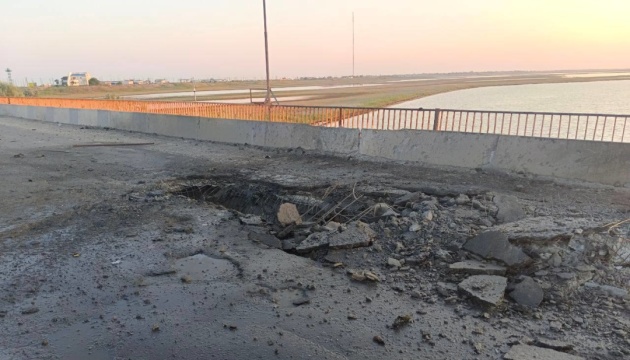
Ukraine has been striking major roadways across the South for months. More recently, bridges connecting Crimea to the mainland were heavily targeted, forcing occupation authorities to close them.
Repeated Ukrainian strikes against the Chonhar Bridge have rendered the bridge essentially unusable for traffic. Russia has been building pontoon bridges nearby, but Ukraine just started hitting those as well. This is the main route for moving ammunition and fuel to the Huliaipole direction in Zaporizhzhia Oblast.
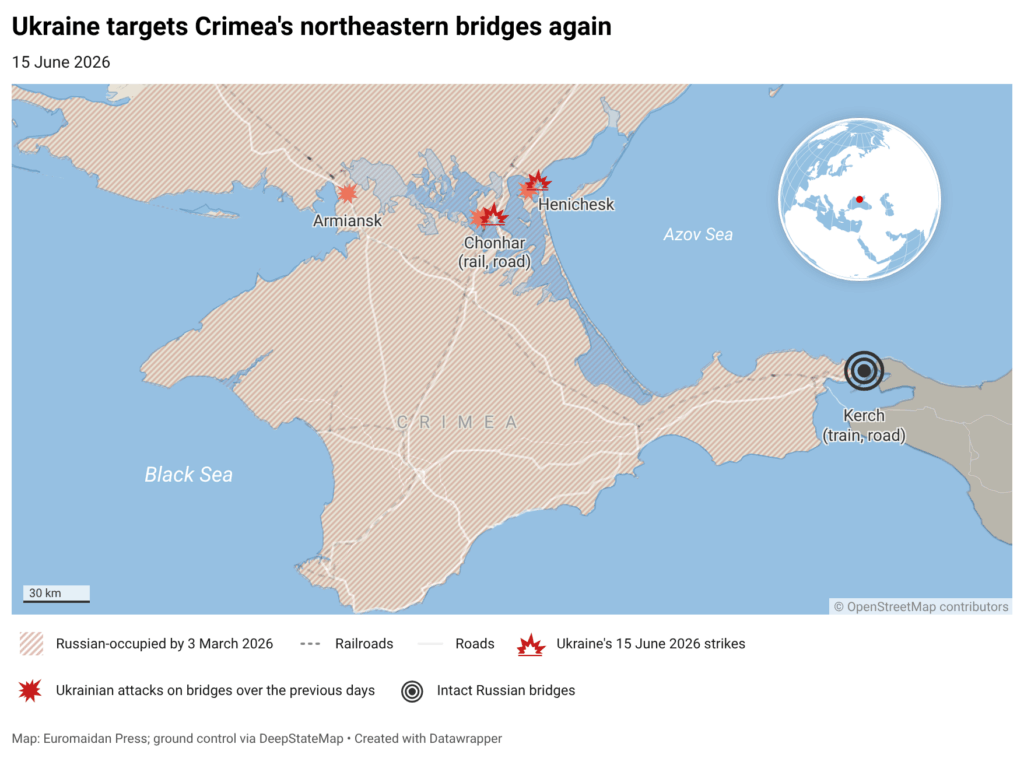
Ukrainian drones also struck the Henichesk–Arabat Spit crossing, four bridges near Armiansk, and the Dzhankoi checkpoint. Russian-installed officials said no intact bridges remained at the peninsula’s land entrances, with traffic rerouted, then halted again under repeated strikes. Multiple railways and locomotives in Crimea were also hit throughout June.
“The enemy’s attempts to reroute main supply flows around key bridges or main arteries are impossible both in theory and in practice, as no viable alternative routes exist,” the Azov Corps wrote.
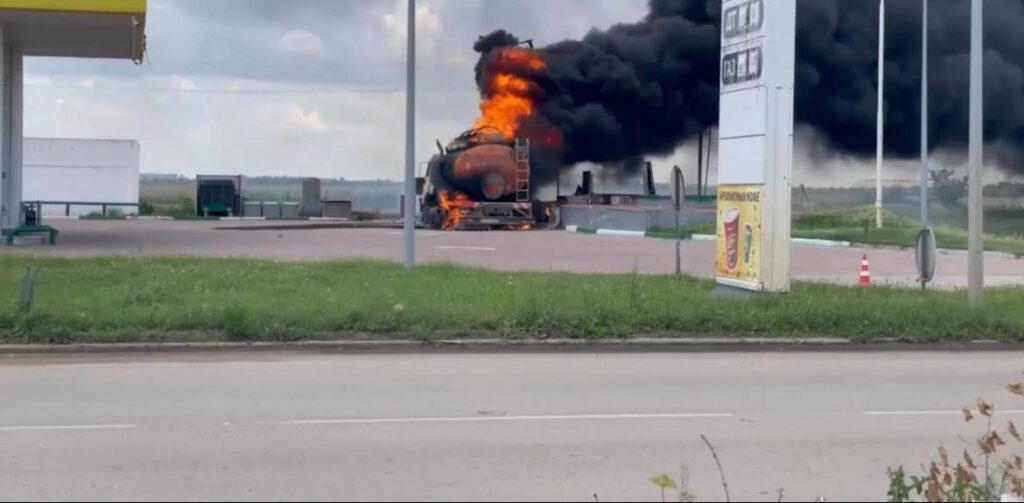
Attacks along major roadways are up as well. Robert “Magyar” Brovdi, commander of the Unmanned Systems Forces, wrote on 9 June that freight traffic plunged by 71% on the M-14 highway from Rostov into Ukraine. Russia’s occupation authorities closed the road to military traffic and Russian forces had to reroute to smaller roads along the coast.
Growing rate of attacks
The rate of Ukraine’s strikes is growing. OSINT analyst Clement Molin, relying on Ukrainian strike videos, found that around 10 trucks are being hit per day and videos went from three per week to nearly three per day. This estimate jives with Ukraine’s K-2 unit’s statistics, which recorded 258 strikes in April, 344 in May and 215 as of mid-June.
“Ukraine’s mid-range strike campaign is definitely growing,” Harward agreed. “We see reports daily about multiple Ukrainian strikes on a wide range of Russian military assets in the operational rear. This trend tells us that Ukraine is improving its technology, such as the range of its drones, and that Russia has not figured out effective countermeasures yet.”
Fedorov said that Ukraine has contracted 300% more mid-range attack drones in the first four months of 2026 than in all of 2025.
“Our middle-strike capabilities are expanding through increasing the number of trained crews, scaling the assets deployed in massed attacks, and achieving a significant technological breakthrough,” the Azov Corps wrote.
“New systems are already entering service whose capabilities the enemy is entirely unaware of. They have a substantially greater range and are equipped with next-generation communications systems.”
At the same time, Russia’s net monthly advances in Ukraine crashed. Fedorov and Ukraine’s commander-in-chief Oleksandr Syrskyi claimed that Ukraine managed to recapture 100 square kilometers more than Russia was able to conquer in May. ISW puts Ukraine’s net gains even higher, writing that Russia seized 40 square km but lost control of 280 square km last month.
Some analysts are more cautious: the OSINT analytics cooperative Black Bird Group estimated that Russia gained a net 82 square km in May, still a pittance compared to monthly net gains throughout 2025.
The Zaporizhzhia grind
Russian command has set an end-of-summer deadline to get as close to Zaporizhzhia as possible. They’re trying to advance simultaneously in several areas, especially near Orikhiv and Huliaipole, according to Vladislav Voloshyn, spokesman for the Defense Forces of Southern Ukraine.
For the time being, the intensity of Russian attacks with FPV drones and artillery has not slowed down on this part of the front, and airstrikes have only ramped up, he told Suspilne. In the active Stepnohirsk district, there are two to five combat clashes. However, that’s nothing compared to the Huliaipole direction where 40-45 engagements happen every day.
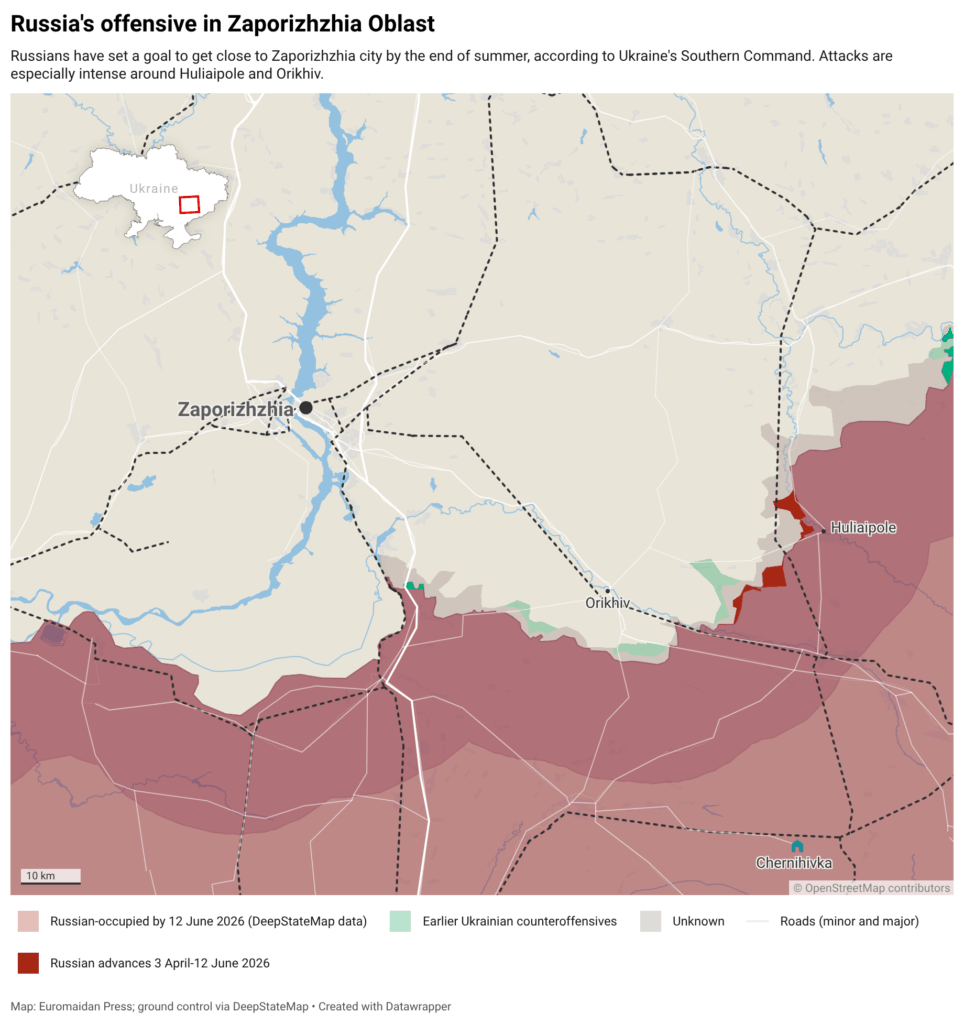
“The enemy here is trying to conduct assault operations in two areas. The first is in the area of the settlements of Charivne, Zaliznychne, and Huliaipilske,” Voloshyn said. “In addition, Russian troops are quite active around Dobropillia, Pryluky, and Varvarivka. Here they are eager to seize control of Ternuvate, Kosivtsevo, and Rizdvianka.”
In spite of all this, OSINT maps show barely any forward movement for the Russians, with Ukrainian counterattacks occasionally taking back small patches of ground. According to Voloshin, over the past two weeks, Russian troops have not had any significant successes in spite of their claims to the contrary.
“The strikes are likely preventing Russia from fully deploying forces to the frontline and from maintaining a high tempo of assaults in Zaporizhzhia Oblast,” Harward said.
Kherson: edge of a treacherous route
Russian forces in Kherson Oblast heavily depend on the Crimea route. The Dnepr grouping of forces, consisting of the 58th Combined Arms Army and elements of the 18th Combined Arms Army is the most affected by delays and interruptions.
According to Pasi Paironen, an analyst with the Black Bird Group, the 58th probably relies more on rail and road connections towards Mariupol and Rostov on Don but 18th is more directly affected by the situation in Crimea.
“Crimea is basically the direct support and supply area for the 18th combined arms army as they guard the Dnipro river bank in Kherson oblast,” he said.
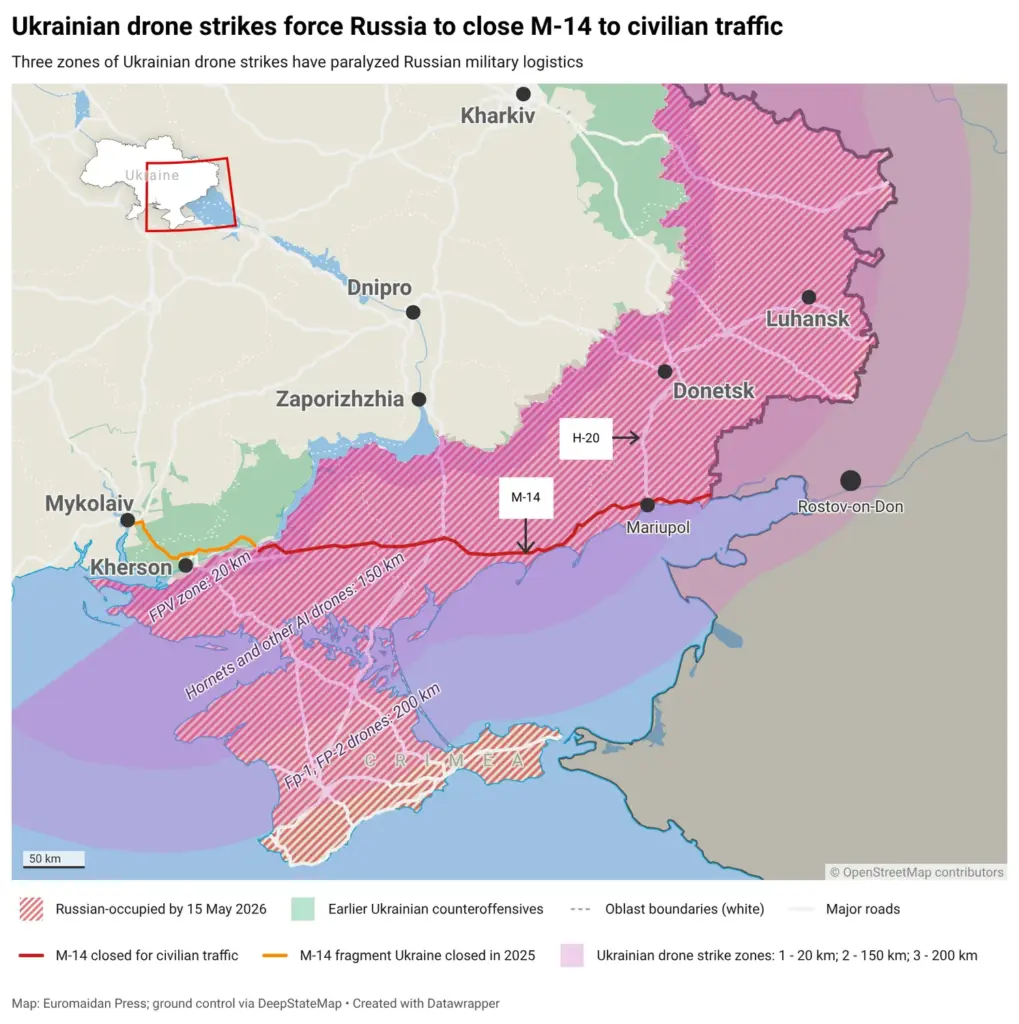
While both can rely somewhat on alternative routes, running along the coast of the Azov Sea, these routes are very long and vulnerable. The 18th sits at the very tip of this supply line. Still, its logistics needs are less pressing, as it is not actively trying to advance and gain ground. However, even standing guard requires uninterrupted lines of supply
“When enemy infantry holds positions or advances without critical support, it suffers catastrophic losses, and any assault attempts simply collapse,” the Azov Corps wrote.
“Without fuel, the mobility of heavy equipment and transport vehicles grinds to a halt. Without shells, artillery goes silent, FPV drone pilots have nothing to fly when there is simply no power to charge their equipment.”
Not enough tools to defend Crimea
If the Russians hope to do something about Crimea and supply lines on the mainland, they need to step up their game by destroying or disrupting Ukrainian attacks or seriously reducing their volume. So far, attempts have not been very successful, multiple sources say.
“Russian forces appear to be struggling to adapt and defend against the Ukrainian strikes,” Harward said. “Russian occupation authorities are reportedly having to independently take steps to increase the number of mobile air defense groups in occupied Crimea because the Russian Ministry of Defense’s responses have been so lacking.”
The Russians have been seen committing personnel to escort rear-area logistics and moving trained drone observers and EW equipment away from frontline areas to defend Russian logistics in the rear, which have not been enough to defend against the relentless attacks, according to the ISW.
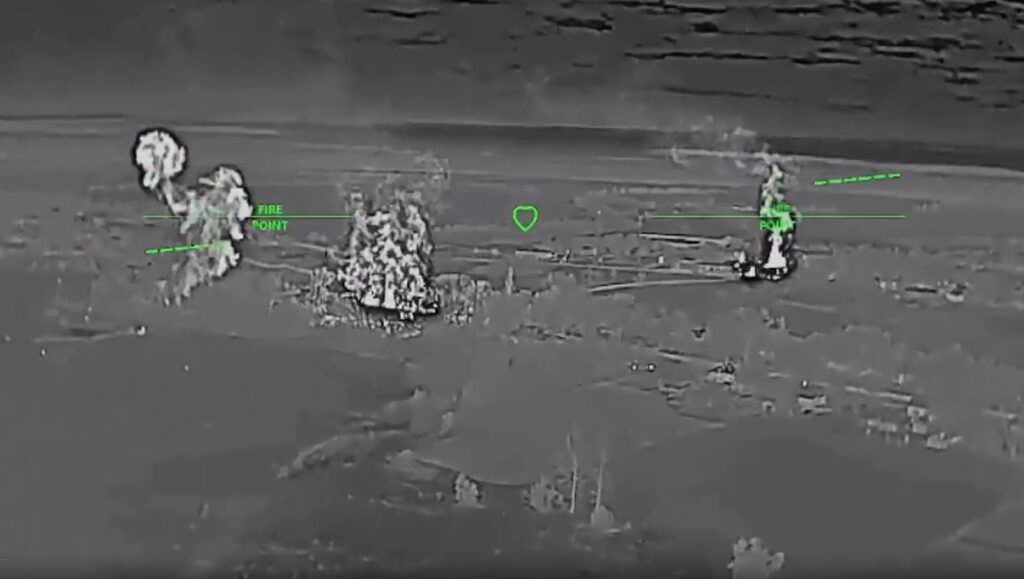
Several Ukrainian units said that more quixotic solutions, like painting trucks in dazzle camo to confuse AI targeting, or disguising their trucks as civilian vehicles, isn’t very effective either. “Our aerial reconnaissance documents the exact moment military green crates are loaded onto a ‘civilian’ vehicle at bases or depots on Russian territory. We track the target from there,” Azov wrote.
Air defense shortages are also a growing issue. “Because it’s a scarce resource, it’s very expensive, and even if they just throw a sack of dollars at the manufacturer, air defense won’t just materialize because there’s no microchip,” said callsign Charger, a company commander with the 413th Unmanned Systems Regiment “Raid,” whose unit specializes in hunting these systems.
“There is no device where you feed it money and it gives you a microchip that controls an anti-aircraft missile.”
Air defense is also required elsewhere. With the growing number of long-range strikes on Russian territory, Russia appears to have moved more air defenses to protect major cities like Moscow and St. Petersburg, the ISW said. Any such allocation leaves fewer defenses available in the combat zone.
“They’re now forced to deploy air defense systems less frequently. They’re losing the concept of layered air defense… so, they’re left with blind spots,” Charger said. “Now, thanks to our previous work, we’re reaching through these blind spots and striking soft, unprotected targets.”
About the Author
