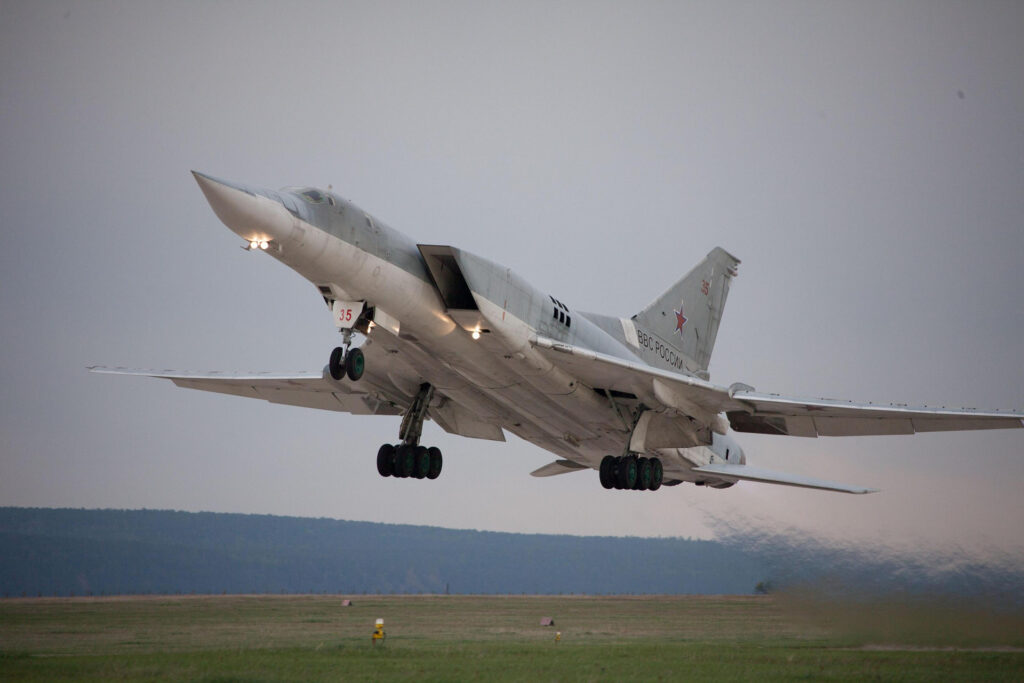
- A Russian air force Tu-22M bomber crashed in central Russia on or before Monday
- Russia has lost around 10% of its irreplaceable Tu-22Ms
- But it doesn’t take very many bombers to terrorize Ukraine
A Russian air force Tupolev Tu-22M Backfire bomber crashed in Irkutsk Oblast near Mongolia on or just before Monday. Dramatic videos from the ground depict the swing-wing bomber falling to the ground after apparently suffering some kind of mechanical malfunction near Belaya air force base, which hosts Russian long-range bombers.
The crash is a victory of sorts for Ukraine, as it labors to reduce Russia’s fleet of long-range bombers. The bombers routinely launch cruise missiles at Ukrainian cities as part of Russia’s wider campaign of terror targeting Ukrainian civilians.
But the Russian air force is adapting to the risks of Russia’s wider war in Ukraine faster than its most powerful warplanes—its roughly 115 bombers—crash or get shot down. It doesn’t take a lot of bombers to terrorize Ukraine. Especially as the Russians have learned new methods of maximizing the bombers’ firepower.
A fleet that can’t be rebuilt
The Russian air force went to war in Ukraine in February 2022 roughly 125 long-range bombers: 60 supersonic Tu-22M3s, 50 propeller-driven Tu-95MSs and around 15 Tu-160s. In 52 months of wider war, as many as 10 Tu-22Ms and nine Tu-95Ms have crashed, been shot down or been destroyed on the ground by Ukrainian drones.
Most incredibly, Ukrainian agents smuggled hundreds of tiny explosive drones deep into Russia as part of Operation Spider Web on 1 June 2025, striking multiple air bases including Belaya. Ukrainian and OSINT assessments put losses as high as four Tu-22Ms and eight Tu-95Ms; exact figures remain disputed.
The problem for the Russian air force is that neither the supersonic Tu-22M nor the subsonic Tu-95M is in production anymore, and reestablishing production lines is virtually impossible given the extreme high cost. The T-160M is in production, however, and the Russians have managed to add four of the supersonic bombers to the fleet since 2022.
The Tu-22M3 and Tu-95MS, which carry most of the cruise missiles Russia launches at Ukrainian cities, are no longer in production. The last Tu-22M3 rolled off the line in 1993; the NK-25 engines that power it have not been manufactured since 1996. Russia’s only active strategic-bomber pipeline, the Tu-160M program at Kazan, delivered just two aircraft to the armed forces in early 2026 after a four-aircraft 2025 target slipped, according to Defense Express. Even those Tu-160Ms are not a like-for-like replacement for the older bombers Russia is losing.
That means every Backfire or Bear Russia loses is, in effect, gone for good.
Why the math doesn’t help Ukraine enough
Every Tu-22M and Tu-95M the Russians lose is Tu-22M and Tu-95M it can’t replace. New Tu-160Ms arrive too slowly to make good losses related to the war in Ukraine, which have averaged one lost bomber every two or three months.
But a typical air strike targeting Ukrainian cities involves only a handful of bombers, each carrying several cruise missiles. That means the Russian bomber fleet is probably big enough to keep fighting for years to come—unless, of course, the Ukrainians can organize several more special operations in the vein of Operation Spider Web to take out a lot of bombers, quickly.
New tactics have helped the Russians leverage their slowly dwindling bomber fleet. Early in the wider war, Russian bombers launched several hundred Kh-22, Kh-101 and Kh-555 cruise missiles, explained analyst Justin Bronk from the Royal United Services Institute in London.

Early on, the bomber crew launched their cruise missiles alongside sea-launched Kalibr, ground-launched Iskander and air-launched Kinzhal missiles, “but not in a closely coordinated fashion,” Bronk noted. The scattered launches fed missiles just a few at a time at Ukrainian air defenses, making their job intercepting the Russian missiles conceptually simple if not always easy owing to a shortage of long-range surface-to-air missiles.
By 2025, Russian coordination had greatly improved, and Russia’s Geran one-way attack drones—Moscow’s localized version of Iran’s Shahed-136—had joined the bombardment campaign in huge numbers. Ukrainian air defense had improved, too, but shortage of the best long-range air-defense missiles persisted.
The sheer number of Gerans droning toward Ukrainian cities at the same time cruise and ballistic missiles streaked in made them all “far more difficult for Ukrainian air defences to intercept,” according to Bronk. He continued:
Continued improvements in Russian air defence reconnaissance and in last-minute route planning capabilities for missile and drone salvos also increase the challenge they pose for defences. Furthermore, Russian missiles have increasingly been equipped with improved electronic and physical countermeasures to degrade the effectiveness of air defence radars, and programmed for more effective terminal manoeuvring to further improve penetration against Patriot PAC-3 and other advanced air defences.
Maneuvering more deftly under better built-in protection, surrounded by hundreds of Gerans in every raid, the bomber-launched missiles are much more likely to reach their targets than they would be flying alone.
That means that just a few cruise missiles, launched by a few bombers, can greatly increase the destructive potential of a given raid. Where a Geran might pack a 90-kg warhead, the Kh-22 missile that the Tu-22M routinely carries packs a whopping 1,000-kg warhead.
Another Tu-22M3 lost to apparent engine failure deep inside Russia is still a win for Ukraine. But every Backfire that crashes, burns, or is shot down helps Ukraine less than the math suggests it should. The bombers Russia still has are hitting Ukrainian cities harder than the larger fleet ever did.
Russia can’t replace them—so it taught the survivors to hit harder instead.
About the Author
