FLORHAM PARK, N.J. — By the rules of football stats-keeping, David Bailey did not get a sack on the play.
Texas Tech’s defensive end did not register a takeaway.
The play-by-play in the game book does not credit Bailey with a quarterback hit.
But in the third quarter of Texas Tech’s playoff game against Oregon, as Dante Moore dropped back on fourth-and-2, Bailey charged toward left tackle Isaiah World and closed quickly on Moore.
The quarterback needed to get the ball out quickly before Bailey made him pay. So he threw up the middle of the field, toward his tight end. Texas Tech linebacker Ben Roberts jumped the route to secure the interception.
The Red Raiders would lose the game, their offense shut out. But against an expected 2027 first-round quarterback in Moore, Bailey was once again flashing.
“David Bailey about ripped him in half on that play,” Texas Tech defensive coordinator Shiel Wood told Yahoo Sports by phone this week. “He knew it was coming and he had to get rid of the football and I think he got sped up. …
“Even if he’s not the one per se knocking the ball out or stripping it out of the quarterback’s hands or whatever, he’s going to cause the football to be put in harm’s way. And it’s going to allow the guys around him to capitalize on it when it does.”
No team needs that this season more than the New York Jets.
Play 2026 Soccer Pick ‘Em with FOX One and make your picks for the world’s biggest soccer tournament
The Jets selected Bailey with the second overall pick of the 2026 NFL Draft amid needs at several premium positions including quarterback, pass rusher, receiver and secondary. Their most glaring — and, as players acknowledged this week, their most infamous — downfall in the 2025 NFL season was exiting the year without a single interception for their defense.
No team had failed to secure an interception since the NFL began tracking the stat in 1933. And the last team to record fewer takeaways than the Jets’ four in 2025 was the 1934 St. Louis Gunners, per Pro Football Reference … who played just three games as an independent team due to league membership controversies.
As with most football trends, context around injuries, luck and traded-away players (hello, All-Pros Quinnen Williams and Sauce Gardner) color the Jets’ story. But the zero nonetheless stands in the history books, a frustration motivating Jets decision-makers and players alike entering this season.
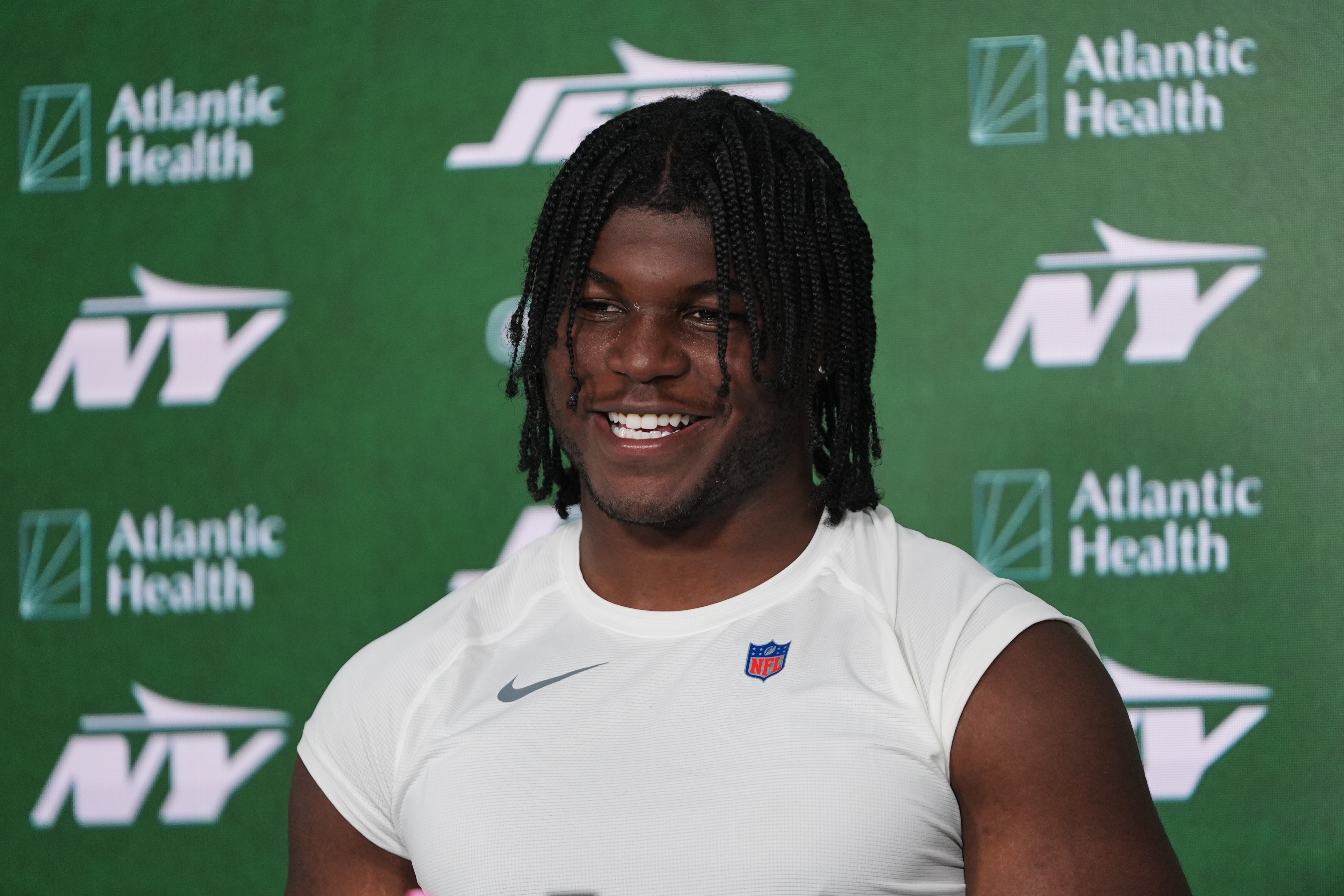
“All the guys kind of taking that personally, because that’s now a part of our names, you know what I mean?” cornerback Brandon Stephens said Wednesday. “And so, how do we want to rewrite the story after that?”
The Jets hope Bailey will contribute to the solution.
While the Jets’ secondary has undergone a makeover, a pass rush glow-up that begins with Bailey will influence their takeaway trends.
Bailey prefers to list off his teammates as reasons why improvements will come. But he’s willing to share in the responsibility.
“Obviously if we’re able to get a little bit of pressure on the quarterback, maybe it’s not always a sack, but if we can get him off his mark, we could help the coverage out and help them get interceptions,” Bailey told Yahoo Sports in a Wednesday interview. “It’s going to be a team effort.”
In one Tech season, Bailey led FBS in sacks
Perhaps it shouldn’t be surprising that Bailey transitioned so quickly and so effectively in his lone year at Tech after three seasons at Stanford.
Sure, Bailey was moving from a part-time role that transitioned him from an outside linebacker dropping in coverage on first and second down to an every-down defensive end rushing the passer. And sure, Bailey’s first-step quickness and well-tailored explosiveness drive his ability to out-leverage offensive tackles with speed from his 6-foot-3, 251-pound frame. (Bailey is essentially the same size as the 6-3, 250-pound Micah Parsons, another effective but undersized rusher compared to heftier edge players like the 6-4, 272-pound Myles Garrett).
But also: Bailey has an unusually refined set of study habits for a 22-year-old in football or any industry. He’s already made his own Quizlet digital flashcards for his Jets responsibilities, a second layer of his learning process to complement his tendency to “bucket” or categorize plays in a defensive system as he learns them conceptually and creates connections.
“I use play call as the term and then I’ll have my responsibility as the [definition],” Bailey said. “I’ll see it, and I’ll be like, ‘OK, what do I do?’ And then I’ll go through my responsibilities, flip the card and then see if I get it.”
At Tech, he got it. The Red Raiders’ staff wanted to pare down their edge rusher’s responsibilities to ensure he could play quickly and maximize his production. They weren’t concerned that he couldn’t drop into coverage, but they also couldn’t fathom why they’d sacrifice his quarterback-pressuring potential to drop him on any regular basis.
Bailey dropped into coverage just once all season, on a third-down simulated pressure vs. Oregon, Wood said.
As an every-down rusher, his 14.5 sacks led the FBS last year — and tied his combined three-year sack mark at Stanford.
In all, Bailey finished his season with 52 tackles, 19.5 tackles for loss, three pass deflections, three forced fumbles and a fumble recovery.
His pressure helped Texas Tech to the opposite luck of the Jets last year: The Red Raiders led all FBS teams with 32 takeaways.
Can Bailey bring some of that trend with him to New Jersey?
“You put pressure on the quarterback and we talk about tips and overthrows, we got to have them,” Jets defensive line coach Karl Dunbar told Yahoo Sports. “And if you can get the quarterback off his mark, you got a chance for some of them errant throws from quarterbacks.”
Stephens said the secondary recognizes their role in helping the pass rush, too.
“Everything works hand in hand,” he said. “If we don’t do our jobs in the back end, the d-line can’t eat, they can’t get their sacks, they can’t do what they get paid to do.”
Transitioning to pro, Bailey knows which mistakes he can’t afford anymore
Takeaways were not the Jets’ only defensive weakness last season.
The Jets’ 26 sacks ranked second-worst in the league as did their 30 quarterback knockdowns (consider the Super Bowl-winning Seahawks had 80). No team had fewer quarterback pressures (87) or quarterback hurries (31) than the Jets.
The Jets ranked second-worst allowing 29.6 points per game and seventh-worst allowing 355.6 yards per game.
After drafting Bailey second overall, the franchise wants him to suit up as an outside linebacker in its 3-4 base defense and a defensive end when the Jets move to four-man front packages.
“It’s a little bit of a different role than I played at Tech,” Bailey said. “I’d say fairly similar to what I played at Stanford in terms of that SAM [strong-side linebacker] position. And then at Stanford, third down I was coming into that box playing a true end, basically what I’m playing during that nickel.”
Expect Bailey to move from across the line of scrimmage and between rushes, blitzes and coverage. At Tech, he rushed from both the right and left edges. The Jets value that versatility, Dunbar referencing his Steelers days coaching Cam Heyward and T.J. Watt to move across the line.
“That’ll make him a more potent player and the offense can’t just say, ‘Well, he’s always going to be here and you got to do this and do this,’” Dunbar said. “Pick your poison.”
While Bailey’s continuing to hone his explosiveness, he and the Jets view his eye discipline as a key area for growth. The Jets’ defense will require him to think more than Tech’s did. NFL offenses tend to throw more gimmicks and disguises at defenders than those of college. Bailey said Jets veterans have offered tips on hand placement and step efficiency during the OTA portion of the NFL offseason that limits physicality and contact. Bailey’s twitch and athleticism are already standing out even as strength tests will come more when training camp brings pads.
Then will come the need to hone in on block destruction and run-defense principles that Wood says were new to Bailey upon arrival at Tech but soon became more comfortable. Leverage and toughness at the point of attack improved over his season at Tech, Wood said. Integrating those with mental cues will be a 2026 challenge.
“Obviously now I’m on the next level, people are a lot faster, more physical, smarter,” Bailey said. “So maybe some of the things that I got away with in college in terms of looking in the backfield or trying to process more than what I need to be processing, sometimes maybe I got away with that. But now I’m playing with professionals so obviously I can’t be making those mistakes or taking those risks.”
Flashcards should help. Stern coaches unafraid to press Bailey on growth areas could, too.
“This is the time you want to work on some things that you might not feel comfortable with,” Jets head coach Aaron Glenn said Wednesday. “So he’s working on some of his weaknesses but you do see the strong points of what he has and I don’t ever want him to lose sight of that …
“Man, let’s make sure we use that speed rush that you have, but also understand that you can rush with power and you have a spin move that can be pretty deadly in [your] arsenal.”
Before long, perhaps, the pressure will help the Jets to an interception.
About the Author
