The U.S. Department of Agriculture (USDA) this week confirmed the presence of a New World screwworm (NWS) in Zavala County, Texas.
The report comes just five days after the USDA announced that a parasitic fly was found in a young sheep in the Mexican state of Coahuila within 31 miles (50 km) of the U.S. border.
🚨 With the recent detection of New World screwworm in a 3-week-old bovine in Zavala County, TX, USDA urges residents to contact your veterinarian right away if you see any suspicious wounds, maggots, or infestations in your animals or herd.
If you see signs of maggot… pic.twitter.com/lxxsjIgDcb
— Dept. of Agriculture (@USDA) June 4, 2026
Until this week, that was the closest the parasite had come to the U.S. during the ongoing outbreak, which has been steadily tracking north from Central America and through Mexico for more than a year despite a sprawling effort by USDA and Mexico to contain the pest.

In a statement released on Wednesday, the USDA said the affected animal in Texas is a 3-week-old calf and larvae were identified in its umbilical area.
If the fly enters the U.S., record beef prices could surge higher since more calves would be kept out of the U.S. cattle supply. The USDA estimates that an outbreak could cause billions of dollars in damage to the U.S. economy and Texas — the biggest U.S. cattle-producing state — could suffer economic losses of US $1.8 billion.
“The United States has defeated this pest before, and we will do it again,” said Dudley Hoskins, a USDA official, adding that “USDA invested heavily in the tools needed to eliminate NWS ever since cases started increasing in Central America and Mexico.”
NWS is a species of parasitic blowfly whose larvae burrow into open wounds and eat the living tissue of warm-blooded animals, eventually killing their host if left untreated.
The U.S. has thrice suspended cattle imports from Mexico over the past 18 months in an effort to keep screwworm south of the border.
The infestation — eradicated in Mexico since 1991 (the U.S. eradicated NWS in the 1960s) — resurfaced in summer 2024, and has posed a significant challenge for authorities. Pets, wild animals and humans can also be affected.
Mexico’s Health Ministry (SSA) said there have been more than 350 cases of human infestation across Mexico, with Chiapas being the most affected state (131 cases).
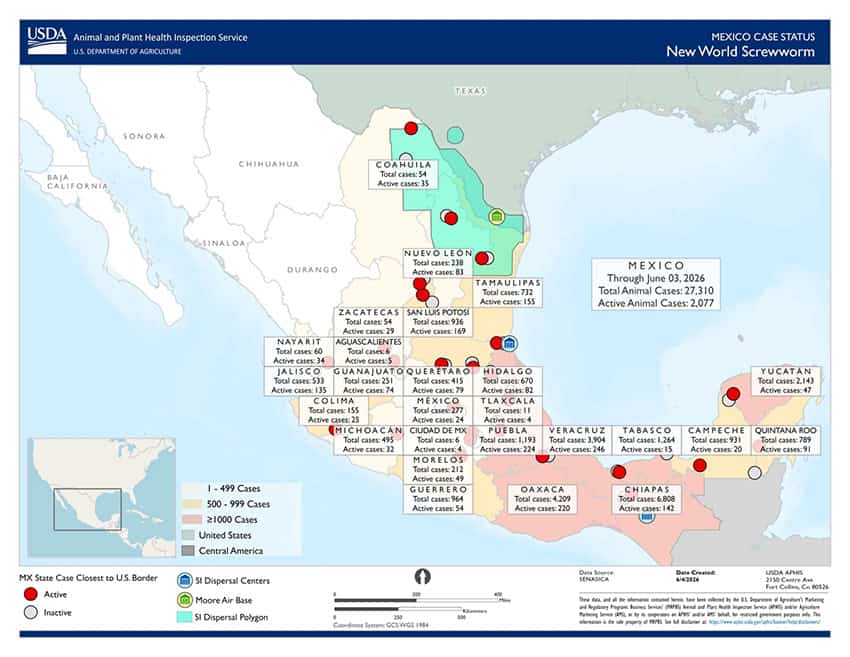
On May 27, SSA reported the first case of NWS infestation in humans in Mexico City and this week it reported the first case of screwworm myiasis in a human in Nuevo León.
As hosts of the upcoming World Cup, both Mexico City and Nuevo León are expecting millions of visitors in this month and next.
SSA has recommended using protective clothing, such as long sleeves and pants, when visiting the countryside or near animals, as well as using authorized repellents on skin and clothing to prevent the presence of flies.”
With reports from Reuters, El Financiero, El País and Univision
The post Screwworm parasite arrives at the US border, with new cases in Coahuila and Texas appeared first on Mexico News Daily
About the Author
