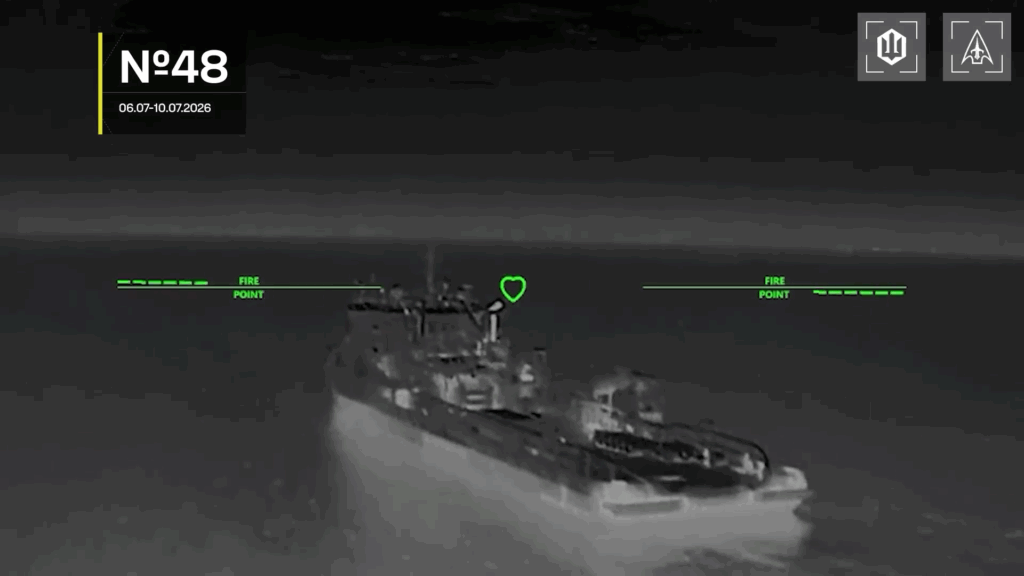
Ukraine’s Unmanned Systems Forces say they have struck 48 Russian vessels over the past five days as part of an expanding campaign against the maritime logistics supporting Moscow’s invasion and occupation forces in Crimea.
The campaign has increasingly targeted tankers, cargo ships, ferries, and other vessels that Ukraine says transport fuel and military supplies sustaining Russian forces after repeated strikes degraded road and rail supply routes to the occupied peninsula.
Campaign targets Russia’s shadow fleet in Azov Sea
According to the Unmanned Systems Forces, Ukrainian drone operators struck 13 vessels in the Sea of Azov on 10 July alone – 10 tankers, one dry cargo ship, one ferry, and one tug.
The force said the targeted ships belonged to Russia’s sanctioned “shadow fleet.” Russia’s shadow fleet is a network of vessels used to evade Western sanctions on Russian oil exports. Ukraine says some of the ships are also used to transport fuel and supplies supporting Moscow’s military operations.
It also reported striking 41 military targets in occupied Crimea and southern occupied Ukraine overnight, while drone operators hit another 1,660 Russian targets along the front line, including 426 personnel.
Maritime logistics campaign expands
The reported strikes come as Ukraine intensifies its campaign against Russia’s maritime logistics in the Sea of Azov. After months of attacks on the road and rail routes supplying occupied Crimea, Ukrainian forces have increasingly targeted the seaborne fuel network that supports Russian forces on the occupied peninsula.
The announcement updates earlier reports from Ukraine’s Unmanned Systems Forces, which had reported striking 15 vessels on 9 July and a further 12 ships by mid-day on 10 July as the campaign unfolded.
The Institute for the Study of War recently assessed that the campaign marks a new phase in Ukraine’s effort to isolate occupied Crimea by adapting to Russia’s increased reliance on fuel shipments by sea.
Earlier this week, Ukraine’s Unmanned Systems Forces reported striking 35 Russian vessels over four days before announcing additional attacks on another dozen ships.
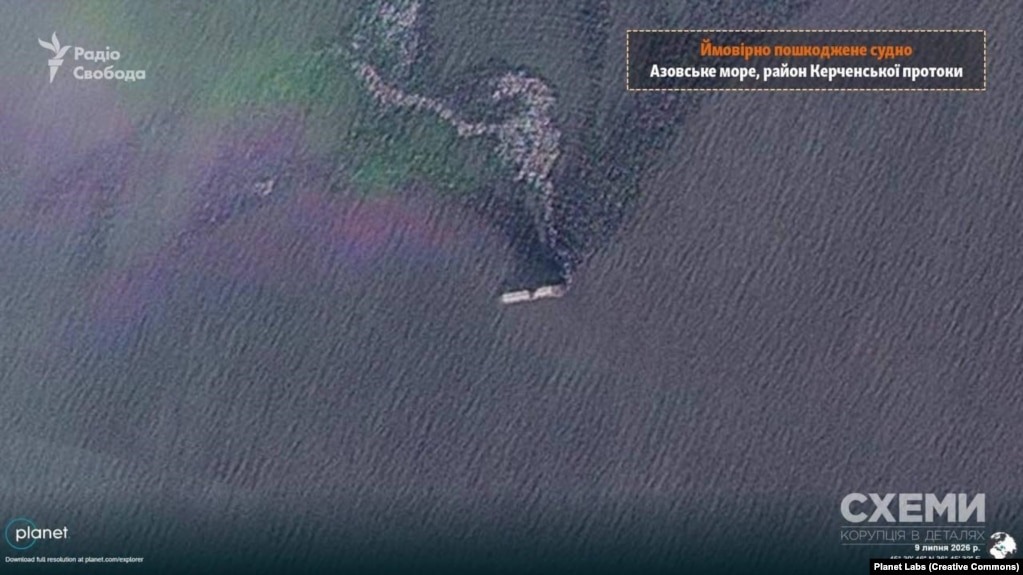
Earlier on 10 July, satellite imagery published by RFE/RL’s Skhemy showed a burning tanker and another apparently damaged vessel near the Kerch Strait, while open-source analysts reported that Russian tanker traffic in the Sea of Azov had declined sharply as strikes intensified.
Oil infrastructure also targeted
Alongside the reported attacks on Russian vessels, the General Staff of Ukraine’s Armed Forces confirmed that Ukrainian forces again struck the Ilsky oil refinery in Russia’s Krasnodar Krai. Explosions followed by a fire were reported at the facility, with the extent of the damage still being assessed.
The Ilsky refinery is one of southern Russia’s largest oil processing plants, with an annual capacity of up to 6.6 million tons. It produces gasoline, diesel fuel, and other petroleum products that Ukraine says are used to support Russian military logistics.
Ukraine also reported strikes on the Kurgannefteprodukt oil terminal in Taganrog and the Azovnefteprodukt fuel depot in Azov, both in Rostov Oblast. Fires, explosions, and smoke were reported at the facilities, which the General Staff said are used to receive, store, and distribute fuel for the Russian military.
Long-range strikes continue
The General Staff also reported another strike on NOVATEK’s Ust-Luga gas condensate processing complex in Russia’s Leningrad Oblast, one of the country’s largest facilities for processing gas condensate into petroleum products.
In occupied Zaporizhzhia Oblast, Ukrainian forces also reportedly struck a Russian fuel and lubricants depot near Rozivka.
The General Staff said assessments of the reported strikes are ongoing and that Ukraine will continue targeting infrastructure supporting Russia’s military operations.
About the Author
