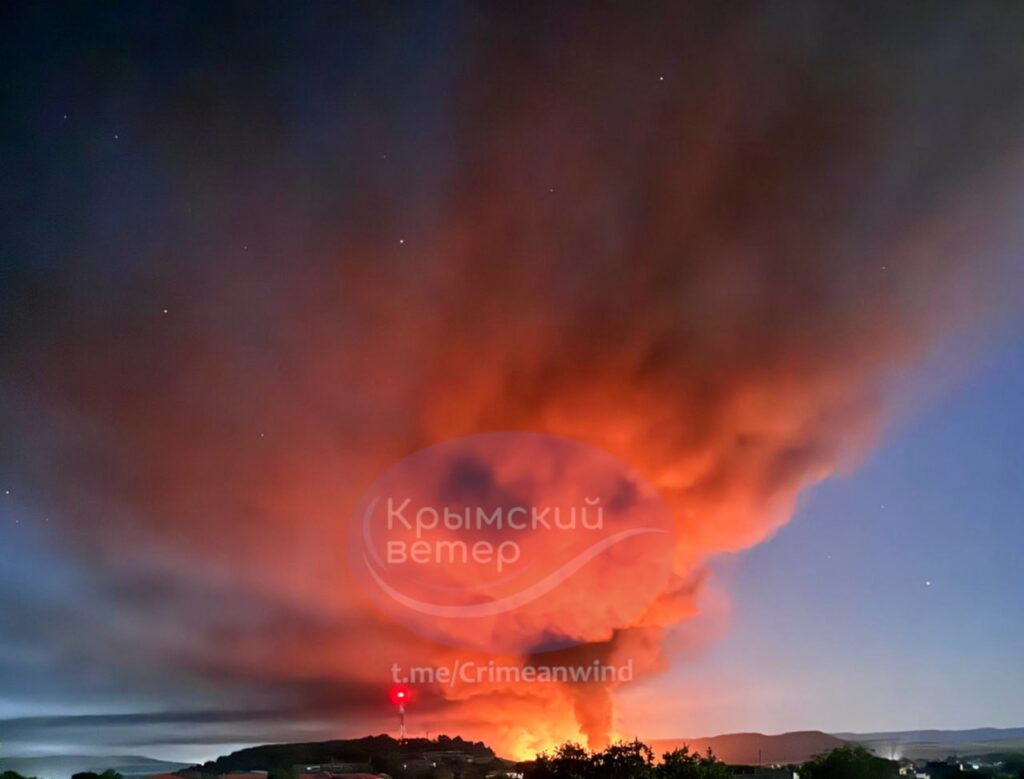
Fires broke out at several power substations across occupied Crimea early on 3 July, monitors reported, in what they assessed as another probable overnight strike — including a repeat hit on a major node still under reconstruction and a critical 110 kV hub that left the town of Staryi Krym without power. Thermal signatures appeared around 02:00 at the Bilohirsk substation, with further fires recorded at Marianivka and Staryi Krym, the Crimean Wind monitoring group reported, citing satellite imagery.
The fires extend a campaign that is doing more than switching off the lights: each strike lands on a grid that cannot be properly rebuilt. Crimea’s power plants run on gas piped from the Russian mainland and on Siemens turbines that Western sanctions have left beyond proper repair, so damage from one attack compounds the next. Marianivka makes the point — the 220/35/10 kV node has been undergoing reconstruction since 2024, its old 20 MVA transformers being swapped for 40 MVA units, and it has now burned twice in a week, the first fire recorded on the night of 29 June.
What burned overnight
The Bilohirsk substation feeds the town, surrounding settlements, and industrial users including a greenhouse complex. At Staryi Krym, residents reported a complete loss of power after a series of explosions; monitors call it a key 110 kV distribution hub for the eastern peninsula. Satellite data also pointed to a fire at the Saky substation, though Crimean Wind cautioned that thermal readings there vary and the fire is not yet confirmed. Occupation authorities had not commented on the energy damage as of the reports, and have blamed earlier outages on “technical disruptions” in the grid.
The disruption reached civilians beyond the blackout: occupation authorities suspended commuter trains to Yevpatoria and Dzhankoi.
A grid absorbing hit after hit
Friday’s fires follow the heaviest 48 hours of the campaign so far. Ukraine’s Unmanned Systems Forces said their units disabled 12 substations and a gas distribution station across occupied territory on 1–2 July, most of them in Crimea. “Moscow will fall,” commander Robert “Madyar” Brovdi wrote alongside the target list. Ukraine has not claimed responsibility for the specific fires reported overnight into 3 July.
Isolating the peninsula
Kyiv’s navy has described the effort as a multi-year operation to sever Crimea’s logistics, and the past two weeks show its shape: strikes on fuel depots, rail crossings, and air defenses alongside the substations. Occupation utility Krymenergo halted supply across parts of Crimea on 25 June; a day later, authorities declared a peninsula-wide state of emergency. Through June they shut children’s summer camps, suspended civilian fuel sales, and imposed rolling blackouts. Before Russia’s 2014 annexation, the peninsula drew more than 80% of its electricity from mainland Ukraine — the grid Moscow built to replace that link is the one now catching fire.
About the Author
