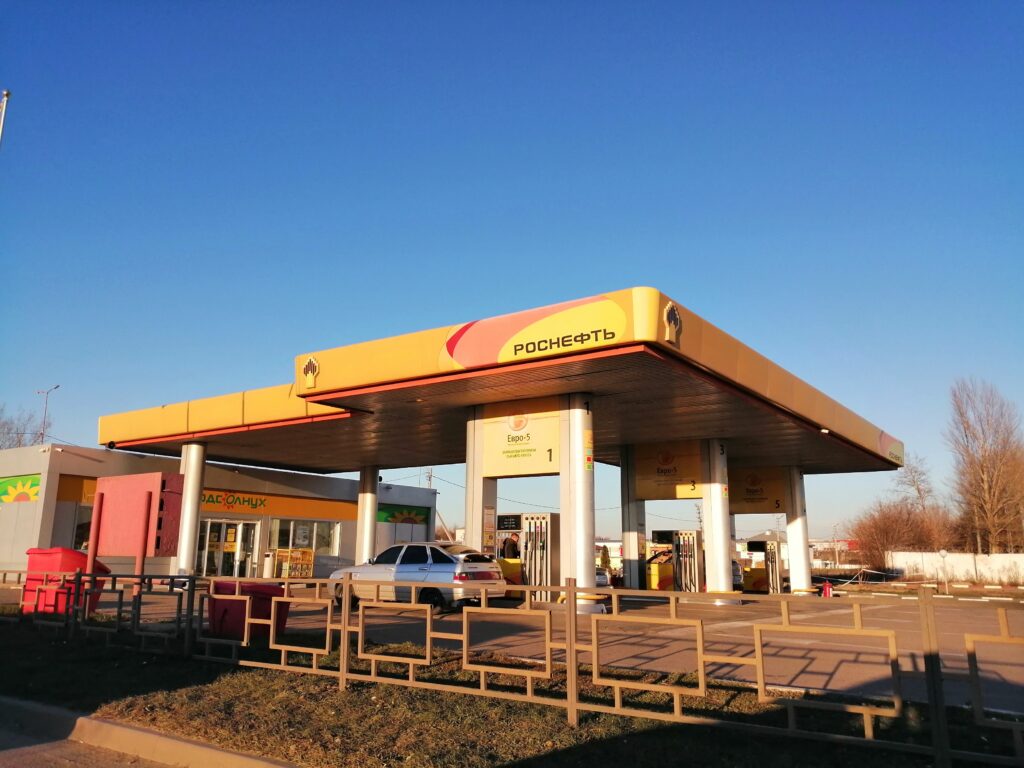
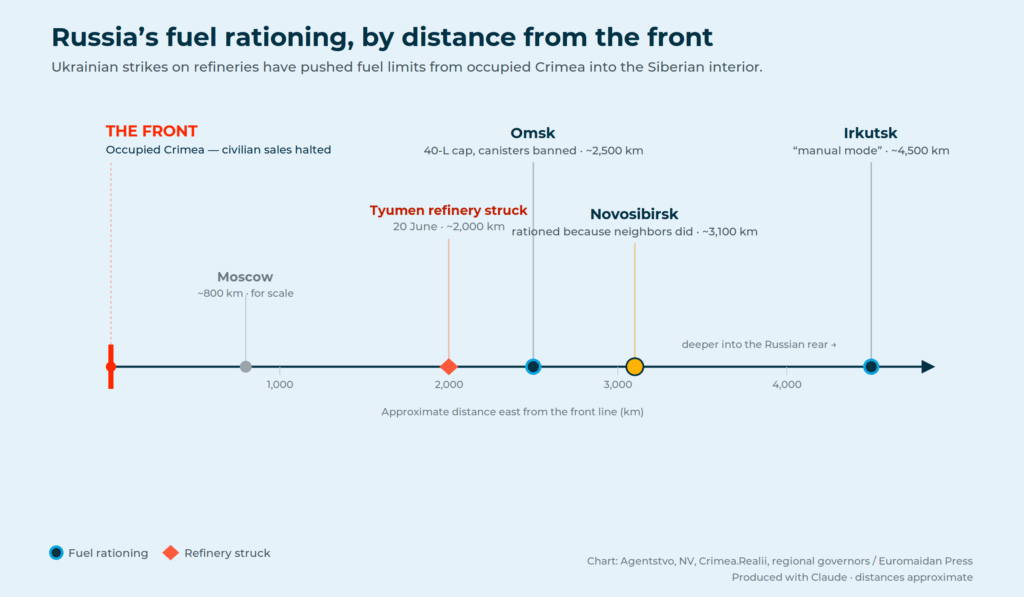
Russia started rationing gasoline in Siberia this week, carrying a fuel crisis driven by Ukrainian strikes into the country’s heartland, thousands of kilometers from the front. Omsk and Irkutsk restricted fuel sales on 22 June, and Novosibirsk signaled it would follow.
The fuel shortage is now jumping from one region to the next, not only where the strikes land.
Novosibirsk had no shortage of its own, Governor Andrei Travnikov said. Yet on 23 June he announced the region would restrict sales because its neighbors already had—the shortage now jumping from one region to the next, not only where the strikes land. It started in Russia’s southern and border regions and occupied Crimea, the product of a Ukrainian drone campaign against refineries and fuel logistics.
From the border to the heartland
By mid-June, the limits had gone national. Chains operating at least 7,000 of Russia’s roughly 29,000 gas stations—about one in four—had capped sales, analysis by the independent Russian outlet Agentstvo found.
Omsk’s governor, Vitaly Khotsenko, banned canister filling and capped purchases at 40 liters of gasoline per car, casting the curbs as a stand against “artificial hype” and “speculation.”
By 20 June, a station in the Novosibirsk region’s Chanovsky district had hit 99 rubles ($1.33) a liter.
Irkutsk went further, switching to what its governor, Igor Kobzev, described as a “manual mode” in which authorities set fuel volumes “for each recipient individually.”
In Novosibirsk, officials reported stable reserves, no queues, and a 0.3 percent rise in gasoline prices in May. By 20 June, a station in the region’s Chanovsky district had hit 99 rubles ($1.33) a liter.
Occupied Crimea runs dry
Crimea has gone furthest. From the morning of 21 June, Russian-installed authorities halted all fuel sales to individuals and businesses—by cash, card, or coupon—keeping what was left for, in the words of Crimea’s Russian-installed head, Sergey Aksyonov, “the state services that ensure the functioning and security of the Republic of Crimea.” He asked residents to “remain calm and trust only official sources.”
The administration suspended children’s summer camps and tourist stays for minors until 1 September.
The next day, his administration suspended children’s summer camps and tourist stays for minors until 1 September, citing “public safety,” while repeated overnight strikes knocked out power across much of the peninsula.
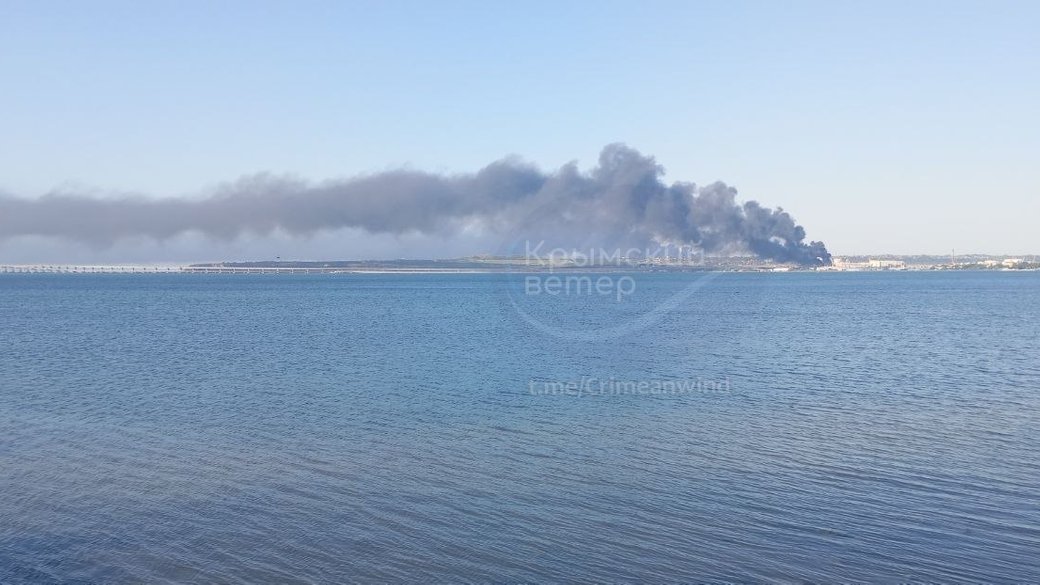
The fuel blockade tightens: Kerch struck again, power knocked out across occupied Crimea
The strikes behind the crunch
By April, with strikes forcing major plants offline, Russian refinery runs had fallen to their lowest level since 2009, and the campaign has reached deep into the country—drones struck a Tyumen refinery some 2,000 kilometers from Ukraine on 20 June.
The cumulative damage has pushed Russia, one of the world’s largest oil exporters, to import gasoline by sea.
About the Author
