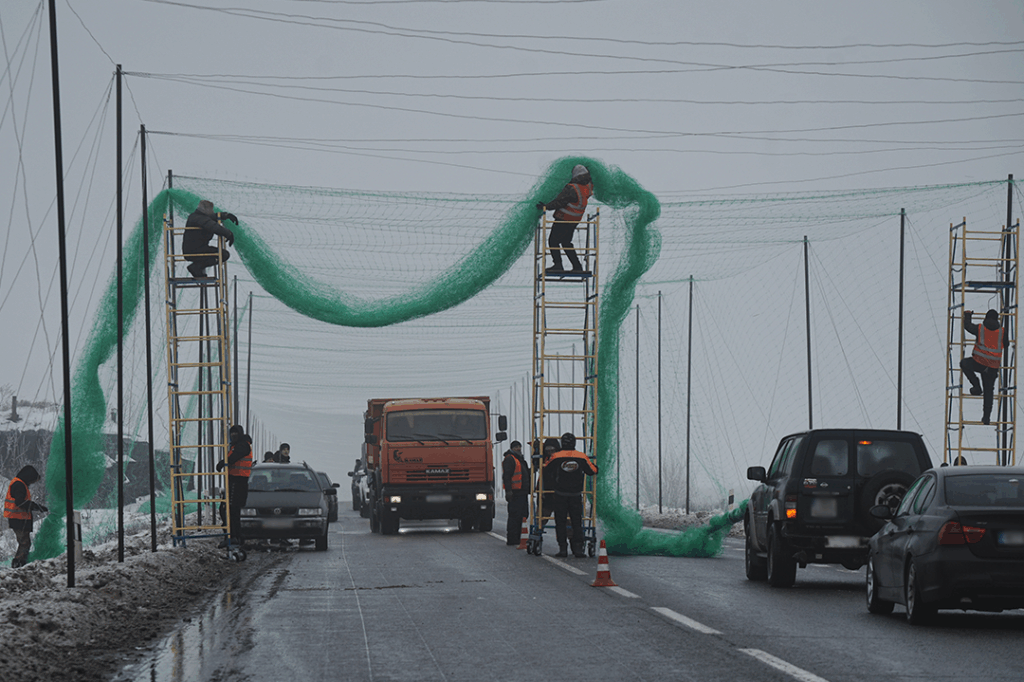
Ukraine has built more than 887 kilometers of anti-drone road protection across front-line oblasts since the start of 2026, with 207 kilometers in Kherson Oblast alone, the Ministry of Defense announces. The service’s daily build rate has more than doubled from 4 kilometers in 2025 to 9.2 kilometers in 2026.
Russian FPV and reconnaissance drones hunting Ukrainian vehicles within 15 to 30 kilometers of the front have forced Ukraine to build permanent national infrastructure for drone-protected movement on its own side of the line.
More than 600 kilometers of additional anti-drone corridors are now being deployed across Donetsk, Kharkiv, Dnipropetrovsk, and Sumy oblasts, the Defense Ministry says. Between May and June 2026, the State Special Transport Service also restored more than 198 kilometers of front-line roads alongside the protective deployments.
In the right-bank part of Kherson Oblast, following Ukraine’s 2022 de-occupation, the service restored 13 bridge crossings essential for regional defense and civilian life.
Kherson Oblast carries highest share
Anti-drone netting in Kherson Oblast costs roughly $40,000 per kilometer, regional official Olha Maliarchuk said, per Most.ks.ua. Russian forces use between 2,500 and 2,700 drones in Kherson Oblast each week, head of the Kherson Regional Military Administration Oleksandr Prokudin told the same outlet.
Oleksandr Tolokonnikov, the regional administration’s deputy head, said it is impossible to cover all of Kherson with anti-drone nets in a short time, given the scale of the work and the conditions under which it is being done. The 207 kilometers already installed cover the most exposed sections between communities and inside Kherson city itself, the Defense Ministry said.
Russian drones force a permanent national response
Russian forces are “actively using FPV drones to attack transport and civilian vehicles,” Fedorov said in April. The protective structures take the form of overhead netting tunnels, wire-mesh canopies, and reinforced barriers along road sections within reach of Russian FPV operators.
“Every protected kilometer of road means lives saved, a safe supply of units, and the evacuation of the wounded,” the Defense Ministry added.
Read also
-
What Ukrainian generals say about Kostiantynivka and what soldiers report are two different things: Russia is already infiltrating city
-
European company says it has built this engine entirely in-house. Now, it can help arm Ukraine at scale
-
Russia keeps striking Ukraine’s northern border: this week, it killed three generations of one family
About the Author
