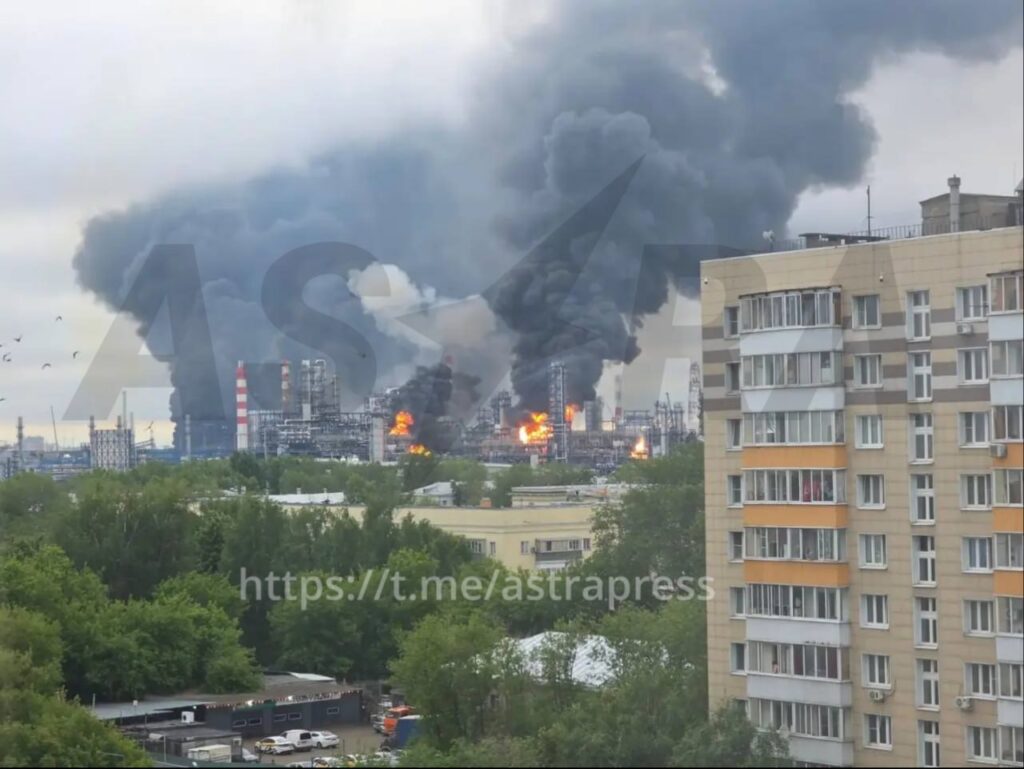
A Ukrainian Security Service (SBU) drone unit has said repeated strikes on the Moscow Oil Refinery in Kapotnya mark a shift in the perceived security of Russia’s capital, arguing it weakens the idea that Moscow remains insulated from the war, according to Interfax-Ukraine.
Deputy commander of the First Separate Center for Unmanned Systems Roman Parkhanov said the refinery is a critical fuel hub for the capital region and that its exposure to repeated attacks signals a broader change in Russia’s internal security environment.
He said the impact extends beyond infrastructure damage, pointing to what he described as a psychological shift inside Russia as strikes reach deeper into previously shielded areas.
“The realization that there are no longer any safe zones in the country – and that the capital’s status no longer protects it from airstrikes – is having a paralyzing effect.
“The notion of a ‘safe Moscow’ is officially a thing of the past. The new reality for the capital of the aggressor state is life under the shadow of war, which is establishing its own long-term rules there,” he told Interfax-Ukraine.
Second strike in three days on key fuel infrastructure
The comments follow Ukrainian drone strikes on the Moscow oil refinery in Kapotnya on 18 June, which sparked a large fire. It was the second attack on the same facility within three days, after an earlier strike on 16 June damaged a primary processing unit and temporarily disrupted operations.
The refinery, located about 15 kilometers from the Kremlin, is a major supplier of Moscow’s fuel needs, covering roughly 40% of gasoline consumption and around 50% of diesel demand in the region, according to reporting on the facility. It also produces aviation fuel for the capital’s airports.
Pressure on fuel system and internal perception
Parkhanov said the refinery’s role makes it central to Moscow’s energy stability, arguing that repeated disruption could force Russian authorities to reroute supplies or introduce restrictions within the capital.
He said such developments are eroding the perception that major cities remain shielded from the consequences of the war, as strikes increasingly reach high-value infrastructure deep inside Russia.
Read Also
-
UK to fund 150,000 Ukrainian-made drones and 350 air defense missiles in £752 million package funded by Russian assets
-
Ukraine, Germany to jointly develop anti-ballistic air defense system amid increased attacks
-
Oil storage site burns in Russia’s Rostov Oblast after Ukrainian strike on key fuel logistics hub behind occupied territory
About the Author
