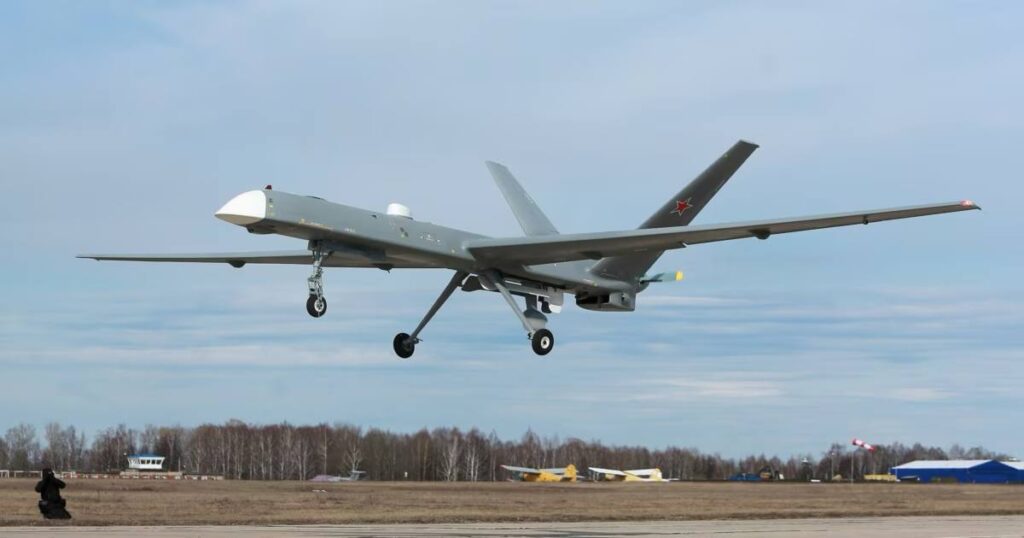
Russia wants to build four Banderol, a hybrid of a kamikaze drone and a cruise missile, a day. The production plan for this year is 120 Banderol a month, Ukrainian Defense Ministry adviser Serhii “Flash” Beskrestnov said on social media. By his estimate, the factory has not yet reached that rate.
The Banderol is generating an alarm disproportionate to its nature, according to the assessment of the man who flagged it in 2025.
“Lately a lot has been written about the Banderol missile, though I talked about it more than a year ago,” Beskrestnov wrote.
His verdict is that the missile is “nothing outstanding.” A budget cruise missile with a small warhead.”
It is made by the sanctioned Russian firm Kronshtadt, which was reported to be facing imminent bankruptcy in August 2025, with 40 lawsuits totaling $7.76 million filed against it in three months.
Banderol flies off drone that Ukraine keeps shooting down
The Banderol launches from air platforms. Right now, it is launched from the Orion drone, and launches from an Mi-8 helicopter have also been worked out, Beskrestnov said.
That launch method is a vulnerability. Big drones are too easy a target over the front, and in the enemy rear, whether it is an Orion or a Bayraktar, Beskrestnov said.
What missile actually does
The Banderol carries an OFBCh-150 warhead with 50 kg of explosive. Beskrestnov loosely compared its destructive capability to a Shahed.
It can fly up to 500 km, though Ukraine’s Defense Forces have recorded strikes at a maximum of 300 km. It usually cruises at 400 to 2,000 meters and drops to 200 meters before impact. It maneuvers actively and needs just 2.5 km of space to turn around. It is guided by satellite navigation and is vulnerable to electronic warfare, but has a backup autonomous navigation system.
Russia’s strike arsenal has been expanding as the Kremlin finds ways around sanctions, with the Banderol joining Kh-101, Kh-555, KAB glide bombs, and Shaheds in its combined attacks on Ukrainian cities.
About the Author
