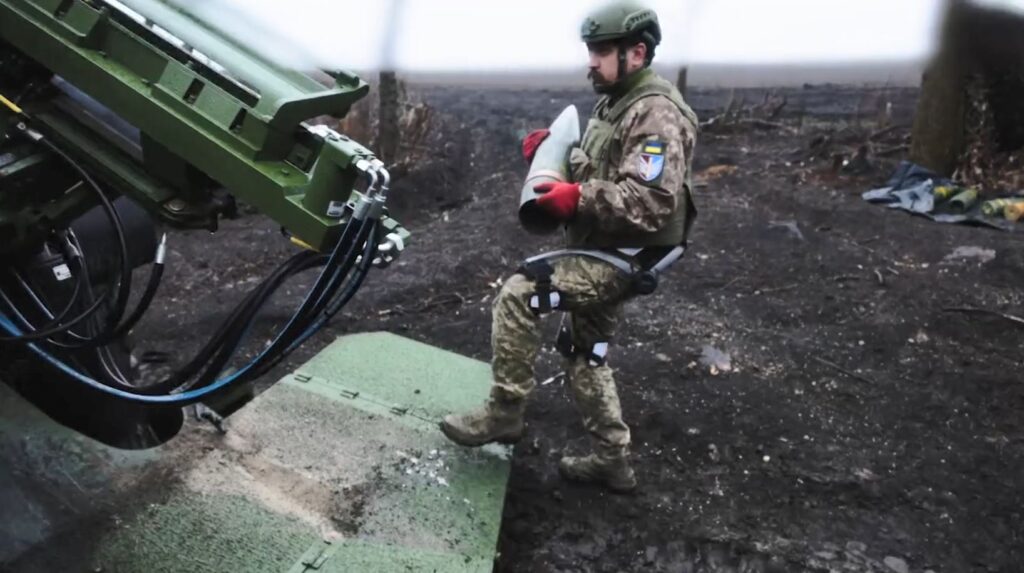
Ukraine’s Brave1 defense innovation cluster has opened new grants for exoskeletons and anti-dugout munitions. Both categories address specific frontline gaps that Ukrainian companies have been experimenting with informally through 2025 and 2026, according to Ukraine’s Defense Ministry.
Ukraine’s Defense Ministry announced 53 new technological priorities across nine directions in the updated Brave1 grant program. Grants range from $12,000 to $192,000, depending on the full development cycle, from idea validation to finished-product testing.
Why does Ukraine need exoskeletons?
Exoskeletons address the load-carrying gap on a frontline where Russian FPV drones destroy nearly any motor vehicle within 20 kilometers. Ukrainian infantry carry 30 to 40 kilograms of gear into positions that must be reached on foot. They evacuate wounded soldiers without vehicles. They build fortifications by hand because tools drop out to Russian drones.
State grant funding formalizes what has been ad-hoc Ukrainian company experimentation.
Anti-dugout munitions address a different tactical gap
Russian forces have built extensive reinforced field shelters across the frontline zones, and standard Ukrainian FPV warheads at 2 to 3 kilograms do not defeat these positions.
Precision-delivered munitions designed to penetrate reinforced dugouts would let Ukrainian infantry break Russian positions at standoff distance rather than closing to grenade range through saturated Russian FPV zones. Ukraine’s larger-scale answer to fortified positions is the Vyrivniuvach guided bomb, which entered combat use on 18 May 2026.
What is Brave1?
Brave1 has become the central hub of Ukraine’s wartime defense innovation ecosystem. As of June 2026, the cluster had processed over $235 million in procurement orders, registered more than 3,600 developments, secured 300 NATO-codified items, and disbursed $50 million in defense innovation grants.
The grant expansion sits alongside a growing network of bilateral defense innovation partnerships. Brave1 already runs Brave Germany, Brave France with $22 million from the French Defense Innovation Agency, Brave NATO through the UNITE program, and Brave Prime for global industrial alliances joined by Airbus in July 2026.
Brave1 also plans humanoid robots and laser air defense
Brave1 will soon announce additional grant competitions totaling over $2.4 million for breakthrough technologies, including humanoid robots, aerobuggies, anti-KAB (glide-bomb) systems, laser air defense, and Ukrainian radars.
The humanoid robot funding continues the world-first Ukrainian program that opened for grants earlier in July 2026. Ukraine became the first state to fund combat humanoid robots as a separate defense procurement category, treating them as a distinct line rather than as commercial adaptations.
Anti-KAB systems address one of Ukraine’s most difficult tactical problems. Russia has deployed KAB glide bomb attacks at rates of thousands per month, giving its air force a standoff strike capability. Laser air defense targets the persistent cost gap between Ukrainian air defense interceptors and Russian missile production. Ukrainian radars aim to replace foreign radar systems with domestically produced ones.
The detailed grant program and technological priorities are available at grants.brave1.tech.
Read also
-
Ukraine has built world’s most battle-tested defense industry. Berlin plugs in with “Brave Germany”
-
Fires at both ends of Russia’s fuel chain: a Lukoil depot in Stavropol Krai and a ferry port facing Kerch
-
Their father died defending Ukraine. A former Ukrainian brigade commander is now suspected in the murder of his two sons
About the Author
