Mentioning a name as famous as Frida Kahlo’s can bring thousands of ideas to mind: from colors and flowers to art pieces. But there is a side of her that few people have seen, and even fewer have explored deeply. The artist, with her handful of passions and her unique way of seeing, couldn’t help but find herself on the path of teaching. This is the story.
Frida, the student
Kahlo was never an art student herself. Her terrible accident at age 18 prevented her from finishing high school, which she was attending at the National Preparatory School (Escuela Nacional Preparatoria) in Mexico City. She was one of the first female students to attend, one of 35 women among 2,000 men.
View this post on Instagram
Regardless of what we know about her today, during her youth she wanted to go to a university to take a completely different path: medicine. Although she had no way of knowing what destiny was about to bring, she had been a child of ill health. Perhaps that made her interested in being a doctor. One day, coming home from school, an awful bus crash changed the course of her life. According to official medical records, Kahlo suffered from a “fracture of the third and fourth lumbar vertebrae; three pelvic fractures; fractures of the right foot; dislocation of the left elbow; a penetrating abdominal wound caused by an iron tube that entered through the left hip and exited through the vagina, tearing the left labium. Acute peritonitis. Cystitis with catheterization for several days.”

For a whole month, she stayed at the Red Cross facilities, waiting for her body to heal enough to go back home. After that, Kahlo had to stay at home for two years, which meant a brutal stop to her studies and a lot of time on her own. She felt asphyxiated by the plaster body casts and felt a growing desperation from not being able to leave her room. So, she began to paint.
From apprentice …
Having so much time alone became the seed for an activity that later became an obsession: the act of looking. At fruits, at animals, at herself. Even though she never attended a traditional art school, she had acquired skills from working at her father’s photographic workshop. She hand-painted black-and-white pictures and learned how light behaved on different surfaces.
Being in bed made Kahlo become the artist we know today. She turned her anxiety to know the world into a pictorial universe with a style so unique we are still trying to untangle it. While her self-portraits are her best-known artworks, there is a whole host of early still lifes that are entirely worth exploring.
… to master
Kahlo’s devotion to painting harnessed her passion into empirical knowledge that would later be passed down to her beloved students at the La Esmeralda School of Art. As with every other aspect of her life, her way of teaching was unconventional. She approached her students, affirming she was there to learn with them and that she had nothing to teach. According to them, this statement was far from the truth.
By 1942, when artist Antonio “El Corzito” Ruiz decided to create La Esmeralda, Kahlo had already lived many lives. She had divorced Diego Rivera once and married him twice; she had lived for periods of time in the U.S., and she had painted some of her most iconic pieces. To her, it was a surprise she was offered the teaching job; to everyone who knew her, it was not. She was in charge of “Pictorial Initiation” or, in other words, in charge of making students fall in love with painting.
‘Los Fridos’
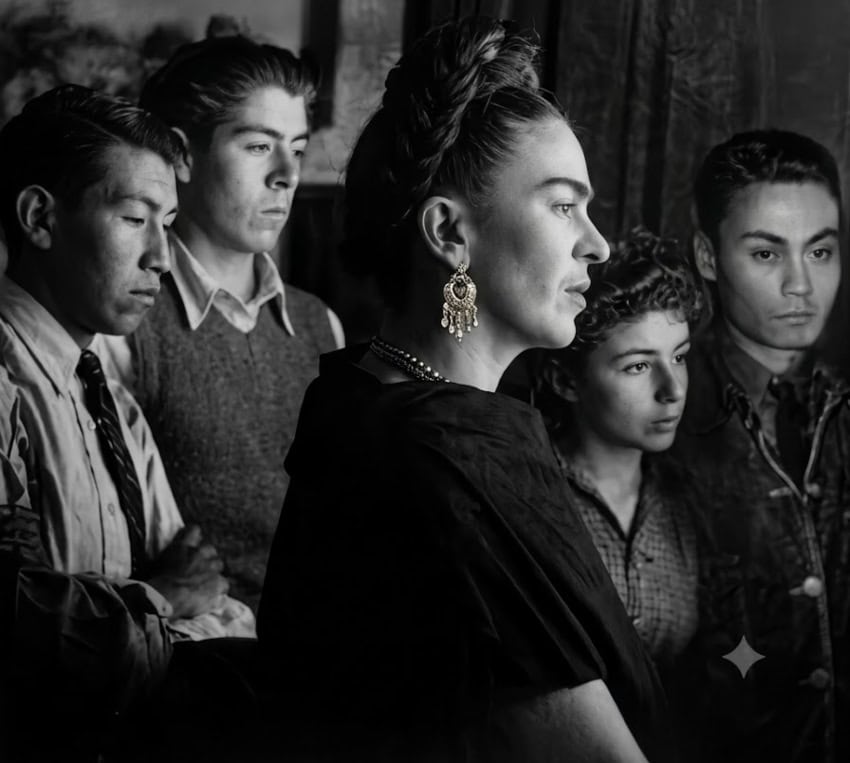
If we said Kahlo created a school of painting, we would be wrong. Not that she wanted to, anyway. The first day she stepped into the classroom was going to change, unknowingly, the lives of some of her students.
From the start, Kahlo tried to make them speak the language of colors and shapes. Instead of giving them lectures filled with theory, she asked them questions: “How many colors do you see in this tree?” Throughout the lessons, she started unveiling her way of looking at life and transmitting it to her students. Unfortunately, her ill health made her unable to continue going to La Esmeralda, which was located in the Centro Histórico, far from her house in Coyoacán.
Lessons from ‘Casa Azul’
Nevertheless, Ruiz stopped her attempts to quit completely. “You have a really nice garden at home. Teach there.” At first, a modest number of students attended, but as classes went by, just four of them remained. Their presence in Kahlo’s famous “Casa Azul” gave Arturo Estrada, Arturo García Bustos, Guillermo Monroy and Fanny Rabel the nickname of “Los Fridos.”
When remembering these days in Coyoacán, all of them mention different details but the same feeling: the certainty that someone believed in their work as artists. Kahlo taught them much more than just painting. As they all came from less privileged backgrounds, she sometimes took them to the movies, gave them materials and even invited them on picnics with Rivera.
Estrada remembers the times Rivera and Kahlo took them to Teotihuacán in his memoir, written by Rodrigo Ortega Acoltzi:
“We went to Teotihuacán several times over the years. Our teacher used to say that to create modern art, we had to study our roots, understanding the past in order to portray the present and project the future.”
The mentor
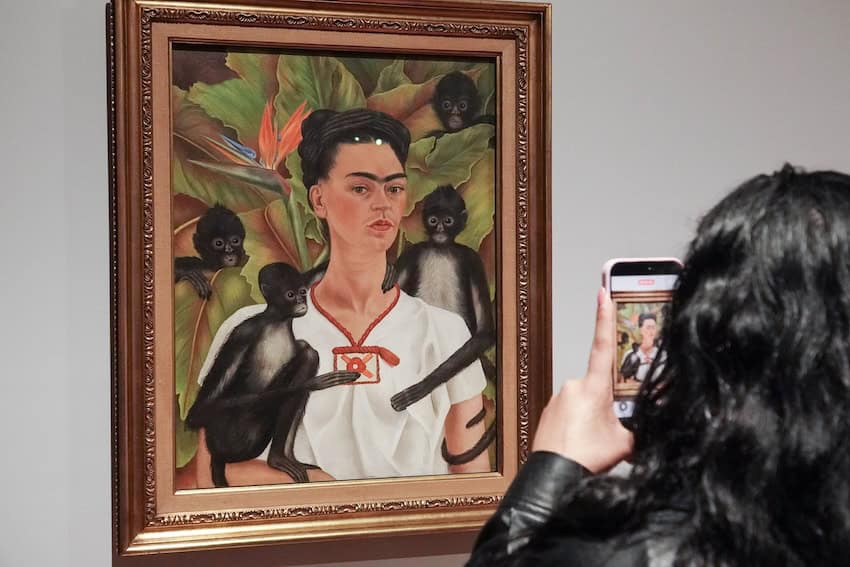
She not only encouraged Los Fridos to see the world and paint it, but she also opened doors for them. Kahlo secured the walls of a “pulquería” (a place where pulque, an ancient alcoholic beverage, is sold) near her house. She made a deal with the owner: the materials would be provided by Rivera and her, but the work would be free. He agreed. When the murals were finally done, the owner threw a huge party attended by many Mexican intellectuals: Salvador Novo, Concha Michel, Carlos Pellicer and even Golden Age actress Dolores del Río. It was a party to remember.
Kahlo also helped García Bustos, Estrada and Monroy get funding to explore the Yucatán Peninsula and make drawings. The three of them had the opportunity to sleep in a yet-unexplored Uxmal and walk through the ruins next to field archaeologists. Their drawings became paintings that were later included in a collective art exhibition.
As for Fanny Rabel, Kahlo encouraged her by promoting her work since her first solo exhibition at the Liga Popular Israelita. She accompanied her and even participated in the curation of the event. For the exhibition’s introductory text, Kahlo wrote: “Fanny Rabinovich paints as she lives, with tremendous courage, intelligence and sharp sensitivity.”
Farewell to Frida
Frida Kahlo passed away on July 13, 1954, at age 47. Her funeral was held at the Palace of Fine Arts (Palacio de Bellas Artes) in Mexico City. During the ceremony, three of the four students were present. Reflecting her communist affiliation, García Bustos, Estrada and Monroy suggested to Rivera the idea of covering Kahlo’s coffin with the communist flag. This symbolic act was so controversial that André Iduarte, her lifelong friend and director of Bellas Artes, was fired after the ceremony.
Beyond the political drama and the grand funeral, Kahlo’s most enduring legacy walked out of Bellas Artes in the steps of her students. They spent the rest of their lives dedicated to the canvas. Decades later, Arturo Estrada — now 100 years old and the final living member of Los Fridos — is still actively creating art.
Lydia Leija is a linguist, journalist and visual storyteller. She has directed three feature films, and her audiovisual work has been featured in national and international media. She’s been part of National Geographic, Muy Interesante and Cosmopolitan.
The post The legacy of an icon: Frida Kahlo’s students appeared first on Mexico News Daily
About the Author
